Day One Court Testimony, Part II: Dr. Wolman Takes the Stand
Posted: April 30, 2018 Filed under: Doctor Wolman Leave a commentFirst Day of Massachusetts’ Family Court Testimony, where the court (Judge Menno) appointed guardian ad litem repeatedly testified that my son wanted to live w/ his father; and in subsequent testimony where the GAL (Dr. Wolman of Boston) demonstrates that he failed to properly investigate the child abuse that occurred.
Testimony delivered on: July 27, 2011 (Part 2)
https://www.youtube.com/watch?v=9P_Ur7iK5og
Day One Court Testimony, Part I: Dr. Wolman Takes the Stand
Posted: April 30, 2018 Filed under: Doctor Wolman Leave a commentFirst Day of Massachusetts’ Family Court Testimony, where the court (Judge Menno) appointed guardian ad litem repeatedly testified that my son wanted to live w/ his father; and in subsequent testimony where the GAL (Dr. Wolman of Boston) demonstrates that he failed to properly investigate the child abuse that occurred.
Testimony delivered on: July 27, 2011 (Part 1)
Congenitally Corrupt: Mass Probate & Judge Menno
Posted: September 23, 2016 Filed under: Doctor Gabrielle Sousa, Doctor John L. Stanley, Judge Menno, Margaret Kenney, Margaret Vannata Leave a commentCongenitally Corrupt: Mass Probate & Judge Menno
COMMONWEALTH OF MASSACHUSETTS
PLYMOUTH, ss PROBATE AND FAMILY COURT
DOCKET NO. PL02D1047FM1
XXXXX XXXX )
PLAINTIFF )
and ) PLAINTIFF’s PRE-TRIAL
) MEMORANDUM
MARGARET KENNEY, )
DEFENDANT – Marshfield, Mass
NOW COMES CCCCC XXXX, the Plaintiff in the above-entitled Complaint for Modification, and sets forth the following in accordance with the Notice of Pre-Trial Conference as follows:
-
Date, time, and place of in-person meeting, and who was present.
As of this writing (9-10-2016), Attorney Ward has agreed that the defendant and the plaintiff, along with Attorney Ward, will meet at Brockton Probate at 3:00 PM on 9-16-2016. The purpose of this meeting is the 4-Way.
-
Uncontested Facts:
The plaintiff will prepare within the next week or two, or as required by the court in advance of the trial.
III. Contested Issues of Fact and Law:
-
The parenting plan for the parties’ son, Chris, is in dispute. The father enjoyed joint physical custody of the child, along with unsupervised visitation and overnight stays, up until Judge Menno’s December 28, 2011 ruling. On the December 28, 2011 ruling, Judge Menno awarded the mother, the Defendant, sole physical custody, and ordered supervised visitation for the father, the Plaintiff. Supervised visitation was effectively ended on Judge Menno’s October 23, 2012 ruling. The father, the Plaintiff, is putting forth three key arguments in support of his request for modification, and the restoration of unsupervised visitation and phone calls.
-
First Argument: As the Plaintiff verbally argued before Judge YYYYYYYs on April 11, 2016, at an emergency hearing, the father states that he is a good father. Specifically, the father has never missed a child support payment; the father has never allowed the health insurance to lapse; the father has no criminal record; the father has never been to rehab or tested positive for illicit substances (nor did Judge Menno during the three year long trial, or his surrogate – Attorney Dorsey – Parenting Coordinator – ever order a drug test); in the eleven years that the father enjoyed scheduled unsupervised visitation with his son, Chris, he never once missed a visit; the father has maintained – and actually overpaid- into his son’s college fund, as stipulated and agreed to within the Divorce Agreement/Decree (interestingly, the Defendant and her attorney, in 2016, never requested of the Plaintiff a copy of Chris’s college fund statement, neither in their interrogatories or request for documents); the psychologist, Dr. Laura Okin, who saw the Plaintiff, post-Menno ruling of December 2011, has stated in writing that the father is mentally fit to see his son, Chris, in an unsupervised capacity. Moreover, the father enjoyed a rich and rewarding relationship with his son. This strong relationship extended to a point that Chris asked the guardian ad litem, appointed by the Menno court (Dr. Richard Wolman), to live with his father five times. Mr. Wolman testified to this on the first day of trial in July 2011. Mr. Wolman testified that same day that he threatened Chris – that he’d tell his mother on him – if he ever made the request to live with his father again. (As Plymouth probate clerks have stated that much of the evidence and information from that 2011 trial has been deleted or purged, the father, fortunately, has on digital disk the testimony from the 2011 trial, and will present into evidence Dr. Wolman’s first day of testimony.) In October 2011, the mother also testified that Chris loved his father, and missed him as a result of change in visitation enforced by Judge Menno’s surrogate, Attorney Dorsey.
The father wishes to express his gratitude to Judge YYYYYYYs for reopening this matter. This is especially meaningful, since Judge Menno in his December 28, 2011 ruling expressly forbid the plaintiff from seeking modification, or filing litigation in regards this matter, unless it was through Judge Menno’s court and with his permission. Not only was this the Plaintiff’s understanding, but clearly the Defendant, and Attorney Ward, have stated the same belief on several occasions in 2016. Which brings us to my second argument.
-
Second Argument: Judge Menno’s ruling(s) were a judicial overreach. Judge Menno’s rulings were an assault upon the father’s 1st, and possibly 6th and 7th Amendment rights. And finally, Judge Menno’s ruling(s) have caused, possibly, irreparable harm to the father’s and son’s relations, and may have lead to child alienation from his father. As a preamble to these arguments, please know Judge YYYYYYYs that it is not the Plaintiff’s goal to retry the case, from the period January 2010 through November 2013. Having said that, and in order to demonstrate both my arguments and the time line of events (and since the evidence from the aforementioned trial dates has been deleted, as relayed to me by Plymouth County Probate clerks), unfortunately, I must cover some of the key events during that period. And it is also important to cover Judge Menno’s and his surrogate’s, the Parent Coordinator’s, reaction and rulings to the events of that period. In regards, Judicial overreach, the father requests that Judge YYYYYYY’s reads Judge Menno’s December 28, 2011 ruling, where under item #9, Judge Menno prohibited the father from filing any further modifications, or “complaints for contempt,” except by Mr. Menno’s written permission. My attorney, Ms. DiGregorio, informed me that this provision meant that I could not appeal Judge Menno’s decision(s), nor sue any of the professionals involved in this case, unless granted express permission by Judge Menno’s court. To the best of the Plaintiff’s knowledge, Judge Menno has no such power. This is why the Plaintiff filed for an emergency hearing on this matter, late Winter 2016, because Judge Menno had finally left Plymouth County, and his cases were assigned to a new judge. Moreover, the Plaintiff in early 2016 requested that Judge Menno review his prior decisions, and Judge Menno passed on my request, citing that his caseload had been transferred to Judge Stanton. Judge Menno’s December 28, 2011 ruling arguably violated the Plaintiff’s right(s) to appeal the Judge’s decision, and pursue civil litigation against the professional(s) in this matter, whom the father argues failed to adequately protect the child, Chris, and some of whom gave false testimony during the course of the trial. Particularly threatening to the father’s constitutional rights, however, was Judge Menno’s (and his surrogate’s) use of child visitation, and restrictions of same, as means to shut down, or certainly punish, the father for exercising his first amendment right of freedom of speech, and freedom of political speech. A quick synopsis of events leading up to the removal of the father’s visitation privileges, which first occurred in August 2011, and again, in October 2012, shows that the father had published, as his First Amendment right, court documents and evidence submitted into the aforementioned trial. During this first event, the father published a blog, entitled FreeChris.com, in August 2011. The father had published the blog out of desperation, as the trial had already dragged out 20 months – since he had originally hired his attorney – with no foreseeable end in sight, and the father had heard the proceeding week, during a parenting coordinator meeting, that Chris was now suicidal under his mother’s care (The father had heard from the mother that Chris had been acting out all Summer long while under his mother’s care, this is in addition to medically documented evidence that Chris had lost 15lbs under his mother’s care, plus a whole host of other issues & concerns regarding the mother’s parenting; the weight loss episodes, and circumstances surrounding my son’s weight loss, were also confirmed by Sandy Durland III, Esq., brother-in-law to State Rep., James Cantwell, the Defendant’s former attorney). The father will provide evidence of Chris’s suicidal behavior, while under his mother’s care, from Attorney Dorsey’s parenting coordinator meeting notes of June & August 2011 (as well as, written documentation from Doctor Sousa of Pembroke MA, who discovered Chris’s 15 pounds of weight loss, which occurred under the Defendant’s care). As a result of the father publishing the blog in August 2011, Attorney Dorsey stripped the father of all visitation privileges and immediately demanded that the web site, FreeChris.com, be shut down. Despite the father shutting down the web site, due to coercion from Attorney Dorsey and the resulting loss of contact with his son, visitation was not reinstated until Spring 2012, and then, only in a supervised capacity. Judge Menno again used visitation as a tool in an attempt to censor the Plaintiff in his October 2012 ruling, shortly after the father published the book, Mrs. Marshfield. Marshfield consists almost entirely of courtroom documents, filings, and evidence presented during the three-year trial period. Judge Menno states in his October 23, 2012 ruling that: “Mr. XXXX has a First Amendment right to publish his book, but he does not have a constitutional right to injure the mental and emotional wellbeing of his minor child.” As of this date, neither the mother, the Defendant, nor her attorney, Mr. Ward, has ever presented evidence that Chris was harmed, neither emotionally or mentally, by any of the father’s publications, nor did Judge Menno ever ask for such evidence. In addition to the pattern of the father publishing information that ran counter to the narrative Judge Menno, and the Defendant’s attorney(ies), were attempting to build around the case (an “official” narrative that completely ignored the evidence submitted by the Plaintiff and his attorney, Ms. DiGregorio), correlated or followed by the removal of the Plaintiff’s visitation time, the father had also ably convinced – via evidence – then State Senator Hedlund to file a formal complaint against Judge Menno with the Commission of Judicial Conduct (on November 19, 2012). In short, Judge Menno, and his surrogate, showed a pattern of punishing the father, w/ the removal of child visitation, as retribution for the father publishing the facts of this case, both on line and through a book published on Amazon.com. In publishing these materials, the father’s stated aim has always been to educate the public, and to seek Massachusetts Probate Court reform. That said, the father removed the web site and the book from publication in advance of a hearing in Fall 2013, but by then, Judge Menno was furious, both at the prior publications and for being brought up before the Commission of Judicial Conduct; and the father’s visitation rights were not reinstated. What to make of a Judge who would use child visitation as a means to attempt to censor, and silence, written criticism, both factual and political, of the Massachusetts’ Probate system? Clearly, Judge Menno’s actions, probably, alienated son from father. Is child alienation permitted under Massachusetts’ law or code, as a means of retribution or punishment? It is the Plaintiff’s fervent nightly prayer, that Judge YYYYYYYs will right this egregious wrong and gross miscarriage of justice.
-
Third Argument: The Plaintiff has no idea of what the ARC attorney will report back to the YYYYYYYs’ court. Both the Defendant and her attorney already claim that Chris does not wish to see his father (which begs a whole host of alternative questions). However, the father – despite assurances from his sister (Chris’s –Aunt) that the son loves his father and expressed a desire to see his father– must entertain the possibility that Chris, for any number of reasons (including relentless pressure from his mother), may have expressed a desire not to restore visitation with his father (particularly after being forcibly estranged from his father by the Menno court for these many years). Therefore, the father wishes to preemptively argue that parental alienation may have occurred, and that the full weight of this alienation be attributed to Judge Menno and his parenting coordinator appointee, Counsel Michele Dorsey. The separation between father and son was involuntary, and was made mandatory solely by Judge Menno’s – and surrogate’s – orders. When supervised visitation was restored, it was cumbersome, awkward, unnecessarily supervised (per the father’s therapist), and expensive (which the father believes was the point of the entire exercise, Judge Menno meant to drive the father away or visitation to be both punitive and embarrassing).
The father waited three long years for Judge Menno to vacate Plymouth County, and once that occurred, the father took this matter before a new Judge to hear this matter, as quickly as possible, and on an emergency basis.
The father, therefore, asks the YYYYYYY’s court to restore visitation to one weekend per month (fitted around Chris’s activities and schedule), and phone calls up to three times weekly, where the father is permitted to speak to his son, immediately. The father is not asking for a change in custody. The father very much wants to aid and assist Chris in his review and selection of colleges, and wants to play an active role in his son’s life. The father wants Judge YYYYYYYs to know that – despite the alienation created by the Menno court and the Defendant – that his love for his son is unconditional. In the State of Maryland, rapists have greater parental rights than the Plaintiff. The father has witnessed, through sitting in Plymouth probate for countless hours, that Massachusetts’ parents – with significant addiction and mental health issues – have substantive parental rights and visitation privileges. The Plaintiff is merely asking that these same visitation privileges be afforded to him and his son, Chris.
-
Status of Discovery:
Discovery is largely complete, albeit the Defendant and counsel refused to provide Chris’s medical and mental health records. These records, particularly the latter, may provide additional support to the Plaintiff’s assertion that Chris wishes to visit his father, misses him, and loves him. Here, the Plaintiff is request that Judge YYYYYYYs order the Defendant to release Chris’s medical and mental health records to the Plaintiff, from the period of January 2010 to the present.
-
Child Custody
Child Custody is not an issue, the father is not seeking a change in custody.
-
Possible Witnesses:
-
The Mother;
-
Plaintiff’s Sister;
-
Dr. John Stanley of _Pembroke_, Chris’s pediatrician;
-
Dr. Gabrielle_ Sousa of _Pembroke___, another pediatrician;
-
Keepers of Records for all documents set forth above; and
-
Any and all other documents or materials necessary to enable the Father to present his position accurate and fully.
The Father reserves the right to supplement this list should this matter go to trial.
VII. Evidence:
-
Judge Menno’s aforementioned rulings;
-
Parenting Coordinator, Attorney Dorsey’s, October meeting notes;
-
Parenting Coordinator, Attorney Dosrey’s, order – ending visitation;
-
GAL, Dr. Richard Wolman’s, digitized testimony;
-
Sousa’s written responses to the Mass Board of Medicine;
-
Stanley’s letter, and response to the Mass Board of Medicine;
-
Okin’s letter clearing father to see Chris;
-
Pictures of Chris and Father together, illustrating Chris’s happiness.
The Father reserves the right to supplement this list should this matter go to trial.
VIII: Depositions
The Plaintiff plans on conducting no depositions.
IX & X: Property Division & Alimony
These are not matters before the court.
-
Estimate of Trial Time:
The Father anticipates that the trial of this matter will take two (2) or more days depending upon the witnesses called and upon the ability of counsel to stipulate to facts along with exhibits in advance of trial.
XII: Financials Issues:
The Father has filed his current financial statement but contends that there are no financial issues involved in this matter.
As of this writing, the father has not received a formal filing on the part of the Defendant, nor Mr. Ward, to amend their response to the modification to include – revisiting college funding. If the Defendant desires to move this request forward, the father will have a formal response to this request. As college funding is specifically covered in the divorce agreement, along with specified funding, it is the father’s contention – based upon Massachusetts case law – that the Judge may not reopen this issue. See McCarthy V. McCarthy, 36 Mass. App.Ct. 490 (1994).
XIII: Child Support
Child support is no longer in contention and is agreed upon.
Respectfully submitted,
XXXXX XXXX
Dated: September 16, 2016
I Tried…
Posted: August 30, 2016 Filed under: Doctor Gabrielle Sousa, Judge Menno, Margaret Kenney Leave a commentFor those who object to the publication of Mrs. Marshfield, and this web site by the same name, they would do well to remember that I attempted to take an alternative path in Fall of 2013, when I shut down the sale of the book and this web site in advance of a hearing w/ Judge Menno. Both the sale of the book, and the MrsMarshfield.com web site, had been shut down for 90 to 120 days in advance of the 2013 hearing date.
My reward for shutting down same (which are presumably a source of embarrassment for the mother, and the professionals involved in this case) was three years of parental alienation from my son, on top of the alienation that had already occurred; and so upon receiving Judge Menno’s 2013 ruling, both the website and the sale of the book, Mrs. Marshfield, went right back up for public consumption and sale, respectively.
The goal in publication of Mrs. Marshfield has always been to educate the public on the manner in which Plymouth County probate conducts itself. If it’s a source of embarrassment, perhaps the courts should look towards reform? As a multi-billion dollar industry, my guess is there will be no reform anytime soon (even though there are non-adversarial/well proven family law models in Northern Europe).
As a father, I had a perfect visitation record; I have no criminal record; and I have never missed a support payment. The medical insurance has never lapsed. There are rapist in Maryland who have greater parental rights than I do; there are drug addicts and alcoholics in Massachusetts that have greater parental rights than I do. And I am none of these things. In 2011, both the mother and the professionals in this case testified the son loved his dad, and Dr. Wolman (the GAL) testified as to the son’s frequent requests to live w/ his father.
I have told the truth is this matter. I have published the truth is this matter (backed up by medical documentation), and my son and I have been rewarded with the unjust and unjustifiable abuse of judicial power. Judge Menno cut off my right to appeal and to seek redress, except through his courts. That is to say, I had no right of appeal.
Judge Menno is no longer in Plymouth County. Here’s hoping and praying the new Judge has a greater appreciation for First Amendment rights, and does not believe child visitation should be used as a tool of vengeance for publishing the truth. If this blog and the book are in the way of father and son reuniting, the Judge should have the courage to say as much. The questions remain however, what other forms of censorship does the Judge wish to impose? And finally, if the mother and professionals in this case did not file for defamation because the father in fact published the truth, should child visitation be used as a means of retribution by those in power?
Looking forward to receiving some answers soon. Here’s to the truth and honest judges, wherever they may be found.
Dr. Sousa’s account of a 10 year old child’s 15lb. weight loss… to The Mass. Board of Medicine
Posted: April 13, 2016 Filed under: Doctor Gabrielle Sousa, Doctor John L. Stanley, Margaret Kenney, Margaret Vannata Leave a comment
Dr. Sousa, of Pembroke, MA, discovers the 15 pound weight loss in a ten year old child (18% of the child’s body weight), and fails to report it to child and family services. Dr. Sousa also discovers fainting spells at the school and the church, due to lack of food intake. The mother, in the enclosed letter to the Board of Medicine, reported to Doctor Sousa that there had been no unusual events or illnesses to account for the child’s weight loss. This is contrary to the boy’s primary care physician’s account, Dr. John Stanley, that the boy had either been suffering from influenza or had “rocks in his pockets,” to account for the child’s substantial weight loss. The child had originally been brought into the clinic w/ a reported soar throat – by his mother; but the boy volunteered to the doctor that his stomach hurt and that he had fainted in his role as altar boy at the church, and at school the previous year (as he had not been fed on both occasions). The child would go onto faint as third time, again at school, the following year.
Both doctors, arguably, failed in their role as mandated court reporters, although the Mass. Board of Medicine cleared both Doctors of the charge.
Dr. Sousa Letter to MA Board of Med – Redacted
(Double-click to read the letter)
Judge Menno goes full on Megalomanical & Assumes the Power of God
Posted: April 11, 2016 Filed under: Judge Menno, Uncategorized Leave a commentFrom Judge Menno’s 12-28-2011 Ruling:
“Father is prohibited from filing any new complaints for modification, or complaints of contempt without written permission though this court.”
Winter Exposure and Neglect: Judge Menno – Norfolk County Probate; Dr. Richard Wolman – Boston Psychologist; and Attorney Michele Dorsey – Scituate, MA condone:
Posted: January 27, 2016 Filed under: Doctor Wolman, Guardian Ad Litem, Jim Cantwell, Judge Menno, Margaret Kenney, Margaret Vannata, Marshfield Public School District, Michele Dorsey, Plymouth County Probate Court Leave a comment

Judge Menno – Norfolk County Probate; Dr. Richard Wolman – Boston Psychologist; and Attorney Michele Dorsey – Scituate, MA… condone:
-
Child neglect;
-
Methodically underfeeding a ten year old child, so as to cause a medically documented 15 pounds weight loss;
-
Suicidal thoughts of a child, while living under the primary caregiver’s roof;
-
Dr. Wolman threatening the child, if he continued to ask to live with his father;
-
And parental alienation.
Judge Menno: Formal Letter of Complaint by Senator Hedlund
Posted: January 11, 2016 Filed under: Judge Menno Leave a comment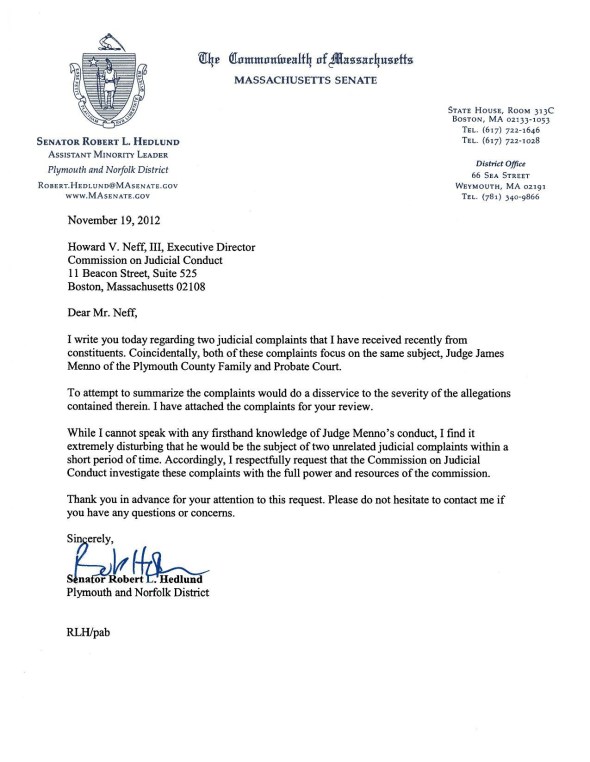
Excerpt: Judge Menno’s Ruling: 10-23-2012
Posted: June 18, 2015 Filed under: Judge Menno Leave a commentMr. ____ has a first amendment right to publish his book (aka Mrs. Marshfield)…
Patience Personified
Posted: March 29, 2015 Filed under: Doctor Levin, Doctor Wolman, Jim Cantwell, Judge Menno, Margaret Kenney, Michele Dorsey, Mrs. Marshfield 3 CommentsUltimately, all evidence rolls up to the judge, and it is at his or her discretion to pull truth from conjecture, speculation and lies. I’ve seen a pile of documented evidence in this case ignored. A probate judge also has the ability to intervene throughout a case and do the right thing. While some judges, within the U.S. judicial system, have limited discretion in their sentencing, probate judges perhaps have some of the broadest authority and discretion in sentencing and how they conduct their courtroom.
The probate judge’s power appears unlimited. They serve without term limit, and are not democratically elected. Moreover, based upon my correspondence with the Massachusetts Bar concerning Attorney Michele Dorsey (Scituate, MA) and her role in this matter it is my understanding that all complaints and disciplinary action, in regards Attorney Dorsey and her role as both mediator and parenting coordinator, also rolls up to Judge Menno. There appear to be no Massachusetts rules or laws governing the Guardian Ad Litem role either. Here again, any complaints or issues concerning same appear to be within the Judge’s domain.
But who is ultimately responsible for Judge Menno, and his professional behavior?
Judge Menno sat in the same trial that I witnessed, and presumably saw the same evidence and heard the same testimony I did. The evidence my attorney and I brought to this case was not refuted, and there was plenty of evidence suggesting that the many collaterals, and court appointees, in this case had either lied at various points in this process, or were inept in their roles and failed to perform. But perhaps this is standard operating procedure in Plymouth County Probate System? Or maybe this just they way Judge Menno conducts his courtroom affairs.
If Judge Menno thought this case was “frivolous,” and I fail to see how underfeeding a nine year old boy to the tune of fifteen pounds, et al., then why did he conduct four day trial? If the matter had already been decided prior to the fourth day of trail than why conduct it? And to hear both father’s and mother’s attorneys speak – it appears that the matter was a foregone conclusion (see proceeding chapter). Unless conducting the trial was strategic in nature, and there was another motive? Either way, serious resources were brought to bear, and this money could have gone to Chris and/or his future.
And I’m afraid that money is what this entire matter was about, almost certainly from Margaret Kenney’s perspective, and possibly from the perspective of the Probate Industrial Complex. After all, there are professionals to feed. That Chris undoubtedly suffered at the hands of his mother is in no doubt from my perspective or the perspective of my son. And I believe any rational adult reading this book will concur. The suffering endured by my son was both physical and psychological in nature, while under the care of his mother. And I little doubt that my son’s suffering continues to this very day. Having been rewarded by the courts for her behavior, one cannot imagine that Margaret changed her behavior, but rather her behavior was reinforced by Judge Menno.
What I have not discussed in this book is the role my son’s therapist played in this matter, Doctor Sol Levin. And there is a great deal that I do not know about this man’s relationship with my son. I do know this however, early in the process Dr. Sol Levin called me into his office after a visit with Chris, and asked for the GAL’s name and address. The doctor was visibly upset, and clearly wanted to discuss this matter with the authorities or the GAL. Chris opened up to me after this session that he had unloaded to Doctor Levin, like a “volcano,” all that was going on in his mother’s home. And yet, in the GAL report, as documented and testified to on the first day of trial, Doctor Wolman only spent fifteen minutes with my son’s therapist, Dr. Levin. So the only independent and professional source, who supposedly knew and spent time with my son, and Doctor Wolman allocates fifteen minutes with this individual, my son’s therapist.
Sounds like the fix was in.
Doctor Levin is yet another of Judge Menno appointees. As such he’s just another member of the Probate Industrial Complex. Doctor Levin and I spoke a couple of times, and he seemed very much in awe of attorney Dorsey. Of course, after this case was over there would be other cases and possible referrals down the road. It wouldn’t do for a member of the probate industrial complex to rock the boat, and cut oneself off from a peer or upset another professional or colleague. The peer pressure for these professionals to mutually agree, and get along and go along must be tremendous. In November 2011, after I had not seen Chris for three months my attorney recommended that I call Doctor Levin to learn how my son was doing. One of the key things Doctor Levin had to say during our call was that Chris missed me and asked about me often. He also went on to say that the professionals involved in this case were deciding if I should be reintroduced into Chris’ life.
It appears that the professionals in the case were so disturbed by my blog, that nobody read, that they would exact retribution by withholding visitation from my son.
What follows is a timeline and a brief narrative on my interaction with the Plymouth County Probate Court. As for the findings of fact, Judge Menno appears to have copied attorney Cantwell’s findings, verbatim typos and all. We were told in the 2.5 months leading up to Judge Menno’s decision that he was working very hard on the case, and putting forth a great deal of time and energy into his decision making, per his secretary or judicial assistant.
As the reader will see… from the date Chris asked me if his mother was trying to kill him (by deliberately withholding food) to the date the ruling was rendered was almost two years. Of course, Maragaret’s Attorney, State Rep. James Cantwell, promised he would drag this trial out indefinitely, against the wishes and best interests of my son.
Many have said I lacked patience in the handling of this trial; but when your son is manipulated like a pawn by Massachusetts Legal professionals (and is suicidal while under his mother’s care), out of presumed maliciousness and greed, what’s a father to do but expose these individuals for their corruption and incompetence. Two years to try this case, and another year of court room proceedings – initiated by Margaret afterwards – I believe I deserve an award for patience.
Probate Court Time Line of Events:
May 2010:
Michele Dorsey of Safe Harbor is appointed parenting coordinator against the wishes of the father, by Judge Menno.
Michele Dorsey’s documented bias against the father in the case, not withstanding.
Instead of appointing a GAL to investigate this matter, the Judge agrees to have both parties go in for psychological evaluation. This psychological testing option, in lieu of the appointment of the GAL, originated from Margaret, her attorney and Michele Dorsey.
Father appeals the Judge’s appointment of a parenting coordinator, providing among many reasons that the judge does not have the authority to appoint a parenting coordinator. The judge denies the appeal.
October 2010:
Father files for contempt because of Margaret’s refusal to adhere to Judge’s orders that they submit to psychological review. Of course, psychological review was Margaret’s idea in May 2010, in lieu of appointing a GAL. Jim Cantwell indicates that he did not know the costs involved with a psychological exam when they originally recommended it in May 2010.
The judge declines to hold Margaret in contempt, and reverses his earlier order- rescinding the order for psychological review.
Chris is to begin attending therapy, as ordered by the judge.
The court declines to appoint a GAL.
November 2010:
The judge reverses himself, again, and agrees that a GAL should investigate this matter.
Trial is scheduled for 6-20 and 6-22-11.
January 2011:
Two months later, the judge handpicks Dr. Wolman to be the GAL.
Doctor Wolman’s track record in this matter and testimony speak for themselves, and are possibly a reflection upon the judge and the probate system.
February 2011
Without explanation the Judge shortens the trial to a single day in June.
May 2011
Dr. Wolman (Judge Menno’s appointee) authorized Margaret to conduct her own investigation on the father’s property with a very upset child, Chris, in tow.
Parenting coordinator, Michele Dorsey, (also Judge’s appointee) also thinks that Margaret conducting an investigation on my property is a good idea in the presence of Chris, and states it’s a matter of “safety.”
(Interesting: When my son we beaten up by neighborhood bullies, at his mother’s residence, and threatened with a BB gun (or when Chris was suicidal under his mother’s care), Michele Dorsey – Judge Menno’s appointee – did not feel that this was a matter of “safety.”)
Father files a restraining order against the mother, due to concerns for his safety and his son’s safety.
Judge Menno agrees to a hearing on the restraining order request.
Judge Menno at the hearing denies restraining order and indicates that the father has made “big mistake” in filing the restraining order.
GAL, Doctor Wolman, issues his report, nearly 60 days late, and eight thousand dollars over the amount budgeted by the court.
It is clear to the father, and this is later revealed in court testimony, and documented in this book, that the GAL appears not to have done his job (by any reasonable standard or expectation), and did not investigate, or simply ignored, the father’ complaints and concerns.
Subsequently, the Judge does not hold the GAL accountable
June 2011
The Probate court is overbooked, and the trail is postponed for July. This is the first time the trial is delayed.
However, the Judge agrees to hear an emergency request by Team Margaret (comprised of Margaret, her attorney, Michele Dorsey of Safe Harbor and Doctor Wolman) that father’s visits with son should be supervised. Team Margaret now allege Chris is suicidal, but fail to recognize that he lives with his mother, 99% of the time.
Dr. Wolman and Parenting Coordinator, Michele Dorsey, testify on the mother’s behalf; however, they offer no new information, since the GAL report was issued which recommended no change in custody or visitation. Michele Dorsey of Safe Harbor Mediation was aware of Chris’ suicidal thoughts, allegedly made in Margaret’s home, and took no action against the father earlier in the month of June (two weeks prior to the June hearing), during a parenting coordinator session.
Nor did the child therapist express any concerns, during the month of June. My attorney describes this as a “trial by ambush.”
July 2011
We appear in court in July, and again, the court is overbooked for the second time; and for the two day’s scheduled in July for trial, we only hear two hours of testimony. This is the second time the trial is delayed.
The judge appears ill, and the proceedings are cancelled short, with the idea that we are to continue in August. There are no court dates in August. This is the third time this trial is delayed.
Dr. Wolman reveals in court testimony that he did not investigate many of the documented and acknowledged allegations made by father against the mother and her collaterals.
Despite Dr. Wolman’s credibility issue, the judge takes no action.
August 2011:
Father, out of fear and concern for his son’s safety, and because of the inconsistencies in the Plymouth County Probate court (including by this time, three trial delays), and in order to advance his son’s wishes to live with his father, begins publishing his blog. The blog makes no threats to anyone, but merely publishes many of the facts of the case, much of which are or will be a matter of public record.
Parenting coordinator, Michele Dorsey (the Judge appointee) orders the blog shut down, and suspends visitation, stating the blog harms the son.
Father told to shut down his site by his attorney, and father immediately complies. Suspension of visitation, however, remains in force. Court dates are now reestablished for late September and early October.
September 2011:
Father files three separate emergency requests within the Massachusetts Probate system, requesting that visitation be restored. My attorney informs me that it is highly unusual that the judges would not hear these emergency requests, and it is more unusual that the judges appear to be talking to one another.
Probate Judge #1 denies the request. (The first time the emergency request is denied)
Probate Judge #2 denies request. (The second time the emergency request is denied)
And finally, Judge Menno denies emergency request, indicating he will hear the request at next week’s hearing. (The third time the emergency request to restore visitation is denied)
Second day of trial in late September (the first day of Trial was in July), the judge suggests he will make a decision on the emergency request to restore father’s visitation after hearing Parenting Coordinator, Michele Dorsey, on the next court date. (The fourth time the emergency request is denied)
Father testifies second day of trial.
October 2011:
Third day of trial, Parenting Coordinator and Dr. Wolman testify…. Both recommend the same exact terms for father: supervised visitation and a suspension of the father’s rights, and that the father should go to therapy. Michele Dorsey is not a trained mental health professional; and Dr. Wolman would appear to lack credibility given his failings as a GAL, his courtroom testimony, and poor guidance given to the mother, in regards conducting her own investigation. Michele Dorsey, Judge Menno’s appointee, labors on the witness stand, her face is scarlet, and she cannot remember many things, despite being a mediator for the last five years. Father believes Michele Dorsey makes many misstatements on the witness stand.
Judge Menno suggest that they will make ruling on the emergency order on the next trial date, after hearing Margaret Kenney. (The fifth time the emergency request to restore visitation is denied)
Fourth day of trial, Margaret Kenney testifies, and Judge now states that he will make a request on the emergency request to restore visitation by no later than November 9th. (The sixth time the emergency request to restore visitation is denied).
(Author’s note: With all these delays in making a decision on the emergency order, could this have been due to Judge Menno having already made up his mind on his ruling, before the trial had even begun?)
The father through documentation illustrates throughout proceedings that the mother underfed child, so that he lost at least fifteen pounds in two separate incidents (as documented by Doctors Sousa and Stanley). It was documented that the child missed 31 homework assignments (even though his mother is a school teacher), while under his mother’s care for the fifth grade. It is freely acknowledged that he was locked out of his mother’s house, and that the mother is mean to the child (which she admits to on the witness stand), and the mother is a danger to household pets. Chris is also poorly clothed in the winter months, and has been repeatedly tested again and again for learning disabilities. His stepbrother, per Chris, has been tested repeatedly for drugs, has anger management issues, and as acknowledged by the GAL has drawn swastikas on the basement walls and punched holes in the wall. It is acknowledged by the mother that Chris has fainted, or nearly fainted, at school (twice) and during mass in front of the congregation – so that medical attention was sought. Doctor Sousa attributes the fainting spells to lack of food. While in the mother’s care in Summer 2011, Chris has repeated suicidal thoughts.
The mother testifies on the witness stand the Chris is aware that his mother hates father, clear evidence of parental alienation.
Mother admits at the trial that Chris loves his father, is upset at not seeing his father, and is miserable. Moreover, there is no documented evidence providing by Team Margaret showing parenting alienation on the part of father. Nor has father ever been convicted of a crime, been to rehab or tested positively for drugs.
And yet, Judge Menno does nothing.
November 2011:
Judge does not rule on interim order for restoration of visitation on 11-9-11, as he committed to doing. (This is the seventh time the emergency request to restore visitation is denied.)
My attorney, after stating she would do everything in her power to restore visitation by 11-9, and after she filed two emergency – interim orders, now states we must wait for final ruling. Why?
November 9, 2011 all documents are into court, final argument and final pleadings, etc.
December 2011:
The judge, through his secretary, now says that he will make a comprehensive decision before Christmas. The secretary assures everyone that the judge is working very hard on the matter.
January 2012:
A decision signed 12-28-11 is received on 1-3-12. The four-page decision took two and a half months to create; and the findings of fact released by Judge Menno are those proposed by Team Margaret, complete with typos, errors, known inconsistencies with documented evidence, and omissions.
Massachusetts’ Shakedown!
Posted: March 8, 2015 Filed under: Doctor Levin, Doctor Wolman, Harbor Medical Associates, Jim Cantwell, Judge Menno, Margaret Kenney, Margaret Vannata Leave a commentMassachusetts’ Shakedown!
Clearly I made a mistake by marrying Margaret. But Chris was not a mistake and in fact is a gift from God. And Chris is by far the greatest person I have met in this world. My friends have often questioned me as to why I feel this way… maybe it’s because Chris taught me what real love is, which is unconditional. In my darker moments I feel that many people have taken advantage of me, because of my family ties for my son.
But that’s neither here nor there. At the end of the day, the question remains, why should Chris continue to suffer while under Margaret’s dysfunctional care.
As the following numbers show the Probate Industrial Complex had no problems helping themselves to my family’s assets… money, which could have been allocated to Chris’ future, had the Judge Menno’s Court functioned properly, or if the “professionals” involved in this case conducted themselves ethically, expeditiously, and appropriately.
But I guess there’s not much money in that is there?
However, when you are held to no ethical or professional standard by the State of Massachusetts, or by the judges overseeing their fellow cadres, abuse is sure to follow.
| First Counsel | Jennifer Digregorio | |||
| 2010 | ||||
| Fed | $3,100.00 | |||
| April | $1,000.00 | |||
| June | $3,000.00 | |||
| Sept | $2,000.00 | |||
| Nov | $2,000.00 | |||
| Dec | $1,500.00 | |||
| 2011 | ||||
| March | $1,200.00 | |||
| April | $1,000.00 | |||
| May | $1,250.00 | |||
| June | $2,000.00 | |||
| July | $1,000.00 | |||
| July | $10,000.00 | |||
| July | $7,000.00 | |||
| October | $2,000.00 | |||
| October | $5,000.00 | |||
| December | $1,500.00 | |||
| Total | $45,470.00 | |||
| Second Counsel | Sandy Durland III | |||
| 2010 | ||||
| Summer | $6,000.00 | |||
| 2011 | ||||
| July | $3,995.00 | |||
| August | $635.00 | |||
| Total | $10,630.00 | |||
| Payment to Dr. Richard Wolman | ||||
| 2011 | ||||
| January | $5,000.00 | |||
| April | $5,000.00 | |||
| May | $3,500.00 | |||
| June | $3,500.00 | |||
| July | $3,500.00 | |||
| Total | $20,500.00 | |||
| Estimates Michele Dorsey | Attorney, Scituate, MA | |||
| Jan ’10 through August ’11 | $8,470.00 | |||
| Court Costs Ordered by Judge Menno | ||||
| State Rep. Cantwell | $16,500.00 | |||
| Mr. Cantwell is the brother in law of Mr. Durland III (see above). | ||||
| Total | $101,570.00 | |||
| Does not include therapy costs for my son, or the therapy ordered by the court. | ||||
The tragedy does not end with the money expended on this case. Margaret also receives child support payments of roughly $30,000 a year. This adds up to $360,000 after tax dollars I have ponied up. Last I checked Margaret had placed less than $10,000 in Chris’ college fund, and Chris often wears beat up clothing, or as we saw in winter 2011 seasonally inappropriate clothing.
So where does it all go?
It certainly isn’t spent upon Chris. So lets make that the final reform, the first $5,000 of any and all child support payments, annually, must go to the child’s college fund.
Michele Dorsey (Scituate MA), Meeting Notes in the Matter of Dumke V. Kenney:
Posted: June 18, 2014 Filed under: Uncategorized Leave a commentMichele Dorsey (Scituate MA), Meeting Notes in the Matter of Dumke V. Kenney:
August 2011
Michele Dorsey was appointed Parenting Coordinator by Judge Menno, Plymouth County Probate on May 2010:
Excerpt: Mother, Ms. Kenney (aka Meg Vannata – Kenney), is explaining sons suicidal tendencies while under her care. Mother has had custody of son since his birth, and yet, she reports our son is suicidal while under her care.
“ Mother notes ‘son’ stood crying often in the evening. One time, ‘son’ remarked that, ‘In heaven, you just live forever and forever.’ He often says, ‘I hate my life.’ One night he had a nightmare and woke up saying he was so disturbed and it’s awful, awful. Mother consoled him and he went back to sleep. Mother says he complains of headaches or stomach aches after seeing his father. He said once, ‘I have a headache from the guilt.’ Mother thinks he’s feeling pressure of the conflict between his parents. He doesn’t enjoy things he had traditionally enjoyed, like sailing. He resists going, talks about dying on the boat, although he seems to enjoy sailing when he gets there.
He tells Mother he isn’t looking forward to the 6th grade; that he has no friends.
Father says ‘son’ is happy when he comes over he is very happy. Father see a lot of happiness and joy. They shopped last weekend and got some legos. Chris plays with them and sings. He sang (sic) seemed happy this past Sunday even though he was raining (sic). Father says his mood changes on Sunday and into Monday morning because he doesn’t want to go home.”
Not only can Attorney Dorsey not write, but neither did she take care of my son, while he lost 15 pounds under his mother’s “care;” and Attorney Dorsey did not take care of my son, while he was suicidal under his mother’s care in Summer 2011. In fact, she left him in his mother’s care. Due to Ms. Dorsey’s, and the Menno Courts failure to assist, aid and help my son (and not honor my son’s repeated requests to live with father), I, father, wrote a blog about these events, and as a result and as a reprisal from the court, I was denied visitation and access to my son. My constitutional rights have been repeatedly violated, as have my sons. To date, no evidence has ever been presented that my son has been harmed by this blog or the book, Mrs. Marshfield. Despite having a history of meeting every child support payment, attending every scheduled visitation, and no criminal record, I have been denied access to my son for three years, because I told the truth about this case.
A Stain on Massachusetts
Posted: December 23, 2013 Filed under: Doctor John L. Stanley, Doctor Levin, Doctor Wolman, Jim Cantwell, Judge Menno, Margaret Kenney, Michele Dorsey, Mrs. Marshfield, Safe Harbor Mediation 1 CommentA Stain on Massachusetts
Or the Top Fifty Lessons Learned from Plymouth County Probate…
“In general, the powerful and influential in our society shape the laws and have great influence on the legislature or the Congress. This creates a reluctance to change because the powerful and the influential have carved out for themselves or have inherited a privileged position in our society, of wealth and social prominence or higher education or opportunity for the future. What can we still do to restore equity and justice or to preserve it or to enhance it in this society?”
– Governor Jimmy Carter, May 4th 1974 – Law Day Address, University of Georgia
By J.M. Hamilton 12-25-13
After a thirteen year child custody battle, and more than a half million spent on legal fees and child support, here’s what I have learned about the Massachusetts Probate Courts (specifically in Plymouth County):
1) If you nine year old comes to you and asks if you, ” Is mommy trying to kill me (?),” if you’re a caring father, your life is about to be turned upside down.
2) Further supporting the medical evidence showing inexplicable weight loss, your son can black out in front of the school twice, and in front of an entire church congregation as an Altar Boy, due to lack of proper nutrition, and the Judge won’t do a damn thing.
3) A mother can underfeed her nine year old, as documented by medical records, to the tune of fifteen pounds, and she will not be held accountable by the Plymouth County Probate courts, particularly Judge Menno.
4) A mother can lock her son out of her home, at least three times that I’m aware of, and she will not be held accountable by the Plymouth County Probate courts (aka Judge Menno).
5) A mother can under-cloth her son, so that he is sick for six consecutive weeks in the dead of a Massachusetts winter, and the Plymouth County Probate Courts will not grant a change in custody.
6) You can present pictures of yours son’s bleeding hands, as a result of exposure, and the professionals and the judge will dismiss the evidence as a “rash.”
7) The mother can abuse pets and animals, and in some instances make them disappear over the course of a weekend, and the Court appointed psychiatrist, Dr. Wolman (Boston), will dismiss this, as “improbable.”
8) Mom can remarry, and bring into your son’s life a stepson, who abuses your son, beats on him, and has a rap sheet on Google the length of your arm, and the Plymouth County Probate court doesn’t care.
8.3) Mom can call your son an “idiot” and “hyper, “and drag him from professional doctor to psychiatrist in the effort to have him diagnosed with ADD, ADHD, or the childhood disorder de jour – Autism, all throughout your son’s elementary school years (with every doctor repeating that there is ‘not a problem’); and when your son turns out to be the straight A student – in his middle school years- you maintained your son would always be, the Judge Menno will give your Ex full credit.
8.5) If you think your Ex has Munchhausens syndrome, because she squanders $33,000 in child support on attorneys and doctors -annually, and your son asks you why he is “poor,” you are probably right, she does have Munchhausens.
8.7) If your son misses thirty-one homework assignments, and your Ex might be a teacher within the Marshfield school district, the school administration, and the Plymouth County probate Judge Menno will give mommy a passing grade.
9) Your son can be suicidal, under the care of his mother, for the duration of an entire Summer, and the Plymouth County Probate court will NOT grant a change of custody, but they’ll blame the father.
10) If your Ex is smart, she’ll hire the local State Rep, Jim Cantwell, who has come out of retirement from his law practice, to represent her.
11) It will be painfully clear to everyone in the courtroom why the State Rep. Jim Cantwell retired from the practice of law, and went into the politics; and yet, he will prevail because cronyism, politics and corruption trumps the rule of law and prima facie evidence in Plymouth County, Massachusetts.
12) A prominent Boston attorney, Sandy Durland III, told me that my Ex had underfed my son, by sending him to bed without dinner – over the span of weeks.
13) Judge Menno will see to it that only long established “friends/cronies” of the court are appointed to the key roles of parenting coordinator and guardian ad litem (i.e. court appointed investigator).
14) The courtroom proceedings are a charade, the real decision making goes on in the star chamber within the judge’s office.
15) A “parenting coordinator,” Attorney Michele Dorsey (Scituate MA), is a surrogate for the court, and has the “ex-officio” powers of a judge, w/out being required to practice the rule of law or due process. Avoid the hiring of a parenting coordinator at all costs.
16) If there is an obvious conflict of interest and you have signed a mediation agreement with a Plymouth County attorney, and this same attorney, Michele Dorsey (Scituate, MA) is dispensing legal advice to the mother in this case….. the Plymouth County probate judge, Menno, will still appoint this same attorney as a surrogate to his court, and assign her to be a “parenting coordinator.”
17) When you point out the obvious ethical issues of the Judge’s parenting coordinator appointment to the Massachusetts Bar, they will side with the Judge Menno’s decision; that is to say, your Ex’s attorney/mediator/court appointed parenting coordinator, Michele Dorsey.
18) If the parenting coordinator divides the payment of her fees in a disproportionate manner, say 70% father/30% mother…. BEWARE! Your former spouse has absolutely no incentive to work things out with you; but rather, has every incentive to drag you before the parenting coordinator on every single issue, monthly.
19) The parenting coordinator (PC), Michele Dorsey (Scituate MA) will not rein this behavior in, because after all, she is being paid, every time your Ex drags you into another meeting with her.
20) You and your son are “scrod,” when the parenting coordinator is meeting with your Ex on the side, via phone and personal meetings. Ignore the fact – at your peril – that you are being charged for these meetings, which you are not a part of, and when you ask for information or records concerning these meetings – you are denied.
21) The divorce rates in the country is 50% for first time marriages and higher for second marriages. If you have children, there is a higher probability than not that your divorce will not be amicable and that you will end up going through a probate court.
22) Probate courts have some of the broadest powers of any other court in the land, that is to say, discretionary, arbitrary, and capricious power. These probate court powers are inimical to the rule of law and are likely unconstitutional, as they deprive persons of property, liberty, and the right to freely associate with family.
23) Family law attorneys do not work on Fridays, and they take off the month of August, along with the Plymouth County Probate Court – Judge Menno – even if your son is suicidal while under his mother’s care.
24) If you are looking for a Hollywood ending to your court room proceedings, where truth and facts triumph over local politics and cronyism, particularly in Plymouth County, Massachusetts, well… forget about it.
25) When you report your Ex to DCF – the Marshfield Independent School District Principal, Mrs. Hubbard, will lie and cover up for your Ex, even though you’ve just been chewed out by this same school administration because your son missed 31 homework assignments, and are told your son is having a terrible year – while under mommy’s care.
26) When you tell the District school Superintendent, Mr. Scott Borstel, that the principal lied to DCF – the Superintendent will “conduct an investigation” and tell you it was okay that she lied.
27). The GAL, Dr. Wolman (Boston), or court appointed investigator, can admit on the witness stand that he did not do his job and investigate the case, and the Plymouth County Probate Judge will just smile.
28). The GAL, Dr. Wolman, will threaten your son if he asks to live with his father.
29). The GAL, Dr. Wolman (Boston) will tell the mother it is okay for her to conduct her own personal investigation on the father’s property in the middle of a trial.
30). The GAL, Dr. Richard Wolman (Boston), will lie about his investigative instructions to your Ex on the witness stand, only to admit to it in subsequent testimony, and the judge will still deem him to be a competent and credible witness.
31). Despite all the horrific acts your Ex has committed against your son, the GAL will say the key point in the trial is when you filed a restraining order against the mother for conducting an investigation on your property.
32). Everyone acknowledges the obvious double-standard: that had I conducted an investigation on mother’s property I would be arrested or worse, shot.
33). Your son’s doctor in Pembroke, MA, Dr. Stanley, can lie about your son’s weight loss, alter medical records, and the Massachusetts board of medicine will not hold your son’s doctor accountable. This Dr. Stanley will lie and say your son must have had “rocks in his pockets” to account for the fifteen pound weight loss.
34). When any of the professionals involved in this case say they are looking out for the interests of your son, you know some highly self-serving SH!T is about to come down.
35). The stated goal of he State Rep, Jim Cantwell, was to drag these proceedings out for three years -completely contrary to the interests of my son, and against the ethical rules governing attorneys in the State of Massachusetts.
36). After four years in the Plymouth County probate court, I’m completely convinced the goal of the probate Judge Menno was to keep you tied up in his courtroom so that you generate fees for the local counsel, therapist and psychiatrist.
37). The Psychiatric profession is under fire in this country as President Obama’s appointee – and the lead psychiatrist – has pointed out that the profession and the DSM is not backed by science or biology. In short, the profession is a fraud.
38). If you witness child abuse and the beating of children at a scouting event in Marshfield , MA — don’t report it to the parenting coordinator, Michele Dorsey, Judge Menno, the Boy Scouts, or the GAL, Dr. Wolman (Boston) because they will not investigate it and you will pay the price for reporting same.
39). Doctors, lawyers, teachers, parenting coordinators, mediators, school principals…. Apparently, nobody is a “mandated court reporter” in Plymouth County, w/ no obligation to report child abuse.
40). Some Marshfield parents still believe it is acceptable to hit, beat and strangle their children.
41). When I found out my son was suicidal under the care of his mother, and the professionals in this case continued to do nothing, I published a blog about my experiences with the Plymouth County Probate court.
42). After the trial was over, I wrote a book entitled Mrs. Marshfield, which was written largely based upon actual court room testimony and court room evidence. I believe the book should be required reading for any parents with children, considering divorce, or any parents considering having children within the institution of marriage.
43) Judge Menno ruled that I had a first amendment right to publish the book; however, as he deemed the book to be harmful to my son – he suspended visitation for over a year.
44). To date, no medical or psychiatric evidence has been presented that my son ever saw the book or was in any way harmed by the book. In fact my son is thriving and a straight A student…. exactly as I foretold.
45). The parties enraged by the book, Mrs. Marshfield, are the cadre of “professionals” who make up the probate industrial complex; that is to say, the star chamber.
46). In Fall 2013, the judge also reasoned that since I did not continue to litigate in his courtroom, I did not deserve to see my son. The definition of insanity is for my family to attempt and continue to litigate in Plymouth County Probate.
47). Judge Menno conveniently forgot that my State Senator had requested that this same judge, Menno, be investigated, which resulted in an investigation spanning over six months, and I had asked the judge to recuse himself.
48). The evidence and statement of facts would suggest that Judge Menno just made up his decision- w/out regard to the facts or evidence presented in this case.
49). The same prominent Boston attorney, Mr. Sandy Durland III, who told me that my Ex systematically underfed my son, also told me that the judge in this case used to be competent but that he now took shortcuts with the law to reach his desired outcome. This prominent Boston attorney is the brother in law of the State Rep, Jim Cantwell, who represented my Ex. I guess he would know.
50). The behavior of Judge Menno and the professionals in this case is arguably criminal, likely unconstitutional; but like some of the more unsavory actions and recent revelations of the NSA, may be possibly legal and permitted by law. At least for now.
Back in 1974, Jimmy Carter, then Governor Carter, gave a famous speech at the University of Georgia attacking our corrupt legal system, dominated by legal elites, the rich and the powerful. Today, little has changed and it probably has grown worse. Lady justice has lifted her blindfold, and with a wink and a nod, her scales of justice have been piled high with loot and tilted in favor of the elite and backroom/crony dealings. The two trials that I have been a part of in Plymouth County were little more than playacting.
The majority of our judges are not elected in this country but are appointed for life, which essentially means their power is nearly absolute. Absolute power corrupts absolutely, just as we saw in this case. And the war of attrition and endless delays-that is often the core strategy of our modern day courts- perverts justice at every turn. That, and it is widely known that justice is all too often for sale in this country.
“Justice delayed is justice denied.” Mr. Gladstone told us that.
Our family law courts damage, and in some instances, destroy young lives, as many lawyers and many professionals play their games and take money away from families that can ill afford to pay or play their game. The Plymouth County Probate court is a stain on the State of Massachusetts, and state bureaus and boards responsible for overseeing the “professionals” further damage the state’s reputation. I believe there is a special place in hell for medical and psychiatric professionals, teachers and judges who abuse, and/or aid and abet, the manipulation of children. It’s the tenth ring of hell or Plymouth County Probate by any other name.
Ultimately, as we live in a democracy – Americans get the government we deserve; that is to say, as long as we tolerate tenured judges and politicians, a crony system of elites running our courts and government for their own personal enrichment – U.S. citizens should expect to be preyed upon and sustain continued injustice on a monumental scale…. especially at the expense of our children.
As for myself, I have never missed a support payment, never missed a scheduled visitation, remained gainfully employed for in excess of thirty years, have no criminal record, and have never entered rehab for the abuse of drugs; and I am eminently better able to provide and afford a better life and care for my son, than the current circumstances my son finds himself consigned to.
While I am not going to publish the names of the individuals involved in this case – for fear of the continued abuse of power and reprisals against me and my son – I am publishing the docket numbers, which are a matter of public record. Perhaps some enterprising reporter, or lawyer or a politician with a conscience, would like to take a look at the corruption within the Plymouth County Probate court?
Should you visit Plymouth County, please give the judges my regards.
Odyssey
Posted: December 10, 2013 Filed under: Mrs. Marshfield Leave a commentMy son’s and my odyssey with the Plymouth County Probate Court has now spanned four years, since my under ten years of age son came to me in January 20XX, and asked me if his mother was trying to kill him. Medical records revealed that my son had suffered two weight loss episodes within the prior year, totaling 15 pounds. A highly regarded family law attorney in Boston told me that my son had been sent to bed without dinner on consecutive nights- spanning weeks, which accounted for the shocking weight loss on my son’s meager under ten year old frame.
After enduring two years of delay and stall tactics by my ex-wife and her attorney, a State Rep, I published a blog on the shortcomings of the professionals involved in this case (counsel, judge, therapist, GAL and parenting coordinator), when I found out my son was suicidal under his mother’s care throughout the Summer of 2011, and the professionals in this case continued to act against the interests of my son. From the moment I published the blog, the case turned and I was told I was the problem, despite having no criminal record, no history of drug abuse, and despite my son’s repeated requests to live with me. Visitation was suspended in Fall 2011 and subsequently restored in Spring 2012. By the fall of 2012, I published a book inspired by the court proceedings of the previous two and a half year years and the blog. The idea was that the public should know how the probate system operates, how the judge is accountable to no one, and how fiction and opinion trumped facts throughout my son’s and my three-year ordeal; but above all, I believed the book would help my son.
Visitation was again cut off with the publication of Mrs. Marshfield. But at the same time, the Judge from Plymouth Country probate also acknowledged the legality of the book, and acknowledged my first amendment right to publish the book. And the reason given for suspending my visitation, like the blog before the book, I was told that the book, Mrs. Marshfield, was harmful to my son.
I immediately contacted my State Senator, and after hearing me out, he contacted the Massachusetts Board of Judicial Conduct and requested an investigation on my judge in November 2012. At this point, my book remained on line for purchase. We were to meet again in the Plymouth Country probate court in May 2013; but the Judge was still under investigation, I asked him to recuse himself (which he denied), and did not appear at trial, as the mother nor her counsel made any attempts to contact me.
In July 2013, I was told by my State Senator’s office that the investigation had failed, and the Judge was found – innocent – what a surprise. At this point, I gave the judge what he wanted and suspended sale of my book, the one I had every legal right to publish- per the judge, pending another hearing in Fall 2013. What follows are the findings of facts that I presented to the court on the heels of that hearing. To date, no medical and psychological documentation has ever been provided that my son was harmed by me telling the truth. My son was not harmed by the blog or the book; but rather, after years of his mother running him around from doctor to doctor, in search of proof that our son was learning disabled (something no doctor would ever validate), my son is now a straight A student, which is what I had always forecast would happen.
COMMONWEALTH OF MASSACHUSETTS
THE TRIAL COURT
PROBATE AND FAMILY COURT DEPARTMENT
PLYMOUTH DIVISION DOCKET NO. PL 02D 1047-DR
MARGARET KENNEY, )
PLAINTIFF ) PLAINTIFF’S PROPOSED
and ) FINDINGS OF FACT AND
) RATIONALE
FATHER, )
DEFENDANT )
On October 2, 2012 and October 2, 2013, the parties in the above entitled Complaint for Modification appeared before the Court, the Honorable James Menno presiding, for Trial. The Plaintiff, Margaret Kenney (hereinafter “Mother”) was present and represented by Attorney Brian Ward. The Defendant, Father, (hereinafter “Father”) was present and represented by himself. Upon consideration of all the evidence, and after assessing the credibility of the witnesses, the Court hereby enters the following
-
Procedural History:
-
Plaintiff Margaret Kenney (hereinafter “the Mother”) currently resides in Marshfield, Massachusetts. She is represented by Attorney Brian Ward of Quincy, Massachusetts.
-
Defendant Father (hereinafter “the Father”) currently resides in Marshfield, Massachusetts. Father presently has not legal representation, and is representing himself.
-
The parties have one (1) child, namely Chris (hereafter “Chris”), who was born in 2000.
-
The parties were divorced on September 5, 2001 before the Superior Court of California with a complete Divorce Agreement on all issues.
-
Pursuant to this Judgment of Divorce and related Divorce Agreement, the parties maintained shared legal custody of Chris, while the Mother maintained his primary residence.
-
In July of 2002, the Father filed a “Complaint to Enforce and Modify a Foreign Decree” with the Plymouth Probate and Family Court.
-
In November of 2002, the Court (Sabaitis, J.) entered a Modification Judgment confirming its jurisdiction over the parties’ case and ordered that the parties shall have shared legal custody of Chris. The Modification Judgment also incorporated the parties’ mutually agreed upon parenting plan.
-
On or about February 26, 2004, the Father filed this Complaint for Modification. Earlier Temporary Orders in 2004 revised the parties’ plan and specifically appointed Dr. Vicki Lyall as Parent Coordinator. The parties never worked with Dr. Lydall.
-
On or about early 2006, the parties executed a Mediation Agreement with Attorney Michelle Dorsey of Safe Harbor Mediation in Scituate.
-
On or about April 21, 2010, the Father filed Motion for Temporary Orders, Motion to Amend Complaint for Modification and Motion for Guardian Ad Litem.
-
On or about May 2, 2010, the Mother filed Defendant’s Opposition to Motion for Temporary Orders and Motion for Guardian Ad Litem.
-
On May 4, 2010, the parties and their respective attorneys appeared before this Court for a hearing on all of these motions. At that time, the Father and the Mother reached a comprehensive and detailed Stipulation of the Parties dated May 4, 2010, which this Court entered as a Temporary Order with the following terms:
-
a) The Father defers his Motion for Guardian Ad Litem until the completion of the psychological evaluations as outlined below (and without prejudice) He also defers his immediate request for custody until this later time (without prejudice).
-
b) The Father and the Mother shall submit to psychological evaluations through an expert with experience before the Probate and Family Court in custody disputes at their individual expense. Counsel for the parties shall agree upon this expert as soon as practicable. Both attorneys shall receive a copy of both evaluations; each parent may review these evaluations in his or her respective attorney’s office but may not receive a copy of them.
-
c) Should either parent later pursue a Motion for Appointment of Guardian Ad Litem, these evaluations may be disclosed to him or her as part of this investigation. Otherwise, these evaluations shall not be disclosed to any third parties.
-
d) The following issues shall be presented to the Court for determination: (a) appointment/continued work of Attorney Michelle Dorsey as Parent Coordinator. There is a dispute as to whether this work has been conducted within “mediation” or within “parent coordination”; (b) payment of Attorney Michelle Dorsey’s fees for May 4, 2010; (c) payment of Attorney James Cantwell’s fees for May 4, 2010; and (d) payment of Attorney Michelle Dorsey’s fees on April 16, 22010 and February 22, 2010.
-
e) The parents will honor and continue to utilize the parenting terms (insofar as their schedule with Chris and their contact with one another only) negotiated with Attorney Dorsey, although the Father’s parenting time with their son shall be on Tuesdays from 4:00 p.m. until 8:00 p.m. (coordinated around Chris’s activities schedule) and every Thursday from 6:00 p.m. until 8:00 p.m. during Cub Scouts and every other Thursday once Cub Scouts ends, from 6:00 p.m. until 8:00 p.m. The parties thus agree that Chris shall continue to have his sailing activities as scheduled each Tuesday and Thursday from 2:00 p.m. to approximately 5:00 p.m. Mother shall take Chris to the sailing lessons. Father shall pick up Chris after the lesson on Tuesdays.
-
After further hearing on the remaining issues, such as appointment/continued work of Attorney Michelle Dorsey as Parent Coordinator and payment of Attorney Michelle Dorsey’s fees and Attorney James Cantwell’s fees, this Court (Menno, J.) also ordered that “the Court finds that Attorney Dorsey has been working with the parties as a parent coordinator and appoints her to continue in the role of parenting coordinator. Her prior fees as “coordinator” are subject to the agreement she made with the parties, and prior order of Court (70% Father/30% Mother), the Court awards no fees for May 4, 2010 appearance. No counsel fees are ordered at this time”.
-
On or about May 4, 2010, the Trial Department of the Plymouth Probate and Family Court issued a notice of Pre-Trial Conference scheduling this case for hearing on November 12, 2010 before Judge James V. Menno in Plymouth.
-
On or about June 10, 2010, the Father filed Motion for Reconsideration of Order for Parenting Coordinator dated May 10, 2010. The Mother failed to file a response.
-
On or about July 8, 2010, the Father filed a Complaint for Contempt against the Mother alleging that she “failed and refused to select an expert and to participate in a psychological evaluation “as soon as practicable”.
-
On or about July 16, 2010, this Court (Menno, J.) denied the Father’s Motion for Reconsideration of Order for Parenting Coordinator dated May 10, 2010.
-
On or about August 15, 2010, Attorney W. Sanford Durland III filed a Verified Petition for Interlocutory Relief and Memorandum in Support of Petitioner for Interlocutory Relief on behalf of the Father with the Massachusetts Appeals Court which was denied.
-
On or about October 22, 2010, the Mother filed her Answer and Counterclaim to Complaint for Contempt.
-
On or about October 26, 2010, the Father filed his Answer to Counterclaim to Complaint for Contempt.
-
On October 28, 2010, the parties and their respective attorneys appeared before this Court for a contempt hearing. At that time, the Father and the Mother reached a comprehensive and detailed Stipulation of the Parties dated October 28, 2010, which this Court entered as a Temporary Order with the following terms:
-
a) The parties agree that the attached “XXXXX-Kenney Parent Coordinator Agreement October 28, 2010” shall be incorporated and become a Temporary Order of the Court. The “XXXXX-Kenney Parent Coordinator Agreement October 28, 2010” states: (1) Both parents shall not speak to Chris, within Chris’s presence or hearing distance, about the other parent (except as to details regarding day to day activities, for example, “What time do you have to be at cub scouts with Mom/Dad?”). There is to be no discussion with or in Chris’s presence or hearing distance regarding litigation, court, custody, lawyers, going to the press, reporting of any nature to any social service agency, etc. Discussions of this nature are disturbing to Chris and not in his best interest. They are detrimental to his well being. This recommendation repeats what the parents already agreed to do in writing on February 22, 2010. This failure of either parent to abide by the provisions of this paragraph shall be immediately reported by the other parent to the Parenting Coordinator if he or she has good faith reason to believe the other is in violation.; (2) Chris shall begin individual therapy with Sol Levin of Hingham forthwith. Both parents shall contact Dr. Levin to arrange a time for him to interview each of them individually and shall cooperate with Dr. Levin’s efforts with Chris. Dr. Levin’s work with Chris shall be protected by the therapist/client privilege with the exception that Dr. Levin may report to the Court or the Parenting Coordinator concerns he may have regarding Chris’s best interests and may fulfill his duty as a mandated reported under law, if necessary; (3) Father shall pay for the services of the Parenting Coordinator in connection with this recommendation/agreement, which include meeting with Chris, speaking with both attorneys and both parties, reviewing written material from each parent and a brief court appearance, up to six hours.
-
b) The parties’ respective requests for attorney’s fees and costs for the Father’s Complaint for Contempt and the Mother’s Counterclaim for Contempt shall be deferred without prejudice to a further hearing.
-
After further hearing on the remaining issues, such as appointment of Guardian Ad Litem and psychological evaluations, this Court (Menno, J.) also ordered that “the Court declines to order a Guardian Ad Litem at this time; and the Court stays the May 4, 2010 order of psychological evaluation until further order.”
-
On or about November 10, 2010, the parties and their respective attorneys appeared before this Court for a Pre-Trial Conference Hearing.
-
On or about January 7, 2011, the Court (Menno, J.) appointed Dr. Richard Wollman as Guardian Ad Litem in the instant matter.
-
On May 1, 2011 the Court (Menno, J.) entered a Temporary Order denying the parties’ requests for depositions and allowing the Court and incorporating a stipulation by both parties on the issues to be determined at trial.
-
On June 22, 2011, the parties appeared before the Court (Menno, J.) on Mother’s Motion for Temporary Orders, requesting that Father’s parenting time with the child be supervised.
-
On July 1, 2011 the Court (Menno, J.) entered a Temporary Order denying the the Motion for Further Temporary Orders without prejudice, and accelerating the Trial on this matter to July 27 and July 29, 2011. The Court (Menno, J), further allowed the Motion to release the Guardian Ad Litem report to Dr. Levin and Attorney Dorsey.
-
On July 21, 2011, September 26, 2011, October 3, 2011 and October 9, 2011, the parties appeared before the Court (Menno, J.) for Trial.
-
Counsel for both parties submitted an extensive Stipulation of Uncontested Facts which is also incorporated herein.
-
In December 2011, the court issued its orders, in the matter of XXXXX V. Kenney, and gave sole legal and physical custody to Mother. Moreover, Father was afforded supervised visitation pending psychiatric therapy attendance (the father completed this and began seeing Chris in late Winter 2012).
-
On September 25, 2012, the Mother filed a complaint for modification, in the matter of Kenney V. Father (f/k/a XXXXX), and on October 2, 2012 Judge Menno held a hearing on the same complaint for modification.
-
On October 23, 2012, Judge Menno issued orders forbidding Father from seeing son, stating as the reason the publication of the book Marshfield, True Crime and Corruption in Plymouth County (herein referred to also as “book”), and the father’s promotion of the book around the town of Marshfield. Judge Menno believed the book was injurious and detrimental to son.
-
A hearing was subsequently set for April of 2013, and the father did not attend, as the Plaintiff’s attorney, Mr. Ward, had made no pre-hearing contact with Father; and the Father asserts that the Menno Court was under review by the Committee of Judicial Conduct, on a matter directly related to the Judge Menno’s conduct and ruling in the matter of XXXXX V. Kenney.
-
A new hearing was established in the matter of Kenney V. XXXXX on October 2nd 2013, and Judge Menno requested both parties to provide a proposed order, procedural history, findings of fact, rationale, and conclusions of law. Herein, is what follows:
-
Findings of Fact
General information
-
Chris XXXXX is an intelligent eleven-year old boy who has been primarily residing with the Mother since his parents’ divorce in 2001.
-
At the time of Chris’s birth, the parties were married and residing in California. (Testimony of Father, Testimony of the Mother)
-
Shortly after Chris’s birth, the relationship between the Mother and the Father soured. (Testimony of the Father, Testimony of the Mother)
-
In 2001, the Mother obtained the consent of the Father to take Chris from California to Massachusetts for a summer vacation. Upon conclusion of the vacation, the Mother refused to return to California. The Father was forced to obtain a Court order directing Mother to return to California to adjudicate the divorce and determine custody. (Testimony of the Father).
-
The Court finds that the relationship of the parties to be one that has been challenged from the outset, in large part due to the contentious tone set by The Mother’s unlawful removal of the Chris to Massachusetts from California before receiving the Father’s or any Court’s permission to her to do so.
-
The Mother is presently employed as a school teacher in the Marshfield Public Schools. She earns $1,174 weekly. (Court records)
-
The Father is presently employed as an Executive Underwriter with Connecticut Insurance carrier, and earns approximately $XXXX weekly plus bonuses. (Court records).
-
On or about November 23, 2009, the parties’ son, Chris, began making repeated requests to spend more time with the Father, a request that was refused by the Mother.
-
On or about December 11, 2009, Chris began expressing a desire to live with the Father, citing problems in the Mother’s home as a reason, including problems with his stepbrother, his mother yelling at him, not having enough food to eat, and being sent to bed without dinner.
-
The Mother remarried in 2005 to Tom Kenny. Mr. Kenny has a teenage son from a previous marriage, who has resided in the Kenney’s home in the past.
Overview
-
The Court finds that the Father has credibly identified reasonable concerns about the Mother’s parenting choices as documented in the book Marshfield (submitted into evidenced at the October 2nd, 2013 hearing in the matter of Kenney V. Father by Attorney Ward), including but not limited to: Mother’s failure to provide adequate nutrition and clothing for Chris; her abuse of animals in her home; her tolerance of the presence of her stepson, John, in her home, even after Chris expressed fear and concern about step son John’s presence and discomfort with John’s drug abuse and drug testing; her unwillingness to see as reasonable the Father’s concerns about Chris serving as an altar boy; his numerous school evaluations and an unnecessary IEP (Chris is now a straight A student as foretold by father); and Chris’s suicidal behavior while in the care, custody and control of mother, as previously testified to by Attorney Dorsey, Doctor Wolman, and Mrs. Kenney.
-
The Court finds that much of the testimony and evidence propounded by the Mother to be focused on the behavior of the Father, attempting to portray Father as a difficult or disruptive person. However, none of this testimony nor any of the documentary evidence has shown clearly (beyond conjecture) that the Father’s personality or behavior has had any negative effect on Chris. The Court does not find that any clear link between the intra-parental challenges or Father’s behavior and any negative effect upon Chris has been drawn.
-
In particular, in the matter of Kenney V. Father, the Menno court took away Father’s visitation rights in October 2012, citing the harm the book Marshfield would cause Chris. The book Mrs. Marshfield was written by father. In the hearing of October 2nd 2013, no evidence was provided by Mother or Attorney Ward that Chris was harmed in any way by the publication of the book Mrs. Marshfield; in fact, Chris was testified to by Mother as thriving, and doing very well both academically and emotionally and socially.
-
The court finds that the father has no criminal record, no history of drug abuse, no history of attending drug rehabilitation, and is a loving parent, who has never missed visitation or a child support or insurance payment. Moreover, the father is a role model for son, as he has never been without employment and has never suffered disciplinary action on the job.
-
The court finds that publication of the book Marshfield was legal and a protected First Amendment right, as cited in Judge Menno’s orders of October 23, 2012. Please note, Judge Menno is also a constitutional law scholar and professor.
-
The court finds that the mother has a long history of attempting to alienate father from Chris, including but not limited to: failure to return to the State of California with son in the year of his birth; withheld visitation with no good reason; making disparaging remarks about father in the Marshfield community; frequent trips to the former parenting coordinator/mediator/legal counsel to the mother, Michele Dorsey; frequent trips to the probate court with no fewer than five visits to court initiated by the Mother, since May 2011. In all these visits to court and to the parenting coordinator, the Mother has a single objective – despite comments to the contrary – to remove father from Chris’s life.
-
The court finds that the mother has a history of bringing Chris into parental conflicts.
-
The court finds that the father enjoyed unsupervised and progressively expanded visitation, from the birth of the child through August 2011, when attorney Dorsey removed father from the child’s life as a result of the publication of a blog, freeChrisXXXXX.com.
-
The court finds that parenting supervisor Keeys (sp?) was in the process of expanding father’s time and contact with son, Chris, when mother brought the present case before the Menno court, in September 2012.
Mother’s testimony and evidence
-
The court finds that the mother appears to have a preternatural obsession with the book Marshfield, and promotion of same, as her nearly hour and a half testimony at the October 2nd 2013 hearing focused almost entirely on the publication and promotion of the book, and indeed, Attorney Ward submitted said book into evidence.
-
The court finds that neither Attorney Ward or Mother submitted any evidence, nor testified, that Chris was harmed by the publication or promotion of the book Mrs. Marshfield.
-
The court finds that mother testified that Chris was doing very well socially, academically, and mentally, all during a time that the book, Mrs. Marshfield, was under publication.
-
The court finds that Chris’s therapist, Dr. Levin, as testified to by Mother, ceased to see Chris as a client in November 2012, despite publication of the book Mrs. Marshfield in the Fall of that same year. The book was published in September 2012 and taken down by father in very early July 2013.
-
The court finds that neither Mother or Attorney Ward provided any medical evidence demonstrating that Chris has suffered any health affects, as a result of the publication of Mrs. Marshfield.
-
The courts finds that the mother provided no testimony or evidence that the Father was stalking, harassing, or contacting Mother, in anyway. This is very important as the mother had previously testified that this was a problem, while the father asserts there was never a problem.
-
The courts finds that the mother neither provided any evidence or testified that the father suffers from any anger or rage issues. Again this is important, because the mother had previously asserted this, as did a Doctor Wolman in the past.
-
The court finds that the mother testified that she had repeatedly asked Chris about his visits with father, and that Chris failed to give his mother a response, at the instructions of Parenting Supervisor.
-
The court finds that the mother has a history or dragging Chris into this case, as she testified that she had told Chris about the book, Mrs. Marshfield, and she testified that she repeatedly asked Chris about his visits with the father.
-
The court finds that the mother testified that Chris asks about his father, and loves his father.
-
The court finds that the mother, once again, testified that she wants Father in Chris’s life, but then went on to say that she wants father removes from Chris’s life, part of a continued pattern of parental alienation.
-
The court finds that neither mother or counsel Ward provided a single fact or piece of evidence, demonstrating that the father had harmed his son, in any shape, form or matter. Moreover, the father, as always, followed the court’s instructions to the letter.
The book, Mrs. Marshfield
-
The court finds that the book Mrs. Marshfield was written by father.
-
The court finds that the book Mrs. Marshfield was cited throughout the hearing by Attorney Ward, and in fact, submitted into evidence.
-
The book Mrs. Marshfield (here after referred to as “book”) describes the trail and court proceedings from the period of May 2010 concluding in December 2012 with Judge Menno’s ruling, in the matter of XXXXX V. Kenney (the case that proceeded Kenney V. Father).
-
The book uses pseudonyms, and changes key dates to protect Chris and the many professionals involved in this case, and the mother. In fact, the book states as much in Chapter One.
-
The court finds that the father testified that he wrote the book as a “whistle-blower,” with the idea of bringing to light the many problems, issues and inconsistencies he saw in the probate court, the professionals involved with the case, and the mother’s problematic behavior towards their son, Chris – without identifying anyone by name.
-
The court finds that the father testified, and is credible, that in publishing the book that he wanted to bring the truth to light, and reform to the probate system. See Chapter Fifteen of the book.
-
The court finds the father’s assertion is correct, in that nearly the entire body of the book, consists of actual court room testimony and court room documents, from the matter XXXXX V. Kenney. The father asserts that these documents are a matter of public record.
-
The court agrees and has written that the publication of the book was protected under the first amendment, as written by the Menno Court.
-
The court finds that the father testified that the mother and Judge Menno were angered by the book, and that the professionals involved in the case were also equally angered.
-
The court finds that the book states how the father published a blog, www, freeChrisXXXXX.com, as a result of hearing that his son, Chris, was suicidal while under his mother’s care throughout the summer of 2011. The book states that Attorney Dorsey documented Chris’s suicidal tendencies while under his mother’s care, and it was testified throughout the trail, in the matter of XXXXX V. Kenney. Moreover, Counsel Ward references the blog in both October 2012 and 2013 hearings on this matter. (See Chapter Seven from the book)
-
The court finds that nobody has successfully addressed or refuted the central themes expressed in the book concerning Chris: that Chris did suffer a medically documented fifteen pounds while under the care of his mother; that child suffered from fainting spells while under his mother’s care; that animals were abused in the home; that Chris was repeatedly tested for learning disorders by his mother (despite the fact that he is a straight A student today); that Chris was dragged into the middle of this case by mother; and that Chris was suicidal under his mother’s care as testified to and/or documented by Mother, Attorney Dorsey and Doctor Wolman.
-
The court finds that the book challenges and affords criticism of Doctor Wolman’s performance as a GAL, Attorney Dorsey performance as a mediator/parenting coordinator/attorney for the mother; and Judge Menno’s performance on the bench, and seeks the reform of same professions, professionals, and courts. (Please see book Chapters Eight through Fifteen, submitted into evidence by attorney Ward).
-
The court finds that it is highly probable for any of the professionals involved in this case, or the Mother, to be upset or angered by publication of the book, even though it is protected free speech, and supported by – and consists largely of – court room documents and testimony.
-
The court finds that the mother, nor any of the professionals involved in this case, have sued the father for defamation, libel or slander, as such legal action is ordered to flow through the Menno court.
-
The court finds that the book documents a history of the court, and its surrogate, removing Chris from Father’s life, for publication of a blog, freeChrisXXXXX.com – not dissimilar from the actions taken by the Menno court for publication of the book. In short, the court has a history or a pattern of removing Chris from the life of the Father anytime he publishes court documents that provide a narrative contrary to the court’s findings or rulings.
-
The court finds that the justification for removing Chris from the father’s life for publication of the blog or book, as afforded by the court and it’s surrogate – Counsel Dorsey- has been that that such publication was harmful to Chris.
-
To date, no medical, psychiatric, or mental health professional has furnished documentation or evidence demonstrating that Chris has ever been injured, physically or mentally, by the publication of the blog or book. And no such evidence was provided at the trial.
-
The court therefore, cannot provide justification or rationale from removing Chris from the father’s life, particularly on the grounds of the father exercising his first amendment right.
Father’s Testimony
-
The court finds that the father testified that the mother and her cadre of attornies have dragged these proceeding out, since May 2010, as promised by Attorney and State Rep. Cantwell at a pre-trial conference in May 2010.
-
The court finds that the father testified that mother cannot stay out of courts, and has dragged father into court no fewer than five times, since he attempted to resolve this matter – on the advice of counsel – on the heals of the GAL report in May of 2011.
-
The courts finds that by virtue of the mother bringing all these complaints and trials against the father that it is harmful and detrimental to Chris. Clearly, it takes time away that mother should be spending with her son.
-
The court finds that the father testified that today’s trial is part of a continuing campaign by mother to alienate father from Chris.
-
The court finds that the father testified that he is a model father: never missed a support payment; never let insurance lapse; always an employee in good standing – never unemployed; never missed a visit; always there for Chris. Moreover, everyone acknowledges that the father loves his son, and his son, in turn, loves his father.
-
The court finds that the father testified that the mother has been grilling and questioning, and listening into, father and son conversations, visitations, and contact for all of these last thirteen years.
-
The court finds that the mother has made Chris’s life, in many instances, miserable, to the point of suicidal talk, because of the mother’s overwrought and obsessive and unfounded concerns about father and son relationship.
-
The court finds that the father testified he has no history of child abuse, like the many and often documented issues – that occurred with mother and while in the mother’s care.
-
The court finds that the father asserts that he should not be denied visitation because of the mother’s inability to control herself. The father wonders why he and Chris must pay the price for his mother’s demonstrable hatred towards father, which she often exhibits though her interactions with Chris.
-
The courts finds that father testified and expressed concern about the child support sent to mother, when she’s in court all the time on this and other matters, and out of concern over how little of his support payments actually reaches Chris. Chris has questioned father before as why he is “poor.”
-
The court finds that the father asserts that the courts have been instrumental in alienating father and son, by supporting the mother.
-
The courts finds that father testified that he would prefer not give information about his new employer and new Connecticut address, due to the mother’s history of trespassing on father property, conducting investigations on father’s property, and entering the father’s home without permission.
-
The father testified that he went to therapy as mandated by the Menno court, as a precondition to seeing his son, through Winter and Spring 2012. Moreover, he went to therapy for four to five months, until his attorney told him he no longer had to go.
-
The courts finds and has received documentation from the father’s therapist, Doctor Okin, that he is perfectly mentally fit to enjoy unsupervised visitation with his son, Chris. Moreover, same therapist saw no issues that would prove detrimental to Chris. This same therapist said that father’s emotions over what transpired at the trial, XXXXX V. Kenney, were both rational and justifiable. A sentiment that was echoed by Counsel DeGregorio.
-
The court finds through the publication of the book, and having it entered into evidence at the trial, that Doctor Wolman testified that Chris had requested to live with his father many times, despite threats to tell his mother on him from Doctor Wolman, himself. (See Chapter nine of the book submitted by Attorney Ward).
-
The court finds that the father testified that the mother again, dragged Chris into the case by telling him about the book, and that the father further testified that he couldn’t have possibly told Chris about the book, because visitation had ceased when the book was started, or father was under supervised visitation. Mr. Keeys never made mention of the father discussing the book with Chris in his reports.
-
The court finds that the father testified that the book is legal, consists largely and almost exclusively of court documents and testimony, and that Judge Menno has already stated that the book is legal.
-
The court finds that the father testified that the mother called him the Friday before the trail and that the mother told him that his son, Chris, loved him, missed him, and asked about him all the time. The father noted how the mother played this down at trial.
-
In regards the name change, father noted how the name change was approved by the Plymouth County probate court, and how it has yet to be demonstrated how this name change was detrimental to Chris. Note, the father has offered to mother to change Chris’s last name at father’s expense. A request that was denied by Mother.
-
The court finds that father testified at the trial that he is a “whistle blower.”
-
The court finds that the father testified that he blew the whistle on the Menno court, in the hopes that the truth would get out to the public and that there would be reform. We can see this testimony reinforced in the book submitted into evidence, see Chapter 15.
-
The court finds that the father testified that he believes, that even though the Judge declared the book both legal and constitutional, that Chris was removed from his life as a form of punishment and retribution for having published a book that was based almost entirely upon the public record. This belief is further supported by the actions the court’s surrogate, Attorney Dorsey, took when the father published a similar blog (the blog was raised by counsel Ward at the trial).
-
The court finds that the father testified that his goal in publishing the book was that the truth get out to the public.
-
The court finds that the father’s assertion and belief that Margaret and other professionals involved in this case, were embarrassed and emotionally invested in seeing the book removed from publication, is further supported by Attorney Wards and mother’s near myopic and singular focus on the book at the trial. Based upon dialogue with Judge Menno, at the October 2012 hearing on this matter, the father also believes Judge Menno very much wanted the book to be removed from publication.
-
The court finds that the father felt and testified that withholding child visitation was a form of duress and pressure to remove the book was tremendous, a direct abridgement and assault on the father’s first amendment right.
-
The court finds that the father’s testimony that Chris actually thrived while his book was in publication to be true and correct, and supported by the mother’s testimony.
-
The courts find that the father testified that no medical records or mental health or school records, have been provided suggested that Chris had been harmed by the book or the blog.
-
The father asserts that since Chris was not harmed by the blog, that the court had full knowledge that the concept or belief that the book would also not prove injurious to Chris; and therefore, the courts actions on visitation were therefore punitive.
-
The court finds that the father testified that the book was taken down from publication on July 4th, 2013.
-
The courts finds that the father testified that he is looking for every other weekend visits with son, and nothing else. Moreover, father testified that he was not seeking to attend school meetings or medical visits, unless requested to by mother.
-
The court finds that the father testified that he hoped he never had to see the judge again, and he was confident that the judge did not want to see him again. In making this statement that father merely hoped that Judge Menno would lock down the visitation schedule, and there would be no need to return to court anytime soon. The father regrets saying this, but only to the extent that the comment was perceived to be hurtful to the judge’s personal feelings.
Chris XXXXX & Father’s Parenting Abilities and His Home
-
The Court finds that the Father is a loving, caring person who always has their son’s best interests in mind. (see book testimony of the GAL; Testimony of the Parenting Coordinator; Testimony of the Father; Testimony of the Mother)
-
The Court finds that the Mother has acknowledged the extent to which Chris loves his Father, enjoys spending time with his Father, that he has missed his Father during this most recent prolonged separation, and that the Father’s forced removal from Chris’s life has been terrible. (see book Testimony of the Mother)
-
The Court finds that the Father’s condominium home is appropriate and that the Father at all times provides developmentally appropriate activities for Chris. (see book Testimony of the GAL; Testimony of the Parenting Coordinator; Testimony of the Father; Testimony of the Mother)
-
The Court notes that the Father moved from California to Massachusetts so that he could be close geographically to Chris. (See book Testimony of the Father; GAL report)
-
The Court notes that the Father sought to comply with the parties’ stipulation that each of them complete psychological exams, while the Mother has failed to comply with this stipulation and order. Moreover, despite disagreeing with nearly every ruling on this court, the father has obeyed all rulings (see book Testimony of the Father).
-
The Court credits the Father’s testimony that Chris consistently wishes to extend parenting time with the Father and has never requested to leave early to be with the Mother. (See book Testimony of the Father).
-
The Court finds that, although the Father has been characterized as “difficult” by some of the professionals with whom he has worked on behalf of Chris, these circumstances involved situations where the Father truly believed that Chris’s important medical, education, physical, or social needs were compromised. He was reacting to protect Chris. (See book submitted into evidence by Attorney Ward.)
-
The Court finds that the Father has great insight into his communication style and personality. Specifically, the Court notes with interest correspondence from the Father to Principal Oakman and other professionals at Chris’s school, written on March 15, 2007. (Exhibit 18). In this letter, the Father notes, “[d]ue to my occupation and my own personal experiences I am not a very trusting adult, and I often question and re-question people in the hopes of obtaining the truth. I place a very high value on the truth. I do not believe present day society or Margaret place the kind of value that I do on honesty; and I have questioned Margaret’s motives for sometime now, in her never ending desire to have Chris labeled with a learning disorder. Quite frankly, I’m not sure that her motives are 100% pure.” The Court finds that the Father’s interest in this letter is very clearly expressed, and can easily draw from this correlations to the Father’s interactions with other care professionals who have worked with Chris. (See book submitted into evidence by attorney Ward)
II. Findings of Fact
The defendant, Father, wishes to amend his original findings of fact to include the following:
89 The court finds that Attorney $$$ and Mother quoted liberally from the book Mrs. Marshfield, submitted said book into evidence, and that the book Mrs. Marshfield is about the XXXX V. XXXX trial.
90 The court finds that the book Mrs. Marshfield is a book is based, in large part, upon testimony and court filings in the XXXX V. XXXX trial.
91 The court finds that a key participant and investigator in the XXXX V. XXXX trial was a Doctor Richard Wolman, the court appointed GAL.
92 The court finds that Doctor Wolman is a licensed psychiatrist by training and profession, and that his profession played a key role in his investigation in the matter of XXXX V. XXXX.
93 The court find that Doctor Wolman’s testimony and his report played a significant role in Judge ’s decision making, and his final decision in the matter of XXXX V. XXXX.
94 The court is aware, as is the public, that the National Institute of Mental Health Director, Tom Insel, M.D., (appointed by President Obama) recently discredited – to a very large degree – psychiatry, psychiatrist, and the diagnostics manual of mental illness or DSM.
95 The court finds that Doctor Insel states among other things: “The weakness of the (DSM) is its lack of validity.” He goes on to say, among other things, that the DSM is not backed by science, or biology. But rather lists mental health “symptoms.” (This from the NIMH web site, post 4-29-13)
http://www.nimh.nih.gov/about/director/2013/transforming-diagnosis.shtml
96 The court finds as the field of psychiatry and the profession has been found lacking in credibility by the highest ranking psychiatrist in the land, Doctor Mephisto testimony and his report therefore, lack professional credibility.
97 The court finds as a result of this lack of credibility, the GAL report should be removed from the public record, and Doctor Wolman’s testimony should be treated for what it is, that is lacking in any real professional credibility.
98 The court finds that without the professional testimony and report of Doctor Wolman that the court should reverse its earlier orders, and that the father should retain legal custody of Chris XXXX, and enjoy unsupervised visitation with his son.
Purchase Mrs. Marshfield today, on Amazon.com
Posted: December 9, 2013 Filed under: Mrs. Marshfield Leave a comment
http://www.amazon.com/Mrs-Marshfield-Corruption-Plymouth-County/dp/1479171549/ref=tmm_pap_title_0
Chapter Eleven: A Tsunami of Cover-Ups and Lies
Posted: December 9, 2013 Filed under: Mrs. Marshfield Leave a commentChapter Eleven: A Tsunami of Cover-Ups and Lies
Psychologist and linguists may tell you that non-verbal cues makes up two-thirds of all communications, expressed between two or more parties. Non-verbal communications are facial expressions and cues, body movement and posture, and ticks and unusual behavior. And while writing out the following excerpts from day three of court testimony is very revealing, what the reader will miss from the following testimony were the extraordinary non-verbal cues attorney Faust of Bay Meadows emitted from the stand. The reader can get some sense of her emotional state from the stammering, and some of the incoherent logic and speaking, that you are about to read (I have done my best to write out exerts of her testimony verbatim, as cross examined by my attorney)… but what the reader cannot see is a person whose face was intensely red, and under a great deal of what I have concluded to be strain. Ms. Faust’s head appeared throughout testimony to turn scarlet and then purple, so that I thought at least once during her testimony that, surely, she would have an aneurism. Ms. Faust appeared deeply troubled, stressed and conflicted; she appeared to be extremely uncomfortable, and was continuously pulling at her face and tugging at her cheeks; and she also fumbled with her water bottle repeatedly.
My guess is if there was video taken of that testimony, and experts had seen it, Ms. Faust’s testimony would have been dismissed out of hand, as not credible. Clearly, there appeared to be a disconnect between what was coming out of an officer of the courts mouth, and her own bodies comfort level with her statements.
Why exactly would an attorney, Ms. Faust, who spent professional time dealing with courts, appear to be so stressed out on the witness stand? One thing is for sure, it is easy to tell the truth in a courtroom, and it’s a whole lot harder to manufacturer testimony from the witness stand, which could possibly explain why Ms. Faust labored under cross examination. Since I have lived through and experienced the events that she was to describe, I can safely say that the ticks I witnessed during her testimony, probably stemmed from the fact that she knew, in some instances, that she was evading the truth. Attorney Faust’s credibility?
I’m not an expert, but I do know what is true in this case, and what I can tell the reader is that Attorney Faust (our mediator, parenting coordinator, and Jane’s apparent co-counsel) was telling untruths, evasive, and relied upon Jane for a great deal of her information, since she did not care enough about my son to interview him directly for the prior twelve months, before to giving her October 3rd testimony. She certainly did not come to me for information. Receipts from Bay Meadows Mediation only tell some of the story, which is this “impartial mediator” in this matter, was having dialogue, phone conversations and email with Jane that I was not privy to, and yet, that I was paying for. My belief is that and audit of Ms. Faust’s phone records and email might demonstrate even more dialogue between these two, and possibly Jane’s co-counsel – the State Representative.
As a result of Attorney Ms. Faust’s disassembling on that stand on October 3rd, 2011, and her decision to suspend visitation in August 2011, the relationship between my son and I has been damaged. By day three of the trial, I had not spoken to or seen my son for six weeks. And only heaven above knows what his mother was telling our child about my absence. The blog, which was allegedly so harmful to my son, was never seen by Chris, at least nobody ever presented evidence to that effect. What is clear is the blog was possibly damaging to the reputations of school officials, lawyers, and the doctors involved in this case; and in particular, to Jane’s community standing.
Therefore, just guessing here, but is this why the court, through its proxy Ms. Faust of Bay Meadows, came down with the heaviest sanctions, and is this why, possibly, the two physicians involved in this case were never called to testify?
The extent of the damage to my relationship with my son has yet to be determined, but I believe it to be severe. And what has Chris learned from these events (?) — that it is okay for Mrs. Marshfield, as Chris stated, to lie? What is clear is that Ms. Faust, with the sanction of the judge, perpetrated upon me that which they accused me of doing to Jane, that is to say, parental alienation. I also believe Ms. Faust’s testimony is payback for me reporting her to the Massachusetts Bar – which conveniently never came up during the trial. Looking back now on this case and the October 3rd testimony, I believe that the judge had already made up his mind; we appeared to be going through the motions at this point. As evidence of this, the judge kept putting off his decision on the emergency request to restore visitation – with his mind possibly made up – he had no intentions restoring visitation any time soon. My family and I, and most importantly my son, were being strung along by the Probate Industrial Complex; their strategy was obvious: waste time and resources, and who knows maybe the father might do something desperate to justify the poor decision making on the professional involved in this case.
On a final note, Doctor Mephisto contradicts his earlier testimony from day one of the trial, and will now testify that he did authorize Jane to conduct an investigation, with Chris, upon my property. Doctor Mephisto also testified that he believed Chris to be very stressed out, emotionally; but appears not to draw the connection between Chris’ emotional and mental health, and the boy living with his mother full time. What a brilliant man.
Moreover, based upon Attorney Dorsey’s and Doctor Mephisto’s testimony during cross examination, neither professional could given specific examples of whether I had, allegedly, alienated Chris from his mother, supposedly the cornerstone of Team Jane’s case.
The following are excerpts from testimony given by Doctor Mephisto and Ms. Faust of Bay Meadows Mediation on the trial date of October 3rd, 2011 – the third day of trial. Names have been changed, and some minor editing has been done for sake of readability and brevity.
CF (Counsel for father)
DM (Doctor Mephisto)
AF (Ms. Faust of Bay Meadows Mediation, Parenting Coordinator and Attorney)
10-3-12
Clerk: Do you swear to tell the truth, the whole truth, and nothing but the truth, so help you God?
DM: I do.
CF: Between the court date in July and the present time did you have the opportunity to meet with Chris again?
DM: No.
CF: Have you had the opportunity to meet with father again?
DM: No.
CF: Have you had an opportunity to meet with Jane?
DM: No I didn’t. I spoke to her on the phone.
CF: What was the substance of that phone call?
DM: I called her to find out how Chris was doing.
CF: When did you make this phone call?
DM: Probably three or four days ago.
CF: And was that in anticipation of the hearing today?
DM: Yes.
CF: Did you make a similar phone call to father about how Chris was doing?
DM: No.
CF: Are you aware that Chris’ contact with his father has been suspended, since August 18th 2011?
DM: That is my understanding.
CF: Who informed you of that suspension?
DM: I believe it was…. I believe it was Jane’s attorney.
CF: And have you had conversations with Jane’s attorney in preparation for your testimony today?
DM: Yes, he told me that I was going to appear. He told me what some of the issues were. And informed me about the suspension of visitation.
CF: And as a result of that conversation with mother’s attorney, did you follow up at all with father about the allegations that were made against him?
DM: No.
CF: Did you feel that would be important to do in preparation for your testimony?
DM: No, father does not talk to me. I have seen him in court and tried to interact with him, but he doesn’t talk to me.
(Authors note: I never said to Doctor Mephisto that I would not talk to him, nor was I ever sanctioned during these proceedings for inappropriate behavior.)
CF: Move to strike as unresponsive.
Judge: The answer stays.
CF: My question was would it be important for you, in your role as GAL, with the allegations made by Jane’s attorney to talk to father about the nature of those allegations.
DM: Not at this time. No.
CF: In your report did you find that Chris had bonded with his father?
DM: Yes, I did.
CF: In your report did you indicate that father was very engaged with Chris?
DM: Yes.
CF: Did you find father was committed and involved?
DM: I found that he was committed, yes. And involved in some aspects of Chris’ life. Yes.
CF: Did you find that Chris loved his father?
DM: I believe he does, yes.
CF: And at times did Chris express a specific preference of where he wanted to live?
DM: Yes.
CF: What was that preference?
DM: He said he wanted to live with his dad.
CF: At any time during your investigation did Chris tell you he wanted to stay with his mom?
DM: Chris told me that he wasn’t sure, and that he wanted to spend time with both his parents.
CF: But he did say he was sure that he wanted to live with his dad?
DM: Uh, he didn’t say he was sure, he just said he wanted to live with his dad.
CF: In your report, you indicate several times that there were things Chris told you that he asked you not to tell his parents? Is that true?
DM: Yes.
CF: Do you recall what those types of things were that he asked you not to report to his mother?
DM: Only that he wanted to live with his dad.
CF: Did Chris make any statements to you that he asked you not to share with his father?
DM: No.
CF: Do you have information about what Chris was told, as to suspension of his time with his father?
DM: (Inaudible.)
CF: And what was he told?
DM: My understanding comes from my conversation with Chris’ mother… who told me Chris had asked her several times why he wasn’t seeing his dad? And that she told him that it wasn’t something he really needed to worry about right now, they were working on it, and that – uh – when the time came he would be able to see his dad. He did not want to get into any of the conversations with any of the details of the suspension with him.
CF: In your conversations with Ms. Jane… did she say how she was “working on it” with his father?
DM: I think this whole process is an attempt to understand what would be best for Chris and how he can have a relationship with his mother and with his dad.
CF: Do you think it’s best for Chris to go two months without any contact with his father?
DM: Do I think it’s best? Under the current circumstances, yes.
CF: Why is that?
DM: Because of the pressure, the stress, the anxiety, the uncertainty, the fear that was developing in Chris to the point that he was really becoming quite tortured, and dysfunctional.
CF: And you were able to identify that pressure as part of your work with Chris?
DM: Part of the work I did as GAL, yes. And also in follow up conversations with mother and the child’s therapist.
CF: You indicated that you did not have any follow up conversations with dad.
DM: I think I answered that. But I didn’t. I didn’t.
CF: And as part of your subpoena to come here today… did we ask of you for a copy of your file?
DM: Yes.
CF: And did you provide a copy to me and mother’s attorney?
DM: Yes, I did.
CF: Please identify the document before you?
DM: These are the notes I had from my conversation with the child’s therapist.
CF: Within your role as GAL … how many times have you spoken to Chris’ therapist?
DM: I would say three of four.
CF: And in you report itself… you indicate that the therapist did not give much information about Chris wanting to live with his father because his therapy with Chris was new?
DM: Yes, in my initial conversation with the therapist, there is not a lot of information for
him to report because Chris has just begun therapy, and because Chris was reticent to open up to the therapist. My conversation with him was relatively brief…. I spoke with him ¾ of an hour, during my investigation. But you know when professionals speak to each other they have a common language so they can convey a lot of information in a short sentence, just as you might to another lawyer. So um, it wasn’t until I talked with him later, which was earlier this month, that I got a sense that Chris was feeling more comfortable with his therapist. That he actually looks forward to his time with the therapist. He is engaged in therapy. And is feeling more comfortable having a safe place in which he can speak about what is on his mind in safety. So ummm….
(Author’s note: From the first day of testimony, and in his report, the GAL only spoke to the therapist for 15 minutes, which I believe is consistent with his report.)
CF: And in your conversations with Chris’ therapist did you ask whether or not in the last couple of months he had been involved with any conversations with the father?
DM: My understanding from the therapist is that mother had been the individual who brought Chris to the appointments and he did not indicate to me that he had talked with father.
CF: In your notes, second line from the bottom… could you please indicate what you recorded from your conversations with Chris’ therapist?
DM: “He is getting no worse, but his self-esteem is in the gutter.”
CF: Going up a little higher in your notes, the third paragraph down, would you please read to the court what that says?
DM: “The boy is very attached his father. Chris is elusive in terms of opening up.”
CF: You indicated that Chris was… you found that Chris was suffering from stress and anxiety as a result of his current circumstances?
DM: I did.
CF: And that was something that was found in your GAL report and filed?
DM: Yes.
CF: Despite those findings in your report, you made recommendations that there be no changes to the parenting plan with Chris?
DM: Correct.
CF: You made no recommendation that father’s time with Chris be supervised.
DM: No, I did not make that recommendation.
CF: And you did not recommend that his time with his father be suspended at all – did you?
DM: No. That was as of the end of May 2011. I did not make that recommendation.
CF: So between the end of May, when the report was issued, and your court appearance in June, in what was to be the first day of trail, you indicate that your recommendations had changed?
DM: Uh. Yes.
CF: But that change was not based upon any new interview that you had with Chris?
DM: That was based upon information I received from my conversations with the parenting coordinator, Ms. Faust of Bay Meadows, and based upon conversations with the mother… ummm…. about Chris’ state of mind. And about his…. Well at one point she said Chris was talking about suicide. And at another point she said, his mother, that Chris had come home and basically fallen on the floor in tears. And the issue had come up in meetings with attorney Ms. Faust, in her meetings with the parents, and I believe she brought those issues to the parents in an effort to relieve the pressure to Chris.
CF: Isn’t it true about you being aware of Chris’ comments about not wanting to be in this world, about being suicidal, when you filled out your report for your original investigation?
DM: No. Don’t believe I mentioned that in my report.
CF: You were concerned that Chris had fallen on the ground and was upset?
DM: Maybe that was the case around that time.
CF: Do you recognize this document?
DM: I do.
CF: What document is this?
DM: This is my GAL report (issued in May).
CF: And would you please read the following from this report?
DM: Okay. In a recent communication with mother she told me she was worried about Chris who had come to her in tears wanting to tell her about something father had done in front of other kids and parents that upset him. Mother told Chris that he should not act like that. I don’t want you tell him because he’ll get mad. I don’t like what he did. Mother said Chris fell on the floor and was so upset about not only what his father was doing but about whether or not he should be telling his mother. She assured Chris and was not in a quandary whether or not to bring the matter up with father and the parenting coordinator. “I want father to be in Chris’ life, but I want him to behave, normally.”
The suicidal wasn’t mentioned here but I think that came up later.
CF: Okay. So based upon your report as written you had information about the alleged falling on the ground when you made your recommendation.
DM: Correct. Correct.
CF: In your findings you indicate that the psychological pressure on Chris was enormous…did you in any part of you GAL report specifically link that pressure to anything father did or did not do?
DM: Sure.
CF: Did you link that pressure to anything mother did or did not do?
DM: I link the stress on Chris to the situation he was living and the circumstances that were occurring, in particular the issue of his safety when he went into the woods, with a friend, and was in a dangerous situation. That entire situation brought down a tremendous amount of pressure on the family, on Chris. Chris was well aware of many of the back and forth conversations, many of the fathers predilections, many of the fathers resentments and concerns about his mother. So the entire report is really based upon the emotional pressure on this child.
CF: And can you show me specifically in the report where you say that Chris is aware of all the things you say that his father said or did? I didn’t find that anywhere in your report. If you could point that out to me it would be very helpful.
(Very long pause.)
DM: I don’t think I said in the report that Chris himself stated that there was pressure on him; what I said in my report is that the situation that had been created to put that kind of emotional pressure and anxiety on him.
CF: And you mention the situation in May …. Are you aware whether or not anyone found a gun behind father’s house?
DM: A gun was allegedly in the wall of the cabin, out in the woods that Chris and his friend had stumbled into.
CF: Are you aware of anyone finding a gun.
DM: I don’t know specifically if they found a gun.
CF: Do you recall on your earlier day of testimony… you emphatically said that you had not directed mother to go over to father’s property with Chris and look around in the woods. Is that not true?
DM: True.
CF: And given the pressure and stress that you describe in Chris, given your professional opinion was it a good decision for mother to bring Chris into the woods, behind his father’s house… knowing that his father would be upset if his father knew about it?
DM: Absolutely, because, mother contacted me about Chris’ report that he had been in the woods. That he had discovered this cabin with a mattress. He said that they saw a gun in the wall. It was near a gun club. And it’s in the woods behind the condominium where the father had lived. Mother also said on the other side of the woods is a gun club and a housing development that is known for having a lot of difficult people living there, and some of the children are students of her as well. She didn’t know what to do. And she was very concerned for Chris’ safety. Chris has been in the woods; he was upset about it. So she said I don’t know what I should do, and maybe I should go and look at it. And maybe I should call the parenting coordinator. So I told that I thought calling the parenting coordinator was something that she should absolutely do. I told her that calling me was the proper thing to do.
And I told her that she also needed to … uh… inform father of what Chris was going on and what was found.
She told me she wasn’t sure she could contact Chris’ father because he would get mad, and would get all upset. And I said, nevertheless it was a question of safety, and the father needs to know, so she in fact did tell father. And in fact he did get upset and tried to take out a restraining order on her.
But in any case, I told her she should take a look at it. I said yes, absolutely, she should take a look at it, and find out what’s going on. Find out for yourself.
She has the report of an eleven year old child. I thought it would be worthwhile for her to see for herself what her son was talking about… ummm… I also thought it would be a good idea for her to take photos. Which she did do because sometimes verbal descriptions do not describe the essence of what is going on. She took photos. She sent them to me. Ummm. And uh… it was clear that Chris was in a situation that was pretty marginal in terms of his safety. And in my opinion she did exactly the right thing.
CF: I’m a little confused Doctor Mephisto because in earlier testimony today you had indicated that it wasn’t good for Chris to be involved in the middle of a conflict between his parents… isn’t that true?
DM: Well it’s never good for any child to….
CF: Well at the same time… you have reported that mother is afraid of father… isn’t that correct?
DM: She didn’t say that… she said he would get very upset, and I wasn’t sure what he would do. And that was the situation she was afraid of.
CF: And you received information from the parenting coordinator earlier that father had rage towards his former wife… isn’t that correct?
DM: Yes. That’s true.
CF: Under those circumstances do you still believe it was right decision to bring Chris into a potentially dangerous situation behind his father’s home and wander in the woods looking for something?
DM: Umm… Yes I do. Yes. I don’t think I brought him into a dangerous situation. I think as a parent she did the proper and responsible thing, which was to check it out for herself. And to find out if there was anything she needed to worry about, which there was. And even though it created more conflict between her and father… I also think it was proper for him to inform him, as father, to inform him of what the conditions were that their son was concerned and worried about.
It was a question of the child’s safety, and the parenting coordinator wrote a strong letter to the father saying uh that she hoped his response would have been more of concern for the child, rather than simply to say, that she had trespassed at there should be a restraining order against her.
I actually asked the father about this situation, and he told me that in his opinion the mother had trespassed on the property; and if he had tried that, or if he had done anything near similar, he would be in handcuffs and an orange jumpsuit…meaning prison outfit.
CF: So you have no way of knowing what particular impact for Chris had upon him?
DM: I cannot specify between this event and how it impacted Chris’ psyche except to say it contributed even more the difficulty of the situation in which he lived.
CF: In your conversations with father did he say it was okay for Chris and his friends to be back in the woods?
DM: Yes, he said he wasn’t worried about it because his friend had a cell phone with him, and could be called or contacted to come home. And that was the extent of his interest or concern in what Chris was experiencing in the woods.
CF: Isn’t it true that instead the father had a hard and fast rule about Chris being in the
woods?
Jane’s attorney: Objection
Judge: Over-ruled.
CF: Isn’t it more accurate, Dr. Mephisto, that father shared not only with you, but with the parenting coordinator, that he had very specific rules about how far Chris and his friend could go into the woods from his house?
DM: He may have, yes.
CF: And isn’t it more accurate to state that father had a very clear rule that Chris could not lose sight of their house from the woods?
DM: Ummm…. A clear rule for an eleven year old child. In this case, Chris had gone beyond the rule, and had discovered something and put himself in a situation with his friend that was a great concern for the child. And he reported it to his mother. And his mother reported it to his father. So to me, rule notwithstanding, the situation was a security/safety situation for Chris. And, needed to be dealt with as such.
CF: Are you aware of any other situations that you would characterize as a security/safety situation, when Chris was receiving care from his father?
DM: No. This one was particularly telling me.
CF: Strike to move as unresponsive.
Judge: Okay. Everything after “no” comes out.
CF: In the course of your work as a GAL did you have an opportunity to visit with Chris at his father’s residence?
DM: Yes.
CF: Would you identify what I just put before you?
DM: Yes.
CF: What is the date on this document?
DM: March 19th, 2011.
CF: Did you draft this document?
DM: Yes.
CF: And what is it entitled?
DM: Uhhhh. Father home visit.
CF: Would you please read the notes that you took for this particular part of your investigation?
DM: Ummm. The notes I took here were that they have been in the condo for several years, ummm… they had a big sofa that Chris had picked out and the father had purchased for them. His best friend lives on the first floor. His name is BBBBB.
CF: And that’s the extent of your notes that you took following your meeting with Chris and his father at father’s home?
DM: Uhh…. That’s the extent of the notes I wrote down. Yes.
CF: Doctor Mephisto, you indicated in your GAL report you noted that father and mother had two very different parenting styles. Could you please identify what type of parenting style you believe father has?
DM: Uhh…. Well, I think father style is not unusual in many situations in which one parent doesn’t see their child that often. In this case every other weekend, and one during the week, it is not unusual for that parent to be more indulgent with the child. And want the experiences to be as friendly and as happy as they can. It’s understandable. The parent, with whom the child lives during the school week, and for most of the time, is really saddled with setting not only pleasurable experiences, but setting rules, limitations, expectations. And uhh, therefore, the parenting style has to be much less one of, shall we say play time… and more of reality time. Time to go to bed, time to get homework done, time to get up, time to go to school, and so forth. So that’s not uncommon to see that split. And in this case, the mother obviously had a major responsibility for Chris’ care and care taking, and so she was more of the disciplinarian… kind of the authoritative voice that was needed. It doesn’t mean that they didn’t have good times together this is just part of the picture. I think when Chris was with his father that requirement really wasn’t there and so they could do things together, they could go to a Lego Store, or buy toys and things – bike riding – and get a little more of a vacation kind of feel. And so that would be reflected in their corresponding parenting styles.
CF: To use your words though, the reality parent… would the reality parent be more or less responsible for bringing Chris to his medical appointments?
DM: That varies but usually my experience is that the parent with whom the child is living the most time takes care of medical appointments – the psycho therapy appointments – get’s them to soccer games, cub scouts. If that parent can get help from the other parent – which is a desirable thing to do – then both parents can participate in some kind of co-parenting arrangement, which is a desirable outcome.
CF: And in this particular situation – did you find that the bulk of the homework responsibility was with mother? Because Chris was with her more of the time?
DM: Yes.
CF: How about the bulk of taking Chris to his medical appointments, and following up on medical care?
DM: Yes.
CF: You indicated that – the words you used were – that the time father spends with Chris is such that father is able to give his full attention to Chris… isn’t that true?
DM: Yes, I believe I said that.
CF: Were you aware that on the June 22nd hearing that Jane was asking this court to suspend contact between Chris and his father or to supervise that contact?
DM: Yes.
CF: Were you later informed that this court declined to enter an immediate order suspending over supervising contact between Chris and his dad?
DM: I was not aware. I did not know the sequence of events. No.
CF: Did you have any follow up conversations with attorney Ms. Faust about her changes to the parenting schedule after the June 22nd hearing?
DM: Yes, I believe I read a note that she wrote ordering a change in the visitation schedule, as a result of the web site. Experience had come up with father, in which he created a web site articulating all his issues and all the court information, the doctor’s information, on a web site; I think it was called FreeChris.com. And I think she was extremely troubled by that, and so she ordered a change in the visitation schedule.
CF: I’ll come back to the blog but I’m talking about the hearing on June 22nd, were you aware that attorney Ms. Faust, acting as parenting coordinator, required after the hearing that Chris’ contact with his dad be supervised by family members?
DM: Yes, I believe I was.
CF: And were you aware that despite that recommendation by attorney Ms. Faust that mother, Jane, told her former husband, father, that supervised visitation was not necessary?
DM: No.
CF: Did you have an opportunity to look at the blog that has been the source of a lot of controversy in this case?
DM: Umm. The first I heard of it, I think, was from attorney Ms. Faust. I went to the web site, that was set up, and looked at it for thirty seconds. And then I haven’t seen it since.
CF: I have nothing further judge.
CF: Returns
CF: You indicate in your investigation that Chris was aware of disparaging comments made by father about his mother? Is that correct?
DM: Yes.
CF: Did Chris specifically tell you about disparaging comments that were made by father about his mom?
DM: Yes, Chris said my father doesn’t like my mother. My mother is afraid of my father, but my father does not like my mother.
CF: And does your report reflect those comments?
DM: I don’t know if I put that in there or not.
CF: I don’t remember seeing that… can you take a look and see if it’s there at all?
DM: Obviously, it would be important for you to include such information, right Doctor Mephisto?
CF: Right.
DM: I don’t think I had that particular phrase.
CF: Are there any other phrases that reflect specific things that Chris told you that father said negatively about this mother?
DM: Nothing in the report. I didn’t quote Chris on that. No.
CF: Did you ask Chris specifically if there were things his father said about his mother, which upset him?
DM: Uhhh…. No. No, I don’t usually do that.
CF: Did you ask father – specifically – if he had made any comments to Chris about Jane?
DM: I didn’t have to. I knew he did.
CF: My question is… did you ask him specifically if he had made any of those statements that you say he made?
DM: I don’t remember if I asked him specifically or not.
CF: And the source for that information primarily came from Jane to you, right Doctor Mephisto?
DM: Uh… no. Father was quite clear to me when I met with him about his hatred for Jane, and his concerns for how she was caring for Chris. And how she thought she was – uh – really malnourishing him, mistreating him… um… taking him to doctors who were unreliable and not going to help him. How she was overbearing in her need and interest in an educational plan. And how she had basically rallied people around her against him. He was very clear about that.
CF: And father has been very consistent about his concerns about mothers care of Chris to you?
DM: He has some specific issues that he brings up. Yes.
CF: And didn’t express specific concerns about the parenting coordinator throughout this case?
DM: You’ll have to ask the parenting coordinator?
CF: Based upon the information that father gave to you… you draw the link that he also shared that information with Chris?
DM: Correct.
CF: You indicated that Chris’s statements to you, that he also wanted to live his father, to be like a mantra and robotic… would you please share with me in your report where you use the word “robotic?”
DM: I think I used that word for me in my testimony here. I don’t believe I used that word in my report.
CF: The letter that Chris wrote to you (requesting to live with father)…. Did you have any interviews with Chris about that letter?
DM: He didn’t write it to me… he wrote it to the judge. Ummm…. Yes, yes I did.
CF: Did you ask Chris specifically about the letter?
DM: It might have come… I don’t think I specifically targeted that letter. No.
CF: There is nothing your report that speaks to conversations you had about the letter, after receiving the letter.
DM: I don’t think I had any specific conversation with Chris about it.
CF: Did you have any conversations with Chris about any threatening or pressure from his father to write that letter?
DM: No.
CF: Did you ask father if he was involved in Chris preparation of that letter?
DM: No.
CF: Did you ask Chris about the use of the words “free will.”
DM: No.
CF: Did you ask father about his possible use of the words “free will.”
DM: No.
CF: Did you ask his mother if Chris has ever used those words before?
DM: No.
CF: How about your conversations with the child’s therapist, did you ask him? About Chris’ understanding of the term free will?
DM: No.
CF: You indicated that the content of the letter signed by Chris contained the same information that Chris shared with you directly?
DM: Correct.
CF: That is Chris wanted to live with his father?
DM: Correct.
CF: So as far as we know the information that was provided to you, and provided to the court, is consistent with Chris’ requests?
DM: Correct.
CF: Did you have any conversations with Chris about the telephone conversation that allegedly over heard by Ms. Jane that took place back in October 2010?
DM: No. No.
CF: No?
DM: No.
CF: Did you have any conversations with father about the substance of that phone call?
DM: No. As GAL I don’t crossexamine during my investigation. I take that information and report it to the courts.
CF: In the course of your investigation you had the affidavit that was prepared by Ms. Jane, about the content of that phone call, but also you felt the need to talk with her directly about the content of that phone call.
DM: Yes.
CF: And based upon the testimony today, you indicated that telephone call was very concerning to you, in terms of father’s parenting of his son.
DM: Yes.
CF: Despite the fact that you have had this information since the origin of your role as GAL, not once have you asked the father, who allegedly made these statements, whether or not that phone call accurately depicted what was said?
DM: No.
CF: You were very clear as a mandated court report that you would have to file allegation or report of abuse or neglect if you saw something concerning?
DM: Yes.
CF: And at no time did you file a report with DCF about father?
DM: Correct.
CF: And at no time did the pediatricians file a report against father, as far as you know?
DM: As far as I know, they didn’t.
CF: And at no time did the educations professionals file a report against father, did they?
DM: I don’t believe they did.
CF: You indicated that father… did not believe that father is capable of participating in decisions involving Chris medical care?
DM: I said at this time, I don’t believe he is. I think he is capable. I just don’t think it is a good idea.
CF: Are there any specific limitations on father’s ability to speak with any of Chris’ health care providers?
DM: Yes.
CF: What limitations are those?
DM: Father’s suspicious and distrustful attitude, which is extreme; and which makes it extremely difficult for him to communicate with physicians, and for physicians to communicate with him.
CF: Are you aware of any refusal on the part of Doctor X to share information on an on-going basis with father?
DM: No.
CF: Are you aware of repeated medical appointments that the parents attended together with Chris, during the course of this litigation?
DM: I don’t know how many there were. No.
CF: Do you know how many times Chris has seen his therapist, since you filed the report in May?
DM: I don’t know the exact number. I think now, maybe, he told me he sees him every ten days? Something like that.
CF: Have you every characterized father’s involvement with the pediatrician as overly suspicious?
DM: Yes. Mistrustful. Suspicious. And at this point in time, father’s judgment, with regard to medical decisions is not good enough for him to be in a position to make medical decisions for his son.
CF: So do you characterize father’s concern over Chris’s weight loss of over fifteen pounds as overly suspicious?
DM: I would say his initial question of it is a question. I think his continuing preoccupation with this weight loss, in spite of all the evidence that was presented to him that this issue with a non-issue… that Chris was of normal height and weight… and the evidence that Chris was eating properly… uh…. Is something that … uh…. Begins to go beyond the realm of normal.
CF: You concluded that Chris was being fed properly by his mother based upon your single visit to the mother’s home… you saw him eating cereal? That was one of the pieces of information you took….
DM: That was a day… yes, correct.
CF: You testified that Doctor X treated Chris since birth?
DM: I believe that is what Doctor X told me. Yes. Chris wasn’t born here… so he knew him since he was an infant.
CF: You indicated that you did not find at this particular time that father was capable of participating in any educations decisions involving Chris?
DM: I think father has a right to his views and certainly can express his views… in terms of decision making however, I don’t think his judgment is of a quality that he can be in a decision making position.
(Author’s note: And what of the mother’s judgment, Doctor Mephisto, that would send a nine year old boy to bed night after night, so that he lost 15 pounds? Or what of the mother’s judgment, in regards her own parenting, so that son is reported suicidal throughout the summer 2011,while under his mother’s care?)
CF: You had relied upon in making that recommendation; you relied upon information that you had gleaned from Chris’ fifth grade teacher?
DM: No.
CF: In your report did you take into consideration any specific information that you had received from Chris fifth grade teacher? Did you speak with Chris’ fifth grade teacher?
DM: Yes.
CF: And in your report did you speak with Chris’ current principal?
DM: Yes.
CF: And you testified earlier that you spoke with his prior principal?
DM: Yes, that’s all in the report.
CF: Can you share with me in the report where specifically, you identify that you talked with the prior principal?
DM: I don’t think I referenced him in my report. I referenced the current principal.
CF: Did you have an opportunity to look at Chris’ educational records as part of your investigation?
DM: Yes.
CF: And did you review them for all the years that were presented to you?
DM: Yes, I think I read them.
CF: And on your question from mother’s attorney, you suggest that Chris that success is the result of the Individual Education Plan (IEP)?
DM: No, I didn’t. I don’t draw that causal relationship, but I said that I believe it helped him. And I think that I’m sure there are other things that helped him too? But I think he’s doing better than he was before.
CF: Are you aware that his IEP was suspended in the spring of 2010?
DM: Uh.. yeah.
CF: Do you have information about his success, or lack of success, past MCASS for the fifth grade?
DM: I believe his performance on the fifth grade MCAS was quite high.
CF: Have you seen any educational records for Chris as far as this academic year?
DM: No. My terms of GAL is over.
CF: Your term as GAL was over.
DM: Yeah.
CF: But despite that fact that your term as GAL was over you did speak with Chris’ therapist in preparation for your testimony today?
DM: Right. I spoke with Chris’ therapist, and I spoke with his mother. And this is good news. He’s doing well in school and he’s adjusting. And he has friends, which he didn’t have before. And he’s much more ebullient. And much more engaging with school friends, and he’s doing better.
CF: You talked briefly about the blog… are you aware of Chris seeing the blog, personally?
DM: I didn’t. I never spoke to Chris about it…. No.
CF: Isn’t it true… that you had access to virtually everything you referenced today – with the exception of the blog – when you prepared your report in May of 2011?
DM: Say that again?
CF: Isn’t it true that– other than the blog – you have testified to no new information about this family, since May 31st 2011 when you filed your report?
Jane’s attorney: Objection.
Judge: Sustained.
CF: Jane’s attorney has asked you a specific question about a series of emails that were generated by father to the school, prior to May 2011?
DM: Yes.
CF: And you had access to that information prior to filing your report in this case, didn’t you?
DM: Yes.
CF: And despite that information the recommendations that you made in your original report called for or ordered no change whatsoever in the parenting plan for Chris?
DM: Correct.
CF: And your original report called for no restrictions on the father’s time with Chris whatsoever?
DM: Correct.
CF: And in your recommendations – you specifically suggested that father could benefit from his own therapy?
DM: Correct.
CF: Have you communicated at all with father’s therapist since filing this report?
DM: No.
CF: Nothing further judge.
Ms. Faust on the stand and cross examined by my counsel:
CF: How much time prior to your testimony today did you spend with Jane’s attorney, prior to taking the stand?
AF: I spoke to him briefly today, and I had a telephone conversation with him yesterday afternoon.
CF: And how long did that telephone conversation last?
AF: Maybe a half hour.
CF: And you had testified earlier about an agreement signed by the parties from October 2006 regarding the role as a parenting coordinator.
AF: Correct.
CF: Are you aware that just a couple of days before that the parties had also signed an agreement with you in your role at Bay Meadows Mediation to serve as their mediator?
AF: Sure that’s when they first came to me about switching roles.
CF: So they signed an agreement first for you to serve as the mediator, and then several days later signed agreement for you to serve as a parenting coordinator?
AF: Well they… before… they were would be a gap, and they needed the protection of at least the mediation statute to cover them. ‘Til they formally decided with their attorney’s to have me as parenting coordinator.
CF: And to the best of your knowledge, did the parties talk through with their respective attorneys what they were signing with respect to your parenting coordinator role?
AF: As I understand it… Yes.
CF: You had indicated that as early as February 2010 you participated in a meeting at Chris’ school regarding his IEP?
AF: Correct.
CF: Was that the first time you had participated in a meeting in regards the IEP.
AF: No.
CF: How many times before that?
AF: I… I… at least once, possibly two others.
CF: And how long have you been an attorney?
AF: I have been an attorney since __- __-_____
CF: And how many other cases have you met with parties and school officials regarding
IEP’s of children?
AF: I have done it, but I don’t recall. I couldn’t quantify.
CF: And did father specifically ask you to attend that meeting?
AF: They both did.
CF: And at that time did father express his concern about Chris being involved in an IEP?
AF: He expressed his pleasure that he was off the IEP, I think more than that.
CF: And in fact he came off the IEP not only because of what you had decided, but also because of what the school professionals had recommended at that time.
AF: Yes.
CF: And following that meeting you indicated you had a conversation with father about his request for custody?
AF: There was a brief meeting the three of us had after the IEP meeting at the school, yes.
CF: Was Jane present when he was talking about his request for shared custody or equal custody of Chris?
AF: Yes, I didn’t meet with them alone at that point.
CF: Was that the first time father had raised that particular request?
AF: Ummm… No. I don’t believe so.
CF: Do you recall when he first raised that request with you?
AF: About … shared custody of any nature?
CF: Yes.
AF: I think he’s mentioned it periodically since I have been the parenting coordinator.
CF: So that wasn’t a new request on father’s part, at that time?
AF: It was more formal at that point.
CF: And what was Jane’s reaction to that request if you remember?
AF: I don’t remember her having a reaction.
CF: Did you say to father that he was this close to having shared parenting time based upon the schedule that was in place at that time?
AF: I don’t think I said that then, but at one point – when father was discussing going to the court and litigating – I indicated to him that he at that point had, what I considered, very generous co-parenting schedule. And that it would be considered about that far apart (holds up her hand to show thumb and forefinger less than an inch apart) from what many people considered shared physical custody.
CF: And after that conversation, or at a later one, did you inform father that he could have a shared parenting plan with Jane, if only he was nicer to her?
AF: No.
CF: Did you ever say to father at that meeting, or any subsequent meetings, that he could have shared parenting if he learned to play by your rules?
AF: No… I think I said… I think I already said that I suggested that should be his goal. To work in a way that they could achieve shared parenting.
CF: So as recently as February 2010, it wasn’t an unrealistic goal for father to have more of a shared parenting plan with Chris?
AF: I’m not sure I understand the question.
CF: Well during the meeting of February 2010 there were conversations between the three of you, you, mother and father, about his request to have a shared parenting plan with Chris?
AF: He requested it.
CF: You indicated to him that was a goal to have.
AF: Nah… I don’t remember that … I don’t think that happened then. That, we … I think… you’re talking about comments that took place periodically over many of these meetings. I don’t remember that taking plan specifically then.
CF: Did it take place at meeting that followed that meeting of February 2010?
AF: Ummm… I don’t recall. The nature of our discussions seemed to change in the winter of 2010.
CF: And you first met with Chris in 2006?
AF: Well, I said first grade. Yeah, I think that is probably right.
CF: And then your next meeting after 2006 took place in what year?
AF: Umm… I don’t have the date in front of me. Um, I did not take notes when I met with Chris as a rule cause it seemed to make him nervous. I tried once, so I don’t have notes. I would have to look but I … I can tell you that I met with him once in first grade, and then, I met with him also…. Um… in subsequent years. Ummm… two of three times other prior to the fall of 2010.
CF: And you had testified earlier about a meeting that had happened in April of 2010 …where he was the most relaxed.
AF: Yes.
CF: Umm… do you feel that having him more relaxed and having him to settle down was possibly associated with the fact that he was four years older at that time?
AF: Well there was a progression, there was a progression, but this was sort of the culmination of it. He just seemed like a natural little boy, who… just seemed comfortable, at ease, and he had a little bit of poise talking to me so…
CF: At that was the meeting that happened at Jane’s home?
AF: It happened at Jane’s home. Yeah.
CF: Did you ever have meetings with Chris at father’s home?
AF: I did not.
CF: And as a part of you meeting with Chris at his mother’s home did you coordinate that meeting in advance with her?
AF: I believe I coordinated it with both them. We discussed… when I met with Chris for the most part I believe, it was always discussed at a parent coordination meeting and when it was going to take place. I believe that meeting was supposed to take place at my office, and I had some concerns about Chris being intimidated about coming to a lawyer’s office. I think that is why it switched to Jane’s home.
(Authors note: That is false. I would have never agreed to a meeting between the PC and Chris at Jane’s home, and one in that setting was not cleared with me in advance.)
CF: Do you recall there being specific advance notice to father that the meeting was going to happen at his ex-wife’s house, rather than a mutual sight?
AF: Ummm…. I don’t recall.
CF: And why would you switch the meeting sight with from school, where you had met with Chris all the other times, to Ms. Jane’s residence?
AF: I think it was because there was no school…. It was April, so it was either Easter time or around Chris’ birthday.
CF: And you had testified that the IEP really focused on two things, with him settling down and his problems with hand writing.
AF: Yes. I’m not a special ed. specialist but … a problem that is reflected by his hand writing I should have probably said.
CF: And had you continued to be in close contact with Chris’ teachers during the second grade to see how the IEP was going?
AF: No, I relied on the parents to tell me that.
CF: How about third grade?
AF: Same… I had some contact with teachers over the years but only when either one requested, by parents, or really one when requested by parents.
CF: And who specifically requested that you be present at the IEP meeting in 2010?
AF: Both parents.
(Author’s note: This is a false statement, and I expressly asked Ms. Faust what value she could bring to the IEP, when she did nothing for Chris’ when his weight loss occurred.)
CF: When you first met with Chris attorney Ms. Faust had did you explain your role in his life?
AF: Ummm….. I honestly don’t remember because I think I had an explanation planned, but I don’t think it actually happened because he was really, literally jumping from chair to chair. I don’t remember… I don’t have memory of giving him an explanation. Although I’m sure. I know I have a standard explanation for children.
CF: And what is your standard explanation?
AF: It depends on what role I’m playing but I usually say that both parents love the child, and sometimes it’s difficult for them to see things exactly the same way, and it helps to have another person talk to the child. And everyone just wants to make sure the child is happy. And so… that’s what I’m here to see if I can help with.
CF: Did you indicate to Chris that there was discord between his parents, at any meetings you had with him?
AF: No. He indicated that to me though.
CF: Did he specifically say that his father has made negative comments to him about his mother?
AF: He said something to the effect that his father … he knew his father didn’t like his mother, or something to that effect. I don’t think he got into specific.
CF: But from that comment you draw the conclusion that he said that something his father had said to him?
AF: Can you say that again.
CF: Sure. You indicated that Chris told you he knew his mother did not like his mother…. Did he specifically say to you what his father said or did to him that lead him to make that statement?
AF: No. And I did not interrogate him.
Judge: Break
CF: Do you remember what the original parenting plan was in place for Chris and his dad?
AF: No… not without the file.
CF: Is it fair to say it was every other weekend, including overnight some Sundays, every Tuesday over night and some Thursdays. Does that sound about familiar?
AF: I don’t recall.
CF: Is it fair to say that between 2006, when you first became involved with this particular family, and 2010 – over a series of meetings – Chris’ parenting time with his father was expanded?
AF: It was fair to say over the time I was involved with the family Chris’ time with his father was expanded but I began with this family in 2001 in a different capacity.
CF: And as part of your capacity as a mediator were the fees for you equally divided between the two parties?
AF: I don’t remember.
CF: What is the division of fees for you now?
AF: It’s 30% to mother and 70% to father.
CF: And as part of the agreement that you signed with them, changing your role from mediator to parenting coordinator, did you map out a process by which recommendations you made may be challenged in court?
AF: I would have to look at the actual agreement. Are you talking about the parent coordination agreement? I have to look at it.
CF: But that parent coordination agreement that was signed by you and both parents was not entered by the court as an order until May 2010?
AF: I… I … I know that I gave it to the parties to have their attorneys do that. I never heard differently until much later. And I don’t really actually know when it happened.
CF: Did you receive an order of appointment of parenting coordinator from this court in
this case?
AF: I did but not until May of 2010.
CF: So between 2006 and May 2010, were you acting as a parenting coordinator without a formal court order, attorney Ms. Faust?
AF: I don’t know. I… I… one of the agreements signed in 2006 which covered only a short period of time was an agreement to mediate that covered less than a week. After that there was an agreement saying there was a need for parent coordination. And… I….I… don’t know what happened in between 2006 in terms of it being formalized by the court. I do know that a new order was issued, completely different and under different circumstances in May 2010.
CF: And isn’t it fair to say between the fall of 2006 and spring of 2010 most of the work you handled for these particular parents resulted in them reaching some written agreement?
AF: Ummm…. Some agreement…. Yes. I would say on every occasion that we met, the first effort was to reach a written agreement. And where there couldn’t be a written agreement then I would make a ruling if necessary.
CF: But your first ruling to use your words over one parents objection…. Really didn’t happen until April of 2010, when you entered some decisions in the father’s absence?
AF: No, I don’t believe so. There was always little, little…. When we met there were multiple issues… I would ask father what are your issues you would like to discuss today and Jane what are the issues you would like to discuss today…. I would list them… ummm… and then, what they couldn’t agree upon they would discuss and then if necessary I would enter a ruling. And that happened pretty much throughout. They might have been very small issues but there were issues I would enter an order on.
(Author’s note: Ms. Faust never filed a finding with the court until April 2010, due to disagreement between the parents, and couldn’t have because she was not appointed by the court as a parenting coordinator, until April 2010.)
CF: Okay that was before May of 2010 when the formal order appointing you was issued by the judge?
AF: There was always… since I was parenting coordinator.
CF: And does your agreement for parent coordination that you had the parties sign include any review mechanism, year by year?
AF: I would have to look at it specifically to see.
CF: Is it your intention that you would remain the parenting coordinator in this case until Chris reached the age of 18?
AF: I… I… don’t have any intention, although I would …. I remember joking with them that I wanted to go to the high school graduation, but no, no, I don’t have any intention.
CF: Did you have an opportunity attorney Ms. Faust to look at the spread sheet, as Jane’s attorney characterized it, showing the decisions that were entered throughout this case by you?
AF: I did. I believe father sent it to me at one point. I’ve seen it in other forms.
CF: Okay. Was that something you specifically discussed with the parties in any of you meetings together?
AF: No… it was sent outside of a meeting, and was never, never came up. It may have come up in discussion but it never up in discussion as a point by point conversation, no.
CF: Okay. Let’s talk about Chris’ weight loss…. Father was the parent that first communicated to you that he was concerned about Chris’ weight loss January 2010, right?
AF: Ummm… he was the one that raised the issue…. I don’t know… it may have proceeded January 2010?
CF: And you aware that Chris was brought to his pediatrician in January 2010 for a cough?
AF: I…. I… I may have been aware but I don’t remember that specifically.
CF: Do you remember …. Or do you know if Chris was the person who informed the doctor about the time he was feeling faint?
AF: I don’t know that.
CF: Did you have an opportunity to …. Strike that…. Father called you a number of times in January 2010 requesting a parenting coordination meeting to talk about Chris’ weight loss … do you recall them?
AF: No.
(Author’s note: I have emails documenting several requests for emergency meetings, which were in turn denied by Ms. Faust.)
CF: Did you testify earlier that you refused to meet with the parties until you had an opportunity to look at Chris’ medical records?
AF: I don’t think I refused to meet with them…. I think I said that I facilitated request for medical records… um… and told them that a meeting when it was first raised as a concern that I would be happy to look at the medical records then we could talk about it subsequently.
CF: And at that time didn’t father and mother have shared legal custody of Chris?
AF: Yes.
CF: And they still do according the court order, don’t they? Right?
AF: Yes.
CF: Why would need to facilitate obtaining medical records for a child for whom both parents had shared legal custody?
AF: I believe it was because … um… it was concern on the part of father about information coming…. And wanted it to come from both sources.
CF: Did you have an opportunity to talk with Chris’ pediatrician in January 2010?
AF: I did not.
CF: Did you talk with the pediatrician that was covering at that time?
AF: No. I just reviewed the records.
CF: And if your review of the records did you note that the treating physician, who was covering for Doctor X, the covering physician, Doctor Y, had specifically identified that Chris had a weight loss of 15 pounds?
Jane’s Attorney: Objection
Judge: Sustained.
CF: Were you aware that medical records that are in evidence in this case reflect that there was a fifteen pound weight loss noted by the covering physician?
Jane’s Attorney: Same objection, judge.
Judge: Overruled… you can answer.
AF: I… I…. I have always understood the weight loss to be approximately ten pounds, slightly more, nothing more.
CF: Okay. And were you concerned about Chris weight loss at that time?
AF: At what time?
CF: In January 2010?
AF: Well… I was concerned enough that I said I would review the medical records to see if we could sort through and see what’s at the bottom of it …. And but when I read them I was no longer concerned.
CF: And after the incident in January 2010 did father raise to you attorney Ms. Faust another medical concerning involving Chris’ hands?
AF: I don’t recall it being…. When it was … about one point he raised a concern about Chris hands being kind of raw. And then at another point – much later – umm…. He… um… mother raised a concern about him washing his hands frequently almost obsessively. And I remember father saying, well I haven’t seen it but hand cleaner goes very quickly. So those are the concerns about Chris’ hands. Father’s original that they seemed raw, mother mentioning that Chris was obsessively washing his hands, and father concurring that there was a lot of hand cleaner being used.
CF: Did someone … at some point in the last year did someone provide you with copies or
photographs of Chris’ hands?
AF: Ummm…. I don’t remember seeing photographs…I remember seeing photographs of the hands on the web site. I don’t recall seeing them otherwise.
CF: And did you follow up at all with Chris’ medical team in terms of looking at the alleged issue with his hands.
AF: The, which one… the … the hand washing or the other one?
CF: Well the first is a hand rash?
AF: Did I follow up … No… I… I think that mother said his hands got chaffed in the winter. I didn’t see that as an area for my concern.
CF: Have you had any meeting with Chris that you had without first alerting one of his parents?
AF: Yes. The one…ummm… I believe that the one that took place in October 2010 was without notice to father?
CF: Have there been any meeting that took place between you and Chris that happened w/out notice to Ms. Jane?
AF: No. All the… all the other meeting were with notice and consent in advance by both parents.
CF: Drawing your attention to April of 2010 did you meet with Ms. Jane for a parent coordination meeting in absence of father?
AF: In April of 2010? Yes I did.
CF: And was he away on school vacation with Chris at that time?
AF: No.
CF: Were you aware that Ms. Jane had failed to produce Chris for a scheduled vacation time that month?
AF: Was I aware that?
CF: Did you know at that meeting in April 2010 that Ms. Jane had failed to produce Chris for scheduled time with his father?
AF: I can’t … I can’t answer that they way you are asking it.
CF: Were you on board on this case in May of 2010?
AF: I believe so. Yes. I don’t know the exact date.
CF: And between May of 2010 and September of 2010 did you participate in any parent coordination meetings with this couple?
AF: In August I believe we had a meeting.
CF: And as a part of that meeting was it fair to say that father’s parenting time with Chris remained status quo… that there were no reductions in his time in September 2010?
AF: Everybody’s time had been adjusted a little because of the schedule trials … so … and there had also been an adjustment because Chris had some boy scout schedules … uh… schedule events …. So everybody’s time was a little off this summer…. Uh … between the trial and Chris’ scheduled boy scout time.
CF: Last summer you mean?
AF: This summer. Past summer…. It … it…. I’m sorry.
CF: I’m talking about summer 2010. I’m sorry.
AF: I’m not remembering off the top of my head.
CF: But there were adjustment made to Chris’ schedule this summer to coordinate around his schedule and the time of the trial?
AF: Correct.
CF: And those were actually made in June 2011 and again in August 2011?
AF: Yes, and I think there was some even prior.
CF: Before we get to that, I want to talk about the meeting you had with Chris on October of 2010. How many times did you meet with Chris that month?
AF: Once.
(Authors note: I recorded three visits with Chris…I was not told one was at the mother’s home until this trial.)
CF: Just once, and that meeting was before the alleged telephone conversation that took place between Chris and his father?
AF: No. I believe it was afterwards.
CF: And that was the incident where you found Chris jittery and jumping in and out of his seat?
AF: Yes.
CF: And are you aware of the fact that the principal informed the GAL that Chris didn’t like being called out of class to meet with you?
AF: Yes, I read the GAL report. Yeah.
CF: How many times had you actually pulled him out of class to meet with you in 2010?
AF: Umm… I haven’t … I never had him pulled out of class. I met with him during lunch time…um… or during recess or before school. I don’t think … I don’t recall ever having him actually pulled out of class.
CF: How were you first alerted to the alleged telephone call conversation that took place in
October 2010 between father and Chris?
AF: Mother called me.
CF: And when she called you did she tell you how long that telephone conversation took place?
AF: I don’t recall.
CF: Did she tell you that she intervened when she was listening in on the other line to step the telephone call when she heard what she claimed was happening?
AF: No… I believe she told me otherwise.
CF: That she allowed the call to go on?
AF: I believe she told me that… she inadvertently picked up the phone at the same time Chris did. And when she realized what father was saying she paused and just listened because, even though she said she was conflicted about doing that, she felt that she had to listen. That the things she has been hearing shouldn’t be going on. That’s what she told me.
CF: Was this the first time in you work as parenting coordinator with this couple that the issue of listening in on phone calls had been raised by either parent?
AF: No.
CF: Who first raised that issue?
AF: Father has consistently raised that as an issue …. Um…. Throughout the years.
CF: And have there been interim agreements between the parties that prohibited them from listening in on one another’s phone calls with Chris?
AF: I don’t remember ever writing something into an agreement … there were issues about recording. I think we talked about it. I don’t ever remember reducing it to a writing.
CF: But it had been raised as an issue?
AF: Yes… there… there had been issues about listening to phone calls and recording phone calls raised over the years.
CF: And you have felt the circumstances as described to you by Ms. Jane at that time warranted an emergency court appearance regarding Chris contact with his father?
AF: Well…. I felt it warranted her providing me an affidavit, where she committed under oath, that’s what she heard. And then I felt it warranted contacting counsel, and it happened that there …. I didn’t mark a motion or anything like that. I believe you folks were already coming here for something and I said well this has to be resolved.
CF: Did you at any point talk to father about the allegations raised in mother’s affidavit?
AF: Yes. I don’t know if I talked to him but I… I… know that … umm…. I know that I spoke to him here. And I…I… could … no I…. Probably initially I think I communicated through counsel.
(Authors Note: This is a lie … I was grilled by Attorney Ms. Faust, shortly after the event.)
CF: Did you ask him for an affidavit?
AF: He wasn’t recording anything?
CF: He was denying that he said the things that Jane said he said.
AF: Uhhhh…. I don’t recall hearing anything or receiving anything formal that he was denying.
CF: But you didn’t ask him for any affidavit, so that …. Credible information about what the allegations were?
AF: No… I didn’t … uhhh…. I didn’t ask him for an affidavit because he hadn’t made any allegations at that point.
CF: And as part of the order appointing you as parenting coordinator did the Judge outline a specific process that if either party wanted to review or challenge any recommendations made by you?
AF: Yes.
CF: Isn’t it true that based upon that order … if the parties were not able to come to an agreement that you were going to make a recommendation, you would make a recommendation in writing.
AF: Yes.
CF: And then if either party disagreed with the recommendation in writing at that point then there would be a review through the court?
AF: Correct.
CF: And if only there was a review from the court then only then would a written report be filed?
AF: Yes… I believe that is true.
CF: Was there a written report filed by you in connection with the alleged October 2010 telephone call.
AF: I don’t’ think I wrote a report. I wrote… ummm… I wrote recommendation I believe that was later incorporated into an agreement that was agreed upon by parties and counsel; but I didn’t write a report.
CF: Do you recall meeting in December 2010 attorney Ms. Faust, where you met with the parties to talk about how Chris would be informed about the GAL?
AF: Yes.
CF: A GAL has not been appointed in this case as of yet, had he?
AF: I don’t remember. I do remember about talking about …ummm… I remember a conversation about Chris being affected by the litigation, and how having him talk to one more person might be painful to him, and the parties agreed that it should be done in a way that was least intrusive to Chris.
CF: By that point father has requested a GAL and that request had been ordered by this court.
AF: I don’t remember if it was a pending request. Orrr… but… but … it was clear that there was going to be a GAL appointed, if it had not already been done.
CF: What made it clear?
AF: I believe there was agreement … or maybe the judge said from the bench that he would appoint someone. I don’t’ remember. But I remember understanding that there was a consensus between father and mother that there was going to be a GAL . I don’t think they knew who it was, and the concern in our meeting had to do not what the GAL was or who was appointed, but how this would impact father. Not father… I’m sorry Chris.
CF: Would it surprise you to know that Jane had opposed the appointment of a GAL in this case throughout the litigation?
Jane’s attorney: Objection.
Judge: Can answer.
AF: Well I was aware that she had originally objected to a GAL. And he had talked about GAL, on and off, throughout the parent coordination process.
CF: Drawing your attention to 2011…. Was there a meeting in January 2011 requested by father to address the Super Bowl, so that he could have contact with Chris over Super Bowl weekend?
AF: I don’t recall that that was the sole reason for that particular meeting, but I do
remember a January meeting where we talked about the Super Bowl, as one of many issues.
CF: Do you recall what the other issues were at that time?
AF: Hmmmm….. I think…. Well… part of it was another …. Uhhh…. Extension of the Super Bowl issues which was school and whether or not Chris should miss any additional time from class. Um… he had missed time when going to, uh, Texas with father at Thanksgiving, and so that was part of it. Those were two of the things. I would have to look at my notes to know what else.
CF: At some point during early 2011 did father raise the issue of a winter coat for Chris with you or during those sessions with you?
AF: He raised it a couple of times. Yeah.
CF: And did you have to write a specific recommendation that Ms. Ms. Faust would provide Chris with a winter coat?
AF: No. Jane volunteered to do that. And… and… ummm…. Said she would provide Chris with a similar coat to the one that father had bought Chris. And that she had believed had been taken inadvertently by somebody.
CF: How many meeting was the winter coat an issue for the parties?
AF: Oh… I think we may have talked about it two of three times.
CF: That conversation continued partly because father believed Chris didn’t have a winter coat, despite his former wife’s statement that she would provide one.
AF: Ummm…. I don’t know why we talked about it as much as we did to be honest with you.
(Author’s note: That would be because Chris was sick for six consecutive weeks and running around in a spring jacket, during an extremely cold winter._And Ms. Faust did commit it to writing that the jacket was to be replaced by Jane.)
CF: You testified under direct examination attorney Ms. Faust about discussion involving boy scouts?
AF: Yes.
CF: Did you talk to any of the people involved in the alleged incident involving boy scouts with father and another father?
AF: No I did not.
CF: Do you know if any criminal charges were filed as a result of that incident?
AF: I do not.
CF: Do you know if DCF was ever contacted, in connection with that incident?
AF: I do not.
CF: Are you aware of any DCF cases or reports that were made in this case beyond that were made by father?
AF: No.
CF: Would you deem yourself as parenting coordinator a mandated court reporter?
AF: No.
CF: No? Are you aware of the child’s therapist ever filing a report with DCF for Chris?
AF: No.
CF: What about his pediatrician?
AF: No.
CF: What about anybody at school?
AF: No, not that I know of.
CF: You indicated in April 2011 that father first raised the issue of custody was that correct?
AF: No… No he’s raised custody since I met him, or at least since 2006 in one shape form or another…. He’s talked about custody on and off throughout meetings.
CF: As a continuation of his request for custody did you discuss his request for custody in your role as parenting coordinator?
AF: Yes. We did. We talked about custody when he would raise it. Ummm. As an issue. Yes.
CF: Up until August 2011 the most recent report that you filed, you typically would include language in the meeting notes that you denied his request for custody?
AF: I would. I would say it was denied. I think I finally said to him that I don’t have the authority to enter the order to grant custody. But it’s not something I am going to do here.
CF: And in fact you said that in your August notes you said this was beyond the authority of the parenting coordinator?
AF: Right. I believe I said that verbally before but I actually I wrote it that time.
CF: During the same conversations did Ms. Jane request with you that Chris’ time with his dad be suspended?
AF: I…I thing she asked for that … back in …um… May 2011.
CF: That wasn’t the first time she had requested it?
AF: No, I take that back…. You absolutely…. She had requested … she also asked in October of 2010… she reported the conversation …. When she overhead Chris….um… the conversation between Chris and his father. Yup.
CF: And you denied that request?
AF: I did.
CF: In May of 2011 did the three of you talk about Chris contact at all with his extended families?
AF: Ummm…. I mean… I’m almost certain it did, I would have to look at my notes, but if it was May, and the trial was coming up…. I… I… seem to remember that I was concerned about Chris, and …umm…. How he would fair because he was already …it sounded like from both parents…. Ummm…. Absorbing a lot of stress and so we discussed… father’s family coming up and making time for them to see um Chris, without anybody having a conversation with Chris about the trial in the same for Ms. Jane’s family, who comes up from Florida in the summer time, that they would be spending time.
CF: So you entered the same restrictions on both families that nobody should be talking to Chris at all about the trial?
AF: There was a universal ruling, recommendation, whatever you want to call it; I made it very clear that nobody should be talking to this child about litigation. And it became even louder and more often that I would say this when it became apparent that the child was hearing things he shouldn’t hear and reacting to them.
CF: As part of the work that you did as parenting coordinator in the spring of 2011, did you have an opportunity to talk one on one with Chris’ teacher?
AF: I don’t recall doing that.
CF: Did you have an opportunity to speak with Chris’ principal?
AF: Spoke with Chris’ principal in the fall but I don’t remember speaking to her in the spring?
CF: Did you have an opportunity to look at Chris’ report card, or interim progress reports as part of your work in 2011?
AF: I believe so. They routinely, both parents, proudly produced report cards, and reports… so I… I… whenever we had a meeting if there had been a recent report card, progress report – I saw.
CF: Did you have any concerns about Chris’ academic performance in the spring of 2011?
AF: I recall him slipping a bit. I…I recall that he had, uh… climbed from the point where he was that fidgety little kid, and became more focused, and he got off the IEP plan. And became, uh, a better student and then he started to slip a little bit after that… I believe, if it wasn’t the winter 2011, but the, into the spring.
CF: Were you aware that he missed over thirty homework assignments in the spring of 2011?
AF: I certainly was.
CF: Were you aware that his teacher had indicated to the GAL that he didn’t have a lot of friends?
AF: I’m aware that…. In ah… in ah… the spring?
CF: Yes, for 2011?
AF: I am.
CF: Were you aware that his overall performance was found concerning based upon what the teacher had told the GAL this spring?
AF: What? That he… his performance was beginning to go down?
CF: Have you talked with his teacher this year?
AF: I have not.
CF: Have you seen any progress reports for him this year?
AF: I have not met with the parties since August 2011.
CF: And when did you last meet with Chris?
AF: Uhh… the last time I met with Chris was…. Last, um, October. I haven’t seen Chris for a year.
CF: You haven’t seen Chris for a year?
AF: As best as I recall… Yeah.
CF: So despite having not seen Chris for a year… you entered a judgment on August 19th 2011, which essentially suspending his contact with his father in his best interest?
AF: Is that a question?
CF: Yes.
AF: Yes, I did.
CF: After not speaking with him for a year?
AF: After, after looking at the web site and hearing his father, frequently, say things that lead me to believe that it would be bad for Chris to be continuously – with the stress he was already under – yes.
CF: But you were not able to personally gage the stress Chris was under after October 2010?
AF : Other than through the parents and what they both reported?
CF: Yes.
AF: And other things I had read through the GAL… and … I…I did not go see Chris after that?
CF: Okay. And in fact you appeared in court of June 2011 and request that the judge supervises or suspend contact between Chris and his father at that time?
AF: I did, indeed.
CF: And at that time you were acting on information that you had received from both parties at a meeting in June 9th of 2011, regarding the statements Chris made, correct:
AF: It was not… just that particular meeting but it was the culmination of many meetings, what I had seen last, personally, of Chris… what I knew, um, from the emails I continuously received, um from what happened in May when the father seemed to think that an incident, regarding this child’s safety, should have been embraced as an… first of all… uh, uh… and event where the child was safe and both parents acted out of concern… turned into a DCF complaint… uh, uh, restraining order complaint…. Yeah, I based it on all those things.
(Authors note…. ?????????????.)
CF: Okay. With all those things occurred before a June 9th meeting where the three of you sat down for a couple of hours, and mapped out a schedule for Chris for the summer of 2011…. ?
AF: Yes, we had talked about that schedule before.
CF: Answer my question, so … strike… let me go back a bit…. At the June 9th 2011 meeting were you first alerted by Jane that Chris was making statements that seemed concerning to her?
AF: Was that the first time I heard that?
CF: Those statement about not being on this world… not being on this planet?
AF: Uh… it was the first time I heard statements of that gravity. I had been hearing comment that Chris didn’t sound like he was doing well before but that was the first time that this child might be having some thoughts of suicide and not wanting to live.
CF: Okay and you also received similar information from father at that time at that meeting on
AF: Father was concerned, yes.
CF: Okay. And after that meeting were you concerned enough to meet with Chris to talk about it, one on one?
AF: Uh..uh, I chose not to meet with Chris at that point. He had a therapist. He had a GAL. And I honestly felt he was under a tremendous amount of stress, and I didn’t think there was anything I could add to this little boy’s life at that point. And I took as credible both of his parents concerns about the child …. This is one place where they were consistent. They might have differed about the reason for Chris’ stress was, and they certainly differed about what should have been done about it; but nobody in that room differed that this was a serious thing to hear a little boy say.
(Authors note: I attributed Chris’ single comment made to me, about “not wanting to live,” to him spending over 99% of his time with his mother; and by the August Bay Meadows meeting, the only person hearing Chris make those suicidal comments was his mother; and that is when I asked, why are you, Ms. Faust, allowing this little boy to continue to live with his mother, when he’s expressing these thoughts? Ms. Faust would suspend my visitation within two weeks.)
CF: But the result of that June 9th meeting was that no major changes were made with Chris’ parenting time with either parent for summer 2011?
AF: Well… that’s not entirely true. The schedule was tweaked so that Chris had lots of time at Scout activity … oh… away from the stress. He would be away from both dad and mom. And he also was going to spend time with the extended family, both fathers’ family when he was up, and actually during the time of the trial, I told them, recommended, and they both agreed that Chris should spend the time that the trial was supposed to be taking place in June with …um… Jane’s family, and not have any contact – other than a phone call – from both parents. So no I did make adjustments.
CF: But there were no formal restriction made as of June 9th 2011 that suspended contact between Chris and his father this summer, beyond what you just said.
AF: I think at that point there was still a motion pending here. I think Judge was still waiting to hear whether or not he acted on a motion.
CF: And were you aware that Chris’ therapist the week after your June 9th meeting with his parents?
AF: Ummm…. I may have been … I had some… uh… email exchanges with the therapist.
CF: Do you know if his therapist had recommended any emergency treatment for Chris, as a result of the stress at that time, alleged stress at that time?
AF: Ummm…. I believe I … no I don’t… I… I don’t know about that. I don’t know.
CF: Do you know if the therapist had recommended any hospitalization for Chris, after June of 2011?
AF: No. I don’t. I mean I don’t think he did… I don’t know that he did, and I don’t think he did.
CF: Do you know if the child therapist had recommended any medication for Chris … in June 2011?
AF: I don’t believe he did.
CF: Do you know if the child therapist had filed any report with DCF … in June 2011?
Jane’s attorney: Objection.
CF: I’ll withdraw the question.
CF: Following that you appeared here on June 22nd 2011 for what was going to be the first day of trial? Did you not?
AF: I …um… I think … I think I did. I don’t remember, specifically.
CF: Were you subpoenaed to appear by mother to appear in court that day?
AF: I was subpoenaed to the trial. Ummm… and if that was the first day of the, first time, schedule, I may. I was here at some point in June.
CF: And at that time, did you address the court and indicate that you thought that Chris’ time with his father should be suspended or supervised?
AF: I did.
CF: And despite the fact that there was not order entered by the judge did you take it upon yourself a parenting coordinator to enter a supervision component in the week following the hearing in June 2011?
AF: I… I …. Did not.
(Authors note: Yes, she did.)
CF: Did you require that Chris’ time with his father be supervised or overseen by family member in late June 2011?
AF: No… I reiterated that there should be no discussion whatsoever, about the litigation, and with Chris. And I think my orders said that if anybody had any reason to think that Chris was being spoke to about litigation or engaged in the process that they should report it immediately to me, and I would report it to the court. That’s what I did.
CF: Didn’t Jane’s attorney ask you this morning whether or not father had complied with your order to have his sister present during his parenting time in June 2011?
AF: I’m not sure if that’s what he asked but I did not require … and I think I said that… I didn’t require his sister be with him all the time during his time in the summer. That was not my… that was not what I ordered.
CF: Okay…. So when you testified earlier today that father didn’t have his sister present, during a day that he was schedule to have Chris, and that was a violation… that was not necessarily accurate?
AF: No… that’s accurate. That was a special day that father requested additional …. He wanted a lot of time with his sister…. And, ummm… Chris, when his sister came up for the trial. And I felt it was important to insulate Chris from any discussion about the trial, but I also understood that his sister was up from Texas and he wanted Chris to have time to be with his paternal aunt. And father had a weekend, a Friday through a Sunday, and I said I’m willing to tack on that additional Monday, which I believe was right before the trial … maybe there was a day in between… ummm… give you that extra time, provided that you are telling me the time would be with your sister.
And the sister, and what I what I testified this morning is that my understanding is that, that the sister went to the airport in the morning. And father kept the child, and it wasn’t under the order, it wasn’t under the spirit of the order.
CF: And when you met with father and mother in August of 2011 at that time was a request made by Ms Jane for supervision or suspension of father’s time with Chris?
AF: I don’t remember. It may have… she became more vocal about that.
CF: That wasn’t something that you recommended in early August of 2011?
AF: No… there was some … the trial kept getting postponed and I kept thinking this was going to be taken under advisement by the court; and so I was really dealing with short periods of time here.
Excuse me… actually because there was a meeting, actually scheduled for last week… so that was only intended to cover the end of summer, the first couple of weeks of school. Then we were meeting again, we were supposed to meet last Wednesday to talk about what was going to take place for the first half of the school year.
CF: And how did you first become aware of the “freechris” blog?
AF: I received a phone call from Ms. Jane.
CF: And did she explain to you how she became aware of the blog?
AF: I don’t remember. It might have been a voice mail I got. I was on vacation.
CF: When did you first instruct father to remove the blog?
AF: I believe it was August 19th.
CF: And that was on a Friday?
AF: That’s correct.
CF: And you referenced in your direct examination an email that you sent to father that day, and to my office directing him to take it off line?
AF: And to mother’s attorney, and to the GAL, and to Jane.
CF: And that email that you sent and to all the professionals in the case, was sent at 21:00 hours or 9:30 at night?
AF: I….I… I’ll take you word for it. I sent it from my iphone.
CF: And your recommendation at that time was that the blog be dismantled?
AF: Dismantled… I think I used about six different words to describe that it should come down and nobody should be able to see it.
CF: And did you know that I was on vacation that same week you were on vacation, in August of 2011?
AF: You didn’t check with me… no… sorry, I didn’t.
CF: But did you receive a subsequent email from me attorney Ms. Faust saying that I had instructed father to remove the blog completely?
AF: I believe I did. Yes.
CF: And did I send you a follow up email after that informing you that he had removed the blog to the best of my knowledge?
AF: Yes. I believe you did.
CF: And did I several times request that you vacate your orders and restore contact between
Chris and his father because the blog had come down?
AF: I believe you did on two occasions.
CF: And on those occasions did you change your order?
AF: I did not change my order because I did not believe father had done what you suggested he did.
CF: Did you check the blog today to see if it was up?
AF: I… I don’t think I checked today but I checked yesterday… um…whatever he’s got up … um… you can access privately which I think you can do by signing up. But I know if I hit Google and I hit ‘freechris” and I do images I can see his hands. And I believe that other things come up if you … umm… try the different choices under Google.
CF: Do you know the father has worked specifically with Google in trying to remove all the items, which are called cached items, from the blog?
AF: I don’t know that.
CF: Do you know if Chris has seen the blog?
AF: I do not. I hope he has not.
CF: Have you talked to Chris at all, as to whether or not he has seen the blog?
Jane’s attorney: Objection.
Judge: Sustained.
CF: Have you talked with Chris’ therapist as to whether or not he has seen the blog?
AF: I would not do that.
CF: Attorney Ms. Faust did you ever meet with Chris in the presence of his strepbrother?
AF: No.
CF: Did you ever meet his stepbrother?
AF: No.
CF: In the course of your work with this family as a parenting coordinator did you ever receive concerns from father about Chris’ relationship with his stepbrother?
AF: Ummm….. Yes.
CF: What were those concerns?
AF: Initially, father was concerned that… they were horsing around too much, the he was older and just some general concerns. And then later on… um… after Jane indicated the stepson was having some problems, and they had to set some limitations… uh….father was concerned about the situation.
CF: In your parent coordination meetings with this couple did you ever talk about the holes the step brother had punched in the wall?
AF: I don’t recall.
CF: Did you ever talk to this couple about the drug testing that was happening at the home with the stepbrother, which Chris was aware?
Jane’s attorney: Objection.
Judge: Sustained.
CF: Did you ever talk with this couple about any drug testing at Ms. Jane’s home with her stepson?
AF: No.
CF: Did father ever raise to you that Chris was aware and involved in the drug testing for the step-brother.
AF: No. Father never mentioned that.
(Author’s note: That is incorrect.)
CF: Did father ever talk to you in your work as parent coordinator about a swastika that had been drawn on the wall within Jane’s home?
AF: No he didn’t.
CF: Were there ever any disclosures made to you by father in the course of your work with this family about the step brother being naked around Chris or sleeping with Chris while naked?
AF: Absolutely not.
CF: None of this had ever come up in any of the parent coordinator meetings?
AF: Absolutely not.
(Author’s note: That’s incorrect again. Of course, Ms. Faust would not put into her meeting notes issues or comments that were unfavorable to Jane or her family.)
CF: Did Chris ever raise any of those issues with you directly?
AF: No.
CF: Did you ever ask Chris specifically what he loved about being with this father?
AF: I asked Chris one time what were his favorite things when he was with dad, and what were his favorite things when he was with mom…
CF: How long ago was this?
AF: Ummm…. It was a long time ago. After the first meeting, maybe. The second or third meeting, I was…
CF: A couple of years ago?
AF: Yeah, I was trying to figure out what were the strengths of the relationship between Chris and each parent so we could work on building it.
CF: What kind of things Chris indicate he loved about being with his father?
AF: I think he mentioned Legos.
CF: Anything else.
AF: Ummm… He talked about his friend BBB, and playing outside with BBB
CF: Did you ever tell Chris that what he told you would not be shared with his parents?
AF: I don’t believe I told Chris that, I asked Chris maybe on one occasion was there anything he wanted to talk to me about that he might not want me to share with either of his parents.
CF: And what did he say?
AF: He didn’t… he didn’t give me any information. I offered him the opportunity. Yes.
CF: Was there anything that he disclosed to you voluntarily that he asked you not to share with his mom?
AF: Not that I recall.
CF: Was there anything that he disclosed to you voluntarily that he asked you not to share with his dad?
AF: Not that I recall. I… I… didn’t take notes again, during my meetings with Chris. Cause it was difficult to get him to talk, at least up until the last time I met with him. That was the last time I met with him.
CF: So your answer to my question is you have not been directly in touch with anyone from his employer?
AF: I have not been directly, or indirectly, in touch with anyone… that’s the only thing I have done in regarding ….ummmm… fathers concern about his employer.
CF: Did you inform the GAL that from your opinion that father had influenced Chris and Chris has to parrot what his father wants him to say?
AF: Yes.
CF: Was there anything specific that Chris said to you that you can attribute directly to his father, other than he did not like his mother very much?
AF: Ummm….. Yeah one time when I was speaking to him ….ummm… at one of those meeting he …ummm… he announced he wanted a certain schedule, and it was …ummm… it was hours and times identical to what his father had requested at his previous meeting.
CF: And when was this?
AF: That was not the first meeting and it certainly wasn’t the April meeting ….umm….
Jane’s home, it would have been one of the two meetings in between.
CF: So this would have been a meeting that happened between you and Chris prior to August 2011?
AF: Yes.
CF: Do you know if father has ever been arrested? During this litigation?
AF: I don’t believe he has. I don’t know that he has.
CF: At what point did you have to put a restriction in place that father could not be on
Ms. Jane’s street?
AF: I think it was during the spring of 2011.
CF: And the concern was that he was near her home?
AF: The concern was that Ms. Jane said that her neighbors, as well as herself, had looked
out the window and found father on the street. At a time when there was not a visit.
CF: And that was information Ms. Jane had shared with you that she had received from a third person?
AF: And that she had seen herself I believe.
CF: Did Ms. Jane inform you in August 2011 that she believed father was parked outside her house?
AF: I don’t remember.
CF: Let’s talk about the May 8th, 2001 incident… did you specifically tell Ms. Jane to bring Chris to her former husband’s property and walk around in the woods?
AF: NO!
CF: Had you made earlier recommendations that Chris should be shielded from the on-going dispute between his parents?
AF: Yes.
CF: In your professional opinion would bringing Chris to the woods to search behind his father’s house be shielding him from the dispute from his parents?
AF: In my professional opinion bringing Chris to the woods was a prudent parent action that – it had nothing, it had nothing to do with the litigation between father and Jane. It had to do with Chris’ safety.
CF: You thought it would be appropriate for Chris to be in the woods with his mother behind his dad’s house? When Chris had been concerned about things his father was being told?
Jane’s attorney: Objection
Judge: Sustained.
CF: Do you know if there was ever a gun found in the house in the woods behind father’s house?
AF: Well…. I do know … I… I mean there was a gun but I don’t think it’s the gun you are talking about. I believe there was a gun found there recently. But no, I don’t believe in connection to this there has ever been anything.
CF: And during the August 2011 meeting, when you were talking to father and Jane, did
Jane make any disclosures to you about who her own life and her own feelings?
AF: The August meeting…. Her own life and he own feelings? I…I…I.. It’s not something I recall.
CF: You indicated that you thought father time with Chris should be supervised?
AF: I do now… yeah.
CF: Do you believe that supervised contact should start immediately?
AF: Ummm….I believe that….I… I… think that there’s some need for therapeutic intervention here. I think that somebody should talk to father. Somebody should talk to Chris. I think that person should make an assessment about when it’s time for Chris and father to meet in the company of that person? And where it should go from there. I… I… think it’s gotta start there basic and be built.
CF: Do you have any information about what Chris was told about his father’s sudden absence from his life?
AF: I believe he was told that there was just going to be a break for a while ….ummm… and that he was not going to see his dad.
CF: And do you know what, if any, his reaction was to that?
AF: Ummmm… my understanding is that he asks for his dad regularly. But it’s my understanding also that he has indicated some relief, that his is not stressed, and he has suggested that now he does not know what the gossip is.
(Authors note: This might be possible. His mother certainly wouldn’t be screaming at him anymore after visiting my residence. The it again, it might be self-serving propaganda reported by Chris’ mother to Ms. Faust.)
CF: But that is coming from someone else?
AF: You asked me what I knew … that’s what I know.
(Author’s note: Ms. Faust of Bay Meadows had not met with Chris for an entire year, she received this information from Jane or from third parties.)
CF: And when you entered your order in August of 2011, after suspending contact, was it your intention that that suspension would be going on two months now?
AF: All my intention at that point was to make sure Chris was not going to be harmed…umm… and I believed that the harm from what was going on, and what I was listening to about him from his parents, and from other sources, indicated he was in a bad way. And not seeing father was less of an evil. But no, it gave me no pleasure to stop a relationship between a father and a child. I would only do it as a last resort.
CF: But I’m trying to understand what the last resort is, because the only thing that is different from the meeting you had with these parents in August 9th 2011 when the parenting schedule was implemented, and now two months later when Chris has not seen his father, is the existence of the blog, which he has not seen.
AF: Which Chris has not seen?
CF: Yes.
AF: I…I…I’m sorry.. uh… what’s the question because I want to make sure I’m understanding it?
CF: Isn’t it true that the only thing different between the meeting on August 9th 2011, when you created a parenting plan for the month, and now two months later – when Chris has not see his father – is the existence of the blog, which Chris has not seen himself?
AF: No. The difference is this. That father took a measure that so blatantly ignored and was oblivious to the state Chris was in… even though he himself had expressed concern and knew Chris was feeling if not suicidal, at least sort of desperate for a kid his age…. And then when his father is called too…. Ummm…. Do something about it and to…um… be responsible for some lack of judgment … he became actually entrenched and said if you think that’s something you’re going to see more. … to me that showed that father’s judgment, at least for now, whether it’s in the heat of litigation, for whatever reason, had gone so far askew, that Chris needed to be protected from him. I did not think his judgment was good. And I did not think he should be with a child right now. And I do not consider myself the last resort. I consider the court the last resort.
(Author’s note: My judgment in setting up the blog was out of desperation for the very poor judgment Ms. Faust had exhibited in leaving my, allegedly, suicidal son the care of his mother.)
CF: But you have been very consistent in what you have reported so far that you’re not in a position to make any custody determination. Correct?
AF: That’s correct.
CF: Don’t you think entering this order on the eve of the trial that suspends all contact between a son and his father essentially does just that?
AF: Well…. Uhh…
CF: Yes or no?
AF: Do I think that… that amounts to a custody order? No.
CF: I have nothing further judge.
CF: Returns.
CF: In your conversations with Chris is it clear that he loves his father?
AF: Absolutely. He loves both his parents.
CF: Is it clear that he looks forward to the time he spends with his father?
AF: Umm…. I, I can’t say that. I can say that, honestly, what I got from Chris was concern about that he felt torn about the time he had with both his parents.
CF: In any of the conversations you have had with Chris, which granted, you did not have for the past year, did he specifically tell you that he wanted to spend less time with his father?
AF: No.
CF: Isn’t it true that Chris has a bond with his father now?
AF: Yes, he has a bond with his father.
CF: And yet, you believe that the only way that bond can be reestablished is by having therapy, at this point, between Chris and his dad?
AF: I think that bond had to be made healthy.
CF: Don’t you see that your decision to suspend contact between Chris and his father has affected that bond?
AF: I only see that as protecting Chris at this point. My decision.
CF: Do you know father has been working with a therapist?
AF: I do not…I’m happy to hear that.
CF: I have nothing further judge.
Purchase Mrs. Marshfield on Amazon.com, today…
Posted: December 8, 2013 Filed under: Mrs. Marshfield Leave a commenthttp://www.amazon.com/Mrs-Marshfield-Corruption-Plymouth-County/dp/1479171549/ref=tmm_pap_title_0
Dr. Richard Wolman (Boston), Takes the Stand.
Posted: December 3, 2013 Filed under: Mrs. Marshfield 1 CommentShaman: Doctor Richard Wolman (Boston), Takes the Stand
The following are excerpts from testimony given by Doctor Mephisto (aka Boston’s Doctor Wolman), the court appointed guardian ad litem (GAL), on the trial date of July 27th 2011. Some minor editing has been done for sake of readability and brevity. Again, to protect the collaterals in this case, I have omitted names.
The following testimony speaks for itself, and the credibility of the GAL and the Probate Industrial complex. The fact that Doctor Wolman report and testimony was critical to this trial is simply amazing, and speaks directly to the veracity and credibility of the judge, his appointee, and the judge’s decision.
My attorney did outstanding work on this date, as the readers shall soon see.
July 27, 2011
Counsel for Father (CF)
Doctor Mephisto/GAL (DM)
Court Clerk: Do you swear to tell the truth, whole truth, so help you God?
DM: I do.
CF: In your work as a GAL did you believe it was important to consider the wishes of
Chris?
DM: Yes.
CF: Within your report there’s no suggestion or recommendation that father’s time with
Chris be limited from that which he has now?
DM: Correct.
CF: And there’s no suggestion in your report that Father participate in any anger management classes is there?
DM: Anger management classes? That’s not in there. No.
CF: And at any time in your investigation did you refer Father out for psychological evaluation?
DM: No.
CF: Did you talk to the child therapist in his work with Chris?
DM: Yes.
CF: And Chris referred you to Doctor Nevin
DM: Yes.
CF: And in your report you specifically identify the child’s therapist as a valuable resource?
DM: Yes.
CF: Do you see the child therapist as a key person in this little boy’s life? Your report indicates that the therapist is a safe place to express, explore and resolve the intensely painful emotional conflicts with which he is dealing?
DM: Yes.
CF: And you recommend that Chris continue to see the child therapist
DM: Yes.
CF: Do you see the child therapist as a key person in this little boy’s life at this point?
DM: Yes.
CF: Yet in your report you indicate your only contact with the child therapist was a telephone call on May 16th, 2011 for a quarter of an hour?
DM: Yes.
CF: And there’s only one mention of the child therapist in your report?
DM: Right.
CF: And the only information the child therapist gave you was Chris told him (therapist) about Chris’ mother being mean?
DM: Yes.
CF: Did you talk to the child therapist after your initial fifteen minute phone call?
DM: Umm.. Yes.
CF: But that’s not mentioned anywhere in your GAL report … is it?
DM: Correct.
CF: Didn’t you think in the scope of your work that it would be really important to spend some significant time with Chris’ therapist, as the only mental health person in Chris’ life?
DM: Uhhh…. I spend the time that I thought was required.
CF: Do you know if the child therapist ever contacted DCF, hospital admission, invoked emergency sessions?
DM: I do not.
CF: And do you know how often Chris sees him now?
DM: Now, I think he sees him every week.
CF: In addition to the child therapist you spoke to a Doctor Bonnell (Jane’s aunt)?
DM: Yes.
CF: And you indicate in your report that you talked to her for about one hour?
DM: Yes.
CF: And what is her reported degree… is she a PhD?
DM: She is a PhD. in psychology.
CF: And what is her relationship to Jane.
DM: She’s her aunt.
CF: And Doctor Bonnell never treated Father, did she?
DM: Not that I am aware of.
CF: And she’s never treated Chris?
DM: Not that I am aware of.
CF: Did you know when you were talking to Doctor Bonnell that her last personal contact with the father was over ten years ago?
DM: Ummmm. I knew it had been some time. I didn’t know the exact number.
CF: Do you understand all the information Doctor Bonnell had she gleaned from Jane and her family?
DM: I understood a lot of it was. Yes.
CF: And did you feel that Doctor Bonnell’s role – such as it was – warranted four times the amount of time you spent with the child’s therapist?
DM: Yes.
CF: And it’s fair to say that Doctor Bonnell in no way has a professional capacity to comment on father’s mental health?
DM: Ummm. Doctor Bonnell can comment on anyone’s mental health, if she wants to.
CF: She’s never treated the father?
DM: She’s never treated him.
CF: And she’s never seen him in over ten years.
DM: I don’t know?
CF: But despite all that you thought it was important to indicate what her findings were in your report?
DM: I’m not sure what you mean by findings. She had an opinion. She’s a collateral. She’s one of the collaterals I spoke with. Yes.
CF: And did you speak to a Jim Hale? And your report indicates that you spent 90 minutes with Jim Hale at your office.
DM: Yes.
CF: What is Jim Hale’s role in Chris’ life?
DM: He was the cub scout master. Spent a lot of time with Chris and other children at cub scout meetings.
CF: Do you know how many cub masters Chris has had, or how often he meets with them?
DM: I assume once a week but don’t know specifically.
CF: Do you know how much one on one time Jim Hale spent with Chris, assuming ten children in the troop?
DM: One on one time? No.
CF: And within your report you state that Jim Hale, cub scout master, found Chris to be very intelligent and does well in school. Did you provide Mr. Malloy with any of the father’s reports or report cards?
DM: No.
CF: Do you know if Ms. Faust did?
DM: No.
CF: In your report you state that Jim Hale says Chris has a quote – good disposition – end quote?
DM: Yes.
CF: Umm. Did he indicate to you any sense of sadness in Chris?
DM: If he did, I don’t recall reporting on it.
CF: Okay. And how about any signs of stress in Chris?
DM: I don’t recall reporting on that.
CF: And do you recall talking to Jim Hale where another parent at Scouts was behaving roughly with his son in front of father?
DM: Yes.
CF: Mr. Malloy shared with you that he had not seen that incident directly, did he?
DM: Yes.
CF: And did you ask Jim Hale about any safety measures he would take with his troop?
DM: Ummm. No.
CF: And has Jim Hale ever had to invoke any safety measure concerning the father?
DM: Not that he told me.
CF: And did he share with you that he ever had to ask father to leave a scouting event?
DM: No.
CF: And did Jim Hale ever share with you there was a second incident with the troop…
where father saw one of the parent’s being physical with his son? At a basketball game?
DM: Yes.
CF: And at the event Jim Hale did not personally observe it?
DM: No.
CF: He was just sharing with you what he had heard from other people?
DM: No. No that’s wrong.
CF: That’s wrong?
DM: Yes. That’s wrong.
CF: You make mention in your report about your concern over the list of collaterals provided by father versus the number of collaterals Jane offered? Is that correct?
DM: Correct.
CF: And you indicate in your report that you spoke to many of the collaterals that were provided by Jane?
DM: Yes.
CF: So one of those collaterals was Mrs. M, a co-worker of Jane’s. You spoke to her for thirty minutes, but there’s absolutely nothing in your report about what she told you?
DM: Like I said, I don’t have my report in front of me.
CF: We can give you a copy.
DM: Sure.
(Report provided to DM)
CF: Getting back to the report, you spoke to Mrs. M for approximately 30 minutes.
DM: Yes.
CF: And there’s nothing in that report about the substance of that conversation is there?
DM: Ummm. I think that’s right.
CF: Yes also talked to the assistant superintendant of schools?
DM: Um-hum. Yes.
CF: And you talked to the assistant superintendent of schools for about 30 minutes?
DM: Yes.
CF: Again, there’s nothing in the report concerning the substance of this conversation with the school superintendent?
DM: Right.
CF: You next talked with KP, a college friend of Ms. Jane?
DM: Okay.
CF: You talked to her for about 30 minutes?
DM: Yes.
CF: Is there anything in the report about the substance of that conversation?
DM: No.
CF: And you spoke to Mrs. Jane brother… K? For about 30 minutes?
DM: Yes.
CF: Is there anything in the report about the substance of that conversation?
DM: No.
CF: And you spoke to Chris’ 4th grade teacher, Mrs. ZZ, as well? For about 30 minutes?
DM: Yes.
CF: Again, there is nothing within this report about the substance of that conversation?
DM: Right.
CF: You found it significant to note within your report that father’s only collateral’s were family members? Correct?
DM: Correct.
CF: And yet, of all the collaterals provided to you by Jane, not one of the collaterals gave you information that was relevant or important enough to cause you to place that information within your report?
DM: Ummmm……….. I wouldn’t agree with that. No.
CF: But you specifically say that father’s list of collaterals creates a “deleterious” impact upon Chris?
DM: Yes.
CF: Did you talk with father at all about him being an introvert?
DM: I wouldn’t use that word. No.
CF: Did he use that word?
DM: I don’t recall.
CF: Did he talk to you at all about having friends at work?
DM: Yes.
CF: Did he talk to you about having a prior relationship with a woman that had ended several years ago?
DM: Yes.
CF: Did you think it was concerning that father has not remarried, while Jane had?
DM: In and of itself, no.
CF: And in fact you praise father for being able to devote himself entirely to Chris when he is in father’s care… didn’t you?
DM: Yes.
CF: Let’s shift gears and talk about Miss Jane’s home. Did you request drug testing for her new husband?
DM: No.
CF: Did you request drug testing for anyone involved in this case?
DM: No.
CF: How long were you in the presence of Chris, his mother and his step father, during your home visit?
DM: I would say a half hour to forty-five minutes.
CF: Did you observe Chris with his stepbrother at all? Are you aware that there are concerns about his stepbrother’s involvement with Chris?
DM: Yes.
CF: And who provided you with information about the concerns surrounding the stepbrother’s involvement.
DM: Ummm… the mother, the father and the stepfather.
CF: And did you at anytime request for verification that step brother wasn’t living at home with Chris?
DM: Yes.
CF: Did you know that the stepbrother has been there on a full time basis in the recent past?
DM: I knew that he had lived there some. Yes.
CF: Were you aware that there were difficulties with Chris and his stepbrother sharing a bedroom?
DM: Yes.
CF: Did you include any of that in your report?
DM: I believe I did. I believe I referenced the stepbrother.
CF: Were you aware that the stepbrother punched holes in the wall at the house, and that
those holes were upsetting to Chris?
DM: Yes.
CF: Did you ask Chris to point them out during the home visit?
DM: Yes.
CF: Did he show them to you?
DM: Yes.
CF: Does it say anything in your report about that?
DM: Specifically, no.
CF: Did you ask him about the holes in the wall.
DM: I didn’t ask him about it. No. He told me about it.
CF: What did he say?
DM: There were holes in the wall. His stepbrother punched a hole in the wall.
CF: Did you talk to Chris at all about his stepbrother’s alleged substance abuse?
DM: Chris mentioned it to me. Yes.
CF: What did he say?
DM: That his stepbrother had made bad choices and that some drugs were involved. He
didn’t have any specifics.
CF: Does it say any of that in your report.
DM: No.
CF: Did you talk with Chris at all about his brother’s participation in drug testing within the home?
DM: No.
CF: Did father provide you with information about the stepbrothers drug testing.
DM: No, not that I am aware of.
CF: Did you read Father’s pre-trail memo he filed with this case?
DM: Yes.
CF: Did you rely upon that and use it shape your investigation.
DM: I’m sure I did.
CF: So you overlook the fact that Chris’ stepbrother was undergoing drug testing?
DM: I may have. Yes.
CF: And were you aware that Chris’ step brother was sleeping in Chris’ room naked?
DM: No.
CF: Did you ever talk to Chris about that?
DM: No.
CF: So that doesn’t show up in your report at all?
DM: Stepbrother wasn’t living there, when I was involved. And he hadn’t been living there for some time.
CF: But he was spending time at that residence.
DM: Sometime. Yes.
CF: Did you talk to Chris at all about his pets?
DM: Yes.
CF: Did you talk to him about the bunny?
DM: I don’t know if brothers or sisters? About the dog?
CF: Are you aware that there were significant concerns about the care of the bunny on the part of Ms. Faust?
DM: Ummm. I think so. My memory is vague on that.
CF: So that was an area that you did not feel you needed to explore.
DM: Bunnies? No.
CF: Um.. what did Chris tell you about the bunny?
DM: I actually don’t remember.
CF: And did you talk to father at all about the bunny?
DM: No.
CF: Did you talk about the bunny issue with Ms. Jane?
DM: No… I don’t think the bunny issue made it onto my radar screen.
CF: What about the dog?
DM: Yes.
CF: What did Chris tell you? Did Chris identify that a dog was living in his mother’s house?
DM: Yes.
CF: Did he share with you anything unusual about the dog?
DM: Yes.
CF: What did he say?
DM: He said that his mother was very mean to the dog.
CF: Did he seem upset by that?
DM: Yeah, I would say he was upset. He said if the dog made a mess… he mother would take the dog over to the mess, and rub the dog’s nose into the mess. And then spank it, and send the dog out.
CF: And did Chris share all that with you?
DM: He did.
CF: Did you share this issue with Ms. Jane?
DM: I did.
CF: Did she admit to that?
DM: She admitted she disciplined the dog if she made a mess. She also said she did not rub the dog’s nose in the mess. Her technique for discipline is to rub the dog’s nose near the mess, and then scold it. I think I included it in the report to, it would be very messy, to say the least, to rub a dog’s face it its own mess. So she would never do that.
CF: Was it your opinion that Chris was lying about his mother care for and disciplining the dog?
DM: Ummm… I don’t use the word “lying.”
CF: Misrepresented?
DM: Yes.
CF: What makes you think Chris misrepresented?
DM: Because, uh… it sounded improbable.
CF: It sounded improbable?
DM: Yes. That someone would actually rub there dog’s face in their own feces and then
send them out. And when Mrs. Jane told me how she did discipline the dog it sounded much more plausible and realistic.
CF: Mrs. Jane is involved in a custody dispute with her former husband correct?
DM: Yes.
CF: So would it surprise you that she would not admit to something like that if you’re a person making findings and recommendations concerning her parenting
DM: Ummm… would it surprise me? Please. Say that again. Sorry.
CF: Sure. Would it surprising for her to want to present herself in the best possible light to you, as someone who is reporting findings and recommendations about her parenting?
DM: No. It would never surprise me that parents would want to put them selves in a positive light, but in this case, the specific situation fits more into my analysis of what is probable and what isn’t probable. I found her to be more credible.
CF: More credible than Chris?
DM: Yes.
CF: Were you aware of any financial strains concerning Mrs. Jane and her current husband?
DM: No. GAL’s don’t focus on finances.
CF: In his pretrial memo father indicated that Chris was feeling strain because of arguments in the mother’s home. Did you talk with Chris about any arguments in his mother’s home?
DM: No.
CF: Did you talk to him about that?
DM: No Chris was very reticent to talk to me when I visited him at his mother’s home.
CF: How about when you met with Chris at your office did you talk with him about it there?
DM: No. I don’t think he share with me much that was personal in my office.
CF: Wouldn’t it be relevant to know whether or not Chris was upset or not upset about events in his mother’s home?
DM: Of course.
CF: In his pretrial memo, did you know father had concerns about Chris’ hygiene?
DM: Yes, I believe he did.
CF: And did you talk with Chris about that in anyway?
DM: No.
CF: Did you ask Jane about that?
DM: Specifically about his hygiene? No.
CF: Did you ask his teachers about it?
DM: No.
CF: Did you ask the doctors about it?
DM: When I spoke to the doctors they said Chris was doing just fine.
CF: Did you specifically ask them about hygiene?
DM: No.
CF: Do you know where Chris attends school Doctor Mephisto?
DM: I do but I don’t have it front of me. It’s in township.
CF: And do you know what time his school day starts?
DM: Ummm…. I believe it starts….. 8:30 to 9:00 something like that.
CF: Do you know what time he goes to school?
DM: My understanding he goes early because his mother is also a teacher in the same school system but at a different school. And she drops him off early because she has to go
to her school which starts earlier than his school.
CF: When you say “early,” do you mean 90 minutes to two hours before the start of the school day?
DM: Um… my understanding was it was an hour to an hour and a half, something like that.
CF: Did you ever talk to Chris about going to before school care?
DM: Not specifically.
CF: Did he share with you any feelings about not wanting to be there?
DM: Not specifically. He might have said something about getting up early, but not specifically no.
CF: Were you aware that this was a big concern for father?
DM: Yes.
CF: Despite that being a concern for father you didn’t follow up?
DM: I didn’t question him specifically on it.
CF: Do you know what time Chris gets home from school, Doctor Mephisto?
DM: I think it’s around 3:30, when he shows up.
CF: Are you aware of any incidents where he was locked out of his mother’s house in the last year?
DM: Yes. His mother told me about one incident in which I think her sister was covering for her; and there was a mix up in communication according to what she told me. And so when he got home the covering person wasn’t available and so mother was contacted and she told me she came home directly from school to rectify the situation.
CF: Did you talk to Chris about that particular incident?
DM: I think he might have mentioned it.
CF: Did you include what he told you in your report?
DM: Ummm. No.
CF: Were you aware that there were at least two other incidents where the same thing happened to Chris?
DM: I don’t know about other incidences… that’s the one I was told about.
CF: And as part of your report Doctor Mephisto you indicate you reviewed an affidavit that Mrs. Jane filed in October 2010. Do you recall that?
DM: Yes.
CF: And at that time she was looking to get supervised time between father and son?
DM: I believe that’s right.
CF: Are you aware of any order of this court that allows Jane to listen in on phone calls, between Chris and his father?
DM: No.
CF: Did you talk to her about listening in on a phone call without court permission?
DM: Without court permission? No.
CF: Did you talk to father about the allegations made against him by mother for this alleged phone call?
DM: I believe I did.
CF: He denied making all those statements didn’t he?
DM: I believe he did.
CF: Did you talk to Chris about that alleged phone call?
DM: No.
CF: So you don’t know if Chris story regarding that alleged phone call mirrors that of his father or mother?
Jane’s attorney: Objection.
Judge: Sustained.
CF: In terms of Chris overall physical health, did father share photos with you during the course of your investigation?
DM: Yes.
CF: What were those photos of, Doctor Mephisto?
DM: As I recall, they were photos of Chris’ hands.
CF: What did you learn about Chris’ hands?
DM: I think they were pictures where his hands look sore. Kind of reddish in the picture.
CF: Do these pictures look familiar to you?
DM: Yes.
CF: Are these the photos father gave to you as a part of your investigation?
(Introduces photos of Chris’ raw and bleeding hands)
DM: I believe so. Yes.
CF: At anytime you met with Chris did you notice his hands looking like that?
DM: No.
CF: Did you investigate Chris’ medical reports as part of your investigation?
DM: Yes.
CF: And did you reference any of those reports specifically in your report?
DM: No, I referenced my conversation with his pediatrician.
CF: And did you notice that no care or treatment was sought for Chris’ hand condition over the last several years?
DM: I don’t remember seeing any. No.
CF: Did you talk to Ms. Faust about Chris’ hands?
DM: No.
CF: Did you talk to Mr. Father about Chris’ hands.
DM: Ummm. Not specifically. He told me that his hands were as you see in the pictures. Red and rough, and he was concerned about it.
CF: Did he say specifically what his concerns were about it?
DM: He might have. I don’t remember.
CF: And that was not in your report either?
DM: Right.
CF: Were you concerned about father’s concerns about Chris’ weight?
DM: Yes.
CF: In the medical reports did you glean that Chris has lost a total of 10 pounds between September 2009 and January 2010?
Jane’s attorney objects.
Judge: Over-ruled.
DM: Yes, there was a conversation about a ten pound weight loss. There was a swing of weight over that time.
CF: And the doctor who first highlighted Chris’ weight loss was not Chris’ primary care pediatrician was it?
DM: Actually, Chris’s primary care physician noted it, but didn’t include … garbled… I think one of the pediatricians who was covering for him, when he was away…. Ummm….. Noted it in her records. I think.
CF: And that’s Doctor Y?
DM: Yes.
CF: And in fact Doctor Y met with Chris when she brought him in for a cough in January 2010?
DM: I believe that is correct, yes.
CF: And in fact it was Chris who reported – and not Mrs. Jane – who reported that he was feeling dizzy and that he had fainted, didn’t he?
DM: I believe that is right. I don’t have the report in front of me.
CF: But you did look at the medical report when you interviewed these witnesses and prepared your report?
DM: Yes.
CF: And you had access to all those medical records.
DM: Yes.
CF: But nowhere in your report does it say that Chris was the one who made the disclosure? Does it?
DM: No.
CF: In fact Doctor Y highlighted the weight loss on her reports didn’t she, Doctor
Mephisto?
DM: I don’t believe she highlighted it. I think she may have mentioned it. Uh… saw nothing adverse about it, but it was in there.
CF: She saw nothing adverse about it, but are you aware that she ordered an immediate
EKG for Chris in her office that day?
DM: No.
CF: Are you aware that she pulled up records from a prior EKG that had been ordered for Chris, because of the same exact incident the year before?
DM: I don’t believe I saw any EKG reports.
CF: And are you aware that she referred Chris back to her primary care physician, Doctor X, for follow up?
DM: I’m sure she did.
CF: And if your report, Doctor Mephisto, you shared that you talked to Doctor Y about Chris’ care… didn’t you?
DM: No.
CF: On page 13 you state, I also spoke briefly to Doctor Y, a pediatrician who covered for Doctor X on one of Chris’ visits.
DM: Right.
CF: And that she had only talked to Chris once, and that I should consult with his regular care physician for more information….
DM: Right. Doctor Y would not talk to me.
DM: And you think Doctor Y wouldn’t talk to you because there was a complaint against her pending with the Massachusetts Board of Medicine?
Jane’s attorney: Objection
Judge: Overruled.
CF: Did Doctor Y indicate she would not talk to you due to the pending investigation?
DM: No.
CF: And yet you didn’t pursue any additional information from her, even though she was the first one saw Chris in January 2010 and identified the ten pound weight loss.
DM: I told you she wouldn’t talk to me. I got a letter from her lawyer instead.
CF: Did you reference the letter from her lawyer in your report at all.
DM: No.
CF: Do you find it concerning that she wouldn’t talk to you?
DM: Concerning? What do you mean?
CF: How often in your work as a GAL have you had a child’s pediatrician refuse to talk to you about her patient?
DM: Um, in this case… she was not the primary pediatrician for Chris. So it didn’t surprise me that she wanted me referred to his primary pediatrician, which she did.
CF: And did you also speak with his primary pediatrician Doctor X?
DM: Yes, I did.
CF: And did you have an opportunity to review Doctor X’s response to the Board of Medicine?
DM: Ummm. No.
CF: Did it seem likely to you that Doctor Y would admit to any inappropriate or inadequate care of Chris?
Jane’s attorney: Objection
Judge: Overruled
DM: I don’t understand the question.
CF: Well your involved in a case where you’re looking at parenting of Chris, and your looking into care by both parents…. when you talk to Doctor Y, you had already received a copy of the information from the Board of Medicine that she was under investigation.
Didn’t you?
DM: I don’t know she didn’t tell me what she had or didn’t have.
CF: But if you look at the time line of the records received in the context of your investigation, it shows that the letters were received well before your conversation.
DM: That may well be. All that I know is Doctor Y didn’t want to talk to me.
CF: Would you find it surprising that she wouldn’t tell you that she had made a mistake? And that she had behaved inappropriately?
Jane’s attorney: Objection
Judge: Sustained
CF: Thank you judge.
CF: Moving on to Doctor X… did you speak to Doctor X as part of your work? And you indicate in your report that Doctor X said, “Both the mother and the father take good care of Chris, physically.” Isn’t that true?
DM: Yes.
CF: And then Doctor X remarks Chris may have had something in his pockets?
DM: Doctor X also said “I am also concerned about the emotional effects upon Chris of the fathers continuing litigation. The dad is….”
CF: Move to strike as non-responsive….
Judge: You have to answer the question as poised.
CF: So Doctor X indicated to you that maybe Chris has something in his pockets, which elevated his weight back in September 2009?
DM: He said that he had made an offhanded remark to that effect. Yes.
CF: But then if you look at the letter Doctor X provided to the Board of Medicine… he says exactly the opposite doesn’t he?
DM: I don’t have that in front of me. I don’t know.
CF: Well he indicates that I don’t recall making a statement as alleged by father that Chris had rocks in his pockets…. Did you review the letter (Doctor X letter to the Board of Medicine) that you referenced in your report?
DM: No.
CF: No?
CF: And were you aware or did you ask Doctor X if he was aware of any fainting spells? For Chris?
DM: Umm. No. I asked him about Chris’ general health, and he told me. That it was good.
CF: And he also said both parents took good care of him?
DM: That’s what he said.
CF: And as far as you know did Doctor X ever file a case, as a mandated reporter, involving Chris?
DM: I don’t know that he did. No.
CF: How about Doctor Y? Do you know if she did?
DM: I don’t know that she did. No.
CF: Did you ever have a conversation with Chris about fainting spells?
DM: No.
CF: Did you ever talk to him about his dizziness?
DM: No specifically.
CF: When you say “not specifically,” did you talk to him about something related to his dizziness?
DM: Said sometime he got hungry. But didn’t use the word “dizzy.”
CF: Did Chris share with you that on the days he fainted the events related to his fainting?
DM: No.
CF: Do you know where he fainted?
DM: No.
CF: Did father ever tell you where he fainted?
DM: He might have, but I don’t remember.
CF: Lets shift gears, Doctor Mephisto…. To Chris’s educational situation… do you think that Chris academic performance is relevant to his overall wellbeing?
DM: Yes.
CF: Did you have an opportunity to review his academic reports?
DM: Yes.
CF: What period of time were you provided reports?
DM: Ummm. I believe it was three years.
CF: What grade is Chris going to be in for next year?
DM: Sixth
CF: Did you talk with father over concerns about Chris’ work at school?
DM: Yes.
CF: Were you aware that Chris had an Individual Education Plan (IEP)?
DM: Yes.
CF: Do you know the basis for his IEP?
DM: Yes.
CF: What is the basis for his IEP?
DM: My understanding is Chris had an IEP as a result of his mother and teachers concerns when he was younger about his difficulties with attention, paying attention in class, being able to pay attention to his studies. And also in terms of some of his social development, his awareness of his affect on other children, children in groups, and being comfortable with other children. Umm. And so forth.
CF: Do you know when this IEP was first implemented?
DM: Think it was in the third grade
(Note to readers: Chris was introduced to the IEP in the first grade)
CF: Where you aware father opposed the IEP for Chris?
DM: Yes.
CF: Were you aware he was required to sign off on it or he would be precluded from participating in any school meetings?
Jane’s attorney: Objection
Judge: Sustained
CF: Did father share with you that he ultimately signed off on the IEP process?
DM: I think he did. Yes.
CF: And did he tell you if he hadn’t signed off he would be precluded from participating in
any IEP meetings?
DM: He might have. I don’t recall that.
CF: Did you talk with father at all about his concerns over Chris being tested repeatedly?
DM: Yes.
CF: And does that show up anywhere in your report?
DM: No.
CF: Did you know that the last IEP meeting also involved the parenting coordinator, Ms. Faust?
DM: Yes.
CF: And were you aware that Chris’ IEP was terminated in spring 2010?
DM: Yes.
CF: Did you know at that point that father still was opposed to the IEP?
DM: Umm… Yes.
CF: What about Chris’ current development? Have you had an opportunity to look at any scores on the MCASS test?
DM: Yes.
CF: What do you know about that?
DM: I don’t’ have his MCASS scores in front of me but my memory is that he had done well.
CF: Were you aware at some point that Ms. Jane would change her focus on Chris’ educational challenges and begin to categorize her son as “gifted?” Despite years of an IEP?
DM: (Long silence) Could you please repeat that?
CF: (Repeats)
DM: Yes, I believe I heard that.
CF: And were you aware of her having Chris take a placement test for a private school?
DM: (Long silence) I think the answer to that is yes.
CF: Were you aware of father’s position about Chris going to a private school?
DM: Yes.
CF: What did he say to you?
DM: As I recall he didn’t want it, or something to that effect.
CF: Have you reviewed all the court documents that you reference in your report?
DM: Yes.
CF: Are you aware that in her early court pleadings Jane takes all responsibility for Chris’ academic success?
Jane’s attorney: Objection
Judge: Sustained
CF: Have you had an opportunity Doctor Mephisto to look at Chris midterm report 2010 to
2011 academic year?
DM: Yes, I believe I did.
CF: Were you aware that his records showed up as concerning in almost every category?
DM: Every academic category?
CF: Yes.
DM: Ummm. Don’t believe they were concerning in every academic category.
CF: And were you aware that he missed 31 homework assignments?
DM: Yes.
CF: You talked with his teacher?
DM: Yes.
CF: Did you ask Ms. Faust at any time why her son, and she’s a teacher, had missed 31 homework assignments?
DM: I believe I heard from both parents that there were either missed homework assignments when Chris was going from home to home, or that they were turned in late….uhhh….by a few hours or didn’t show up on time, or something that the cases had been done but not turned in. So he was getting negative credit, penalized.
CF: On 31 different occasions?
DM: Uh, yeah, my understanding both parents were trying to get his homework in on time.
CF: Did you talk specifically with father about the work he did with Chris’s homework?
DM: Yes.
CF: And how many nights a week would Chris being doing homework with his dad, versus his mom?
DM: Well my understanding is he did homework with his dad, during the week when he visited with his dad.
CF: How many nights a week is he visiting with his dad?
DM: One night.
CF: Getting back to his current teacher… she indicated that Chris had a hard time staying focused and completing his work?
DM: Yes.
CF: And had Chris indicated to you that his lack of focus was attributable to his mother?
Jane’s attorney: Objection.
Judge: Overruled.
DM: I’m just reviewing what I wrote here. (Long pause.)
CF: Did you talk to Chris specifically about a lack of focus at school?
DM: No.
CF: And did you talk to father specifically about Chris lack of focus at school?
DM: Yes.
CF: And didn’t father tell you that Chris attributed it to his mom?
Jane’s attorney: Objection!
Judge: You can have that.
CF: So you talked specifically with father about Chris’s lack of focus on school didn’t you?
DM: Yes.
CF: Did father share with you what he knew from his conversations with Chris?
DM: Yes.
CF: What did father tell you?
DM: Father said it was the other children’s fault.
(Author’s note: Chris attributed his lack of concentration to problems in his mother’s home, which is what I conveyed to Doctor Mephisto.)
CF: That’s what father told you?
DM: Yes.
CF: You never talked with Chris about it?
DM: No.
CF: Did you talk with Chris about missing over 31 homework assignments?
DM: No.
CF: Did you talk with his teacher over missing 31 homework assignments?
DM: Yes. Like I said. I think I answered that one already.
CF: Did the teacher give you any specific areas of concern in Chris’ behavior and
performance that are not reflected in your report?
DM: No, I think I tried to capture what she said.
CF: One of the things she said is Chris has no friendships, right?
DM: I don’t think she said he had no friendships.
CF: Page 14, pier relationship section…. Read for us…
DM: Reading: Teacher reports he has no friendships, with one love/hate relationship. What she was saying was that nobody really comes to him, not that he doesn’t have friends.
CF: This teacher would have the greatest amount of daily contract with Chris… as his primary teacher… correct?
DM: Yes.
CF: How about his teacher’s relationship with father? Did you ask her if she met with father?
DM: Umm… I don’t think I asked her specifically.
CF: Did you ask her if father volunteered in the classroom?
DM: No.
CF: Did you ask her anything about Chris’ weight loss?
DM: No.
CF: Did you ask her anything about Chris’ fainting spells?
DM: No.
CF: Did you ask her about his overall health?
DM: No.
CF: Did you ask her if Chris had ever passed out in class?
DM: No.
CF: Did you ask her about Chris’ emotional state during the school day?
DM: Correct.
CF: Did you ask her whether or not Chris was always appropriately dressed for the weather?
DM: No.
CF: Were you aware that there was a lot of time spent by these parents with the parenting coordinator concerning whether or not Chris was wearing appropriate winter coat?
DM: I know that has been a conversation. Yes.
CF: So you knew it was a concern for father?
DM: Yes. Yes.
CF: It was important enough that the parenting coordinator entered a recommendation that
Chris have an appropriate winter coat at all times.
DM: Correct.
CF: And yet, you did not ask the teacher about that?
DM: No.
CF: Did you ask the teacher about her observations of Chris in the presence of his dad?
DM: No.
CF: Did you ask the teacher about her observations of Chris in the presence of his mom?
DM: No.
CF: Did you ask the teacher if she had ever filed a DCF report on behalf of Chris?
DM: No.
CF: In addition to the teacher, you also spoke with the school principal?
DM: Yes.
CF: And did she confirm that there had been a series of missing homework assignments?
DM: Um, I have to check my report.
CF: It’s on page 15.
DM: Yes, she references 15 missing homework assignments.
CF: What else did she say about the homework assignments?
DM: Um, said it was a big concern for dad.
CF: Did she say it was a big concern for mom?
DM: She said what I wrote.
CF: She also said she had observations about Chris socially?
DM: (Reading) “She sees Chris just like any other fifth grade kid… he adjusts well. He’s a capable student.”
CF: So does that perception about Chris being socially adjusted, socially like any other kid and adjusting well, mesh with what his teacher said – that Chris has no friends?
DM: No.
CF: Did you also talk with the principal about Chris’ meals and eating at school?
DM: Yes.
CF: And she indicated that she at lunch with him every single day? And saw that he ate his lunch every single day?
DM: No.
CF: What did she say?
DM: She said she’s in the lunchroom, but she doesn’t eat lunch with him.
CF: But she goes onto say he eats the whole meal with no issues?
DM: Right.
CF: Did she tell you that she ate lunch at his table every single day?
DM: ????
CF: Did she talk to you about father’s participation at any teacher parent conferences?
DM: Trying to think if it was a private conversation or a conference with all three of them. I can’t really remember.
CF: So you don’t remember asking specifically how well either parent was about making meetings and keeping meetings?
DM: Not specifically.
CF: Did the principal talk to you all about parenting coordinator, Ms. Faust, coming to school to talk with Chris?
DM: Yes.
CF: What did she say about that?
DM: I believe she had said attorney Ms. Faust had come to school. She was aware that attorney Ms. Faust had come to school.
CF: Did she make any observation about whether or not Chris liked meeting with attorney
Ms. Faust at the school?
DM: My memory is that she thought Chris did not like it.
CF: Actually you don’t have to count on your memory; you can go by your report. Doesn’t it say Chris doesn’t like being called out at school?
DM: That sounds right. I was just looking for that sentence. The answer is “yes.”
Jane’s Attorney: I object to the characterization that Chris does not like the parenting coordinator.
Judge: I’ll allow it.
CF: Did you talk to the principal overall about Chris’ overall health?
DM: Not specifically no.
CF: Did she share awareness with you about Chris’ hands?
DM: No.
CF: Did she share awareness with you about Chris being dizzy?
DM: No.
CF: About Chris fainting.
DM: Nope.
CF: About Chris’ weight loss?
DM: No.
CF: Did you talk to her at all about whether or not Chris was appropriately dressed?
DM: No.
CF: And recognizing that there was a real disconnect between what the fifth grade teacher and the principal said about Chris, did you go back and follow up with her for any clarification?
DM: No.
CF: Did the principal give you any observations about Chris in the presence of his father?
DM: Not that I recall.
CF: And how about in the presence of his mom?
DM: No, I don’t’ remember.
CF: So despite all that, despite all the questions you did not ask, you indicated in your report Doctor Mephisto, father exaggerated about Chris’ academic experience?
DM: Um…can you reference that for me please?
CF: From page eighteen… I’ll withdraw that question for now.
DM: You investigated Ms. Jane as part of your investigation as well, didn’t you?
CF: Yes.
DM: And as part of that interview you included everything that she told you about her relationship with the father?
CF: Well, I include what I consider to be the relevant material, yes.
DM: And if your opinion the relevant material included allegations made about him from eleven years ago?
CF: Well. Yes.
DM: Were you aware that she attempted to obtain a restraining order against father that was
not continued against him?
Jane’s attorney: Objection.
Judge: Repeat the question.
CF: Repeats.
DM: Yes. I am.
CF: And are you aware that restraining order was suspended.
DM: Um…… no.
CF: How many times during the course of your investigation did you have the opportunity to observe Chris with his dad?
DM: How many times? I think two occasions at my office in Boston, and once at my home visit. Two visits or three to my office, I would have to check. (Long pause.) Yes, two times at my office, and the home visit.
(Author’s note: Dr. Mephisto only saw Chris and I together twice… once at home, and once at his office – for a visit that I had to insist upon.)
CF: Two times in your office with dad, or two times with….
DM: Yes, yes.
CF: Are you sure about that?
DM: Yes.
CF: I have in your report that you met with father and son on May 19th for two hours.
DM: May 19th….
CF: Where’s the second indication of a meeting with father and son?
DM: No, one visit.
CF: Okay.
DM: May 19th, one visit… spent some time together, than with one, and than the other.
CF: Another meeting on March 19th…. I don’t’ see any other indications of a meeting with you and father and son? Did I overlook something?
DM: Ummmmmmmmmm……………(long pause)…. No, I don’t see it either. I might be wrong about that.
CF: Did Chris appear comfortable with his dad?
DM: Yes.
CF: Was he affectionate?
DM: Yes.
CF: Did he engage with his dad?
DM: Yes.
CF: Did he make eye contact with his father?
DM: Yes.
CF: Did he smile and laugh with his dad?
DM: Yes.
CF: Did Chris at anytime appear anxious about being around his father?
DM: No.
CF: Did Chris cry at all during the meetings you had with his father?
DM: Not when his father was there. No.
CF: Did he appear upset around his father?
DM: Not specifically. No.
CF: Did he seem fearful?
DM: No.
CF: Why didn’t you include any of that information in your report Doctor Mephisto?
DM: I thought I did, when I referenced the home visit.
LONG PAUSE….
CF: You indicated when you met with Chris that he was crying…. Do you know what he was crying about?
DM: Not specifically. No.
CF: And you first met with Chris in his office?
DM: Yes.
CF: Who brought him to that appointment, Doctor Mephisto?
DM: His mother brought him.
CF: Did you outline your role to Chris at that time?
DM: Yes.
CF: What did you say?
DM: Basically, the Lamb Warning.
(The rules covering disclosure of information generated by court-ordered clinical evaluations in Massachusetts require that patients be warned that the patient-psychotherapist privilege does not apply to the evaluation interview. The nature of the warning required (“the Lamb warning”) is not perfectly clear and is especially uncertain when those being warned are children and families. Comparing the Lamb warning to the Miranda warning offers some insight but is not conclusive. To reach conclusions regarding the type and degree of procedural protections for children required by the Lamb warning, it is necessary to analyze the stakes, interests, and capacities involved for children in juvenile court. This analysis suggests that in most situations a relatively informal procedure is sufficient to provide the required warning. However, there are some exceptional circumstances in which more formal and thorough warnings should be required. These include juvenile transfer hearings and some situations involving child abuse and neglect.)
CF: How did you explain that to an eleven-year old boy?
DM: I let him know who I was. Told him I worked for the court. Told him what he told me I would report to the judge.
And he said don’t tell my mom. I don’t want her to know.
And I said, I have to tell the judge whatever you tell me.
CF: And he specifically said don’t tell my mom what I say?
DM: Yes.
CF: So do you think that might have carried over to later meeting when he refused to talk to you?
DM: I don’t necessarily think so. No.
CF: What was another thing Chris said to you during that first meeting that you referenced in your report?
DM: That he wanted to live with his dad.
CF: In fact in your report you say that Chris said that to you repeatedly…. Didn’t you?
DM: He said it several times. Yes.
CF: You indicate that he did not have a lot of emotion in his voice?
DM: I think I used the word robotic.
CF: Did you find that Chris had a lot of emotion in his voice when he talked about other things with you?
DM: Ummm….. Yes.
CF: Did you include within your report specifics that brought on emotion with Chris, in your conversations?
DM: Um…trips, vacations, he went to the Superbowl with his father. He went to Texas… he enjoyed that. There was emotion.
CF: What emotions did you see when he talked about those kinds of trips with his dad?
DM: Umm…. He laughed, sometimes embarrassedly. There’s a picture on this wall with two cheerleaders from the football game. He said his dad liked the cheerleaders so he took the picture. He giggled.
CF: Was there other things that Chris described where he showed a lot of emotion?
DM: No. I never saw a lot of emotion with Chris.
CF: Did Chris share with you that one of his parents yelled more than the other?
DM: Not like that… no.
CF: Did Chris tell you that his mother yelled at him?
DM: Yes.
CF: Did Chris ever say that his father ever yelled at him?
DM: Nope.
CF: Did Chris say that his mother was mean?
DM: Yes.
CF: Did Chris ever say that his father was mean?
DM: Nope.
CF: Did Chris talk to you about his mother being rough with the dog?
DM: Yes.
CF: Did Chris ever make those kind of statements about his father?
DM: Nope.
CF: Did Chris ever talk to you about his mother doing anything with the bunny?
Jane’s attorney: Objection, asked and answered.
Judge: Sustained.
CF: I’ll withdraw judge.
CF: You indicted that Chris said to you, “please don’t tell my mother about this.” What kinds of things did he not want you to tell his mother about?
DM: That he said he did want to live with his dad.
CF: Is there anything else?
DM: No.
CF: And did Chris ask you not to tell anything he shared with you to his father?
DM: No.
Judge: Five minute warning. Break to hear another matter.
CF: Doctor at any point did you receive a letter from Chris during your investigation?
DM: Yes.
CF: When did you receive that?
DM: I don’t recall the date?
CF: Do you recall after you had met with his dad or with his mom?
DM: I can’t tell you specifically.
CF: What did the note say?
DM: As I recall… it said, I want to live with my dad. And this is a paraphrase, I am writing this of my own free will. Something like that.
CF: Did you show the note to Jane?
DM: I don’t think I did. No.
CF: Did you talk about the note to Chris at the next interview?
DM: I think I got it after my last meeting with him?
Judge: With you last meeting with whom?
DM: Chris.
Jane’s Attorney: The GAL/DM received this letter by way of his father.
CF: And could you tell by looking at the note whether or not it was physically forced upon Chris?
DM: I don’t know what physically forced writing would look like in an eleven year old child, so I couldn’t answer that.
CF: When you met with Chris in each parent’s home… did you find each home was appropriately furnished?
DM: Yes.
CF: Did each parent have a separate room for Chris?
DM: Yes.
CF: Did the rooms contain things that would be important to Chris?
DM: Yes.
CF: Did Chris appear comfortable at his fathers?
DM: Yes.
CF: What kinds of things did you observe in the house that belonged to Chris?
CF: Did you meet privately with Chris at his father’s home? What did he say?
DM: Said he wanted to live with his dad.
CF: Did he say it with more or less emotion?
DM: Pretty much the same.
CF: Did you ask him follow up questions about why he wanted to live with his dad?
DM: Of course.
CF: What kinds of questions did you ask him?
DM: I said why?
CF: What did he tell you?
DM: He said a lot of reasons. Too many to tell you. Can you give me one, I said. And
that’s when he told me his mom is mean and yells too much.
CF: Did he say that you could share this with his therapist?
DM: He did say to me… yes, you can talk to the therapist.
CF: In your report you characterize the pictures at his mom’s house as pleasant, but you didn’t describe the pictures at the fathers the same way. Can you say why?
DM: The pictures were different in Chris’ room.
CF: Can you identify in what you call a “pleasant picture.”
DM: Yes, there were landscapes scenes. Nothing I would note as out of the ordinary.
CF: Did you talk with Chris about those pictures at his mom’s house?
DM: No.
CF: Did you talk to Chris about the pictures at his father’s house?
DM: Well, I was struck by the picture I saw on page ten.
CF: After his you visit with Chris in his bedroom – did you go anywhere else with Chris at your meeting at Chris’ house.
DM: No.
CF: At the meeting at his mom’s house… did you go anywhere besides the house?
DM: Yes.
CF: Where did you go?
DM: Chris decided he wanted to show me the neighborhood.
CF: Did you get to speak with Chris about his wishes while at his mothers.
DM: Not while outside but within the home… yes.
CF: Did he turn his back from you to avoid eye contact?
DM: He did.
CF: You indicate that he really didn’t want to talk about much of anything, did he?
DM: Correct.
CF: At that point did Chris turn on the TV to avoid talking to you altogether?
DM: That’s what I mentioned here, yes.
CF: Did Jane intervene and call down to Chris to turn off the TV?
DM: Yes. She did.
CF: You note in you visit to Jane’s she never once raised her voice.
DM: That’s not what I said, I said the only time she raised her voice was to call down to Chris to turn off the TV.
CF: Did you expect Jane to yell at Chris while you were visiting their home?
DM: No… I didn’t expect one way or the other.
CF: It wouldn’t put her best foot forward, if she was shouting while the GAL was visiting would it?
DM: That’s not up to me to decide.
CF: Then you visited with Chris a third time at your office did he make any comments about where he wanted to live?
DM: When I saw him… his statements were I want to live with my dad.
CF: Did he ever say to you that he wanted to live with his mom?
DM: No… like I said he wants to live with his …. He does live with his mom.
CF: Did he say he wanted to stay with his mom?
DM: Not specifically, but when I asked when would he see his mom… he wasn’t real clear about that. He said he would see her, a lot, but didn’t say he wanted to live or not live with her.
But he did say I want to live with my dad.
CF: Did he report that he wanted to spend more time with his dad, whether or not he lived with him?
DM: I think he might have.
CF: What was the one consistent thing that Chris said throughout your investigation?
DM: He wasn’t consistent… in his last meeting he started interviewing me. He made it real clear he wasn’t interested in engaging.
CF: How many times during your investigation did he make it clear to you that he wanted to live with his father?
DM: Probably four or five.
CF: In your professional opinion Doctor, could it be that Chris is unemotional because no one is listening to what he is saying?
DM: In my opinion – No.
CF: In your professional opinion do you think Chris stop making professional disclosures to you when you made it clear that everything he said to you would be shared with his mother?
DM: No.
CF: That’s not possible?
DM: Is it possible? It’s possible but not probable.
CF: Did you at anytime specifically instruct Jane with Chris to go to the wood by father’s house?
DM: NO!
CF: In your findings you note that there is emotional and psychological pressure on Chris… and you called that pressure enormous?
DM: Yes.
CF: But you didn’t say in your findings that all that pressure was caused by father did you?
DM: I didn’t say that, no.
CF: And you said that Chris has to negotiate his own development… didn’t you?
DM: Yes.
CF: But that’s not specific to Chris….. That’s for all children his age?
DM: Correct. I also add that he has the added pressure.
CF: You also mention that he has emotional and social challenges but those aren’t new… they go way back, and are a continuing challenge? Is that correct?
DM: I agree.
CF: Did you perform any psychological testing with Chris?
DM: No.
CF: Did you make any official determination as to what his emotional intelligence is at this point.
DM: No.
CF: You state Chris faces the difficult world of a custody dispute? Did you have any specific conversations with Chris about what his parents were fighting over?
DM: I might have in my early contact with him…about they were fighting over where he might live.
CF: How did he react?
DM: I think that might have been one of the times when he said I want to live with my dad.
CF: You also reference something called significant reality testing? Can you explain what that means?
DM: To me “reality testing” means Chris’ ability to determine what is real and what is not real, and what’s happening and what’s not happening? And how much of what he believes is coming from himself or other sources?
CF: And would that kind of analysis be something that the therapist would do for Chris as well?
DM: Ultimately… yes.
CF: But you never talked to the therapist about reality testing?
DM: No, I did… I did.
CF: But you make no mention about it in the report.
DM: The therapist had not met enough times with Chris… he said Chris is very reticent with him and has a hard time opening up and telling what was on his mind.
CF: In your interview with Jane, did she ever say she would support Chris’ requests to live with his father?
DM: I don’t believe that came up… no.
CF: Did Ms. Jane ever say she would encourage Chris to have a relationship with his dad?
DM: Yes.
CF: Did Jane ever say she’s agreed to agree to Chris’ request for additional time with his dad?
DM: I do remember Jane saying that she desired (for Chris) to have a continuing relationship with his dad.
CF: Are you aware of vacations between father and son, she specifically request that their time be cut short… so she could have more time with Chris?
DM: I was aware of a day for family function.
CF: Are you aware that a lot of time and money was spent with the parenting coordinator not only so that Chris could travel to Texas with dad to see the Superbowl, but also to see family members on his dad’s side?
DM: I am aware of a long conversation and trying to figure out a way to make it work for Chris.
CF: In your report you say many, many positive things about Chris relationship with his father… don’t you?
DM: I’m sure I do.
CF: You state that Chris and his dad have a strong bond? And that they definitely have a different relationship then that which he shares with his mom?
DM: Correct.
CF: You indicate two different parenting styles… could you indicate you observations about father’s parenting style?
DM: I think father’s parenting style is permissive. He doesn’t see Chris that often, so they spend a lot of play time together. They watch movies together. They ride their bikes together. They do physical activities. In terms of style, he’s very devoted to making sure Chris gets what he wants. There’s not much competition for dad’s attention when Chris is there. I think father is very attached to Chris; Chris is very attached to his father. My concern is not the style. My concern is the father’s judgment.
CF: In terms of all those things, you didn’t say any of that in your report.
DM: No, I say those things in my report…. There are a lot of positive statements.
CF: Do you sense that Chris is feeling pressure to choose between his parents?
DM: Yes.
CF: Do you feel its important Doctor Mephisto for father to be a part of Chris’ life?
DM: Yes.
CF: Are you aware that Ms. Jane is requesting sole legal and sole physical custody be placed with her?
DM: I heard that. Yes.
CF: Are you aware that she is looking to suspend or supervise his time with his father?
DM: Yes.
CF: Did you feel as a result of your investigation that there was anything that should have been reported to the department of children and families?
Judge: We’ll call the attorney’s tomorrow to figure out the timing on Friday, as of right now we are starting at 8:30. We’ll talk to you tomorrow but we are suspending here for today.
Note to readers: The trial dates that were scheduled for the 28th and 29th of July 2011 were cancelled.
Out of desperation, and because the mother reported Chris as suicidal on August 10th – while Chris was living under his mother’s care, and due to the poor treatment received by Chris and me by the court’s surrogate – Ms. Faust of Bay Meadows Mediation – the father began adding entries to a blog, previously described. As a result of the blog’s discovery, visitation was suspended for the duration of the trial, and pending a ruling by the court. I approached the Massachusetts Probate Courts three times with the full knowledge and support of my attorney – approaching three different judges – in the month of September 2011 requesting an emergency hearing to resume visitation. The courts denied the father an audience three different times, visitation was not restored, and the trial, which started in late July, was not resumed until late September.
The trial would ultimately span the months of July, August, September and October.
To the best of my knowledge, Doctor Mephisto is still operating as guardian ad litem, and a fully licensed psychologist, to this very day.
Chapter Fifteen: Witches, Anarchist and Chappie (Kidnapping by the State)
Posted: December 2, 2013 Filed under: Mrs. Marshfield Leave a comment
Chapter Fifteen: Witches, Anarchist and Chappie (Kidnapping by the State)
This story begins with a kidnapping and ends with a kidnapping. The first kidnapping was illegal, and was corrected by the California probate system. The second kidnapping was authorized, sanctioned, and approved by the Probate Industrial Complex of the State of Massachusetts. How many of my son’s, and my own, civil rights have been violated by the arbitrary and capricious behavior of the judge, supported by his coterie of “professionals?” And how many sleepless nights did my son spend worrying about his father and his own wellbeing; both Jane and my son’s therapist, Dr. Nevin, said that Chris had a hard time transitioning away from his father.
These professionals, via churning clients, mismanagement and ineptness of the probate courts, feeds off of and profits from the misery of others, in particular children. The longer the process drags, the more money they make at the expense of children and families (see the next chapter for details).
The reader may think the events described in this book can never happen to them, but I ask you to think again. The divorce rate is 50% or higher in this nation, and it’s even higher for second marriages. Divorce spans all classes of society, even the wealthy and professional classes.
Some people may read into this story that I have an issue with mothers, and I heard that more than once while I was pursuing litigation. Nothing could be further from the truth, because a mother and her child could find herself in the same predicament that my son and I are in. The reforms I advocate in this chapter could serve to benefit mom’s, dad’s and most importantly, children, involved in custody disputes; moreover, the proposed reforms could also help the credibility, transparency, and integrity of the professionals who make up the probate community.
Ultimately, this case was not about Jane, it was about protecting my son. And I believe my son’s mother is very confused in the testimony that she gave: by confronting Jane’s many documented parenting problems, I was not attacking her, and hence Chris, as she argued and testified. I was attempting to protect him from her. Jane could have easily acknowledged her many problems, and quietly walked away with visitation privileges, but her pride and her rage would not allow her to do that. And my son continues to pay the price as of this writing.
I had several opportunities to observe this particular judge work on other cases, while waiting for my case to be heard, and I have an anecdote to share with my readers.
One case in particular stood out in my mind, and demonstrates, yet again, deep flaws in the process or in the judge. A young father, say mid-thirties, professional, and clean cut was in this judge’s courtroom, to see if he could obtain custody of his daughter, who was I believe about six years of age. At issue, the father – who since his divorce had moved to California and remarried – was jetting back and forth to the greater Boston area, often at a moments notice, because the child’s mother could not hold it together during her visitation time, and was in and out of rehab for drug abuse and anorexia. What had brought the father to court was he had returned to drop off his daughter, but the mother had refused to see her daughter because she was back in rehab. Apparently, this process had very sadly become routine. But the judge appeared to be struggling with an obvious decision, and mother’s attorney asked that the judge not make a decision on the case.
I asked my readers what decision was there to be made? All the judge had to do was affirm the obvious. He could have made the decision, and even set conditions – so that when the mother cleans up – she could see her daughter again. But no, the judge would take it all under advisement and retreat to his chambers. Meanwhile, the lawyers made money, the father missed another couple of days of work and productivity, and the daughter suffered and would fly back to California without seeing her mother. I could feel my hair turning white just watching this event. Who is served by such decision-making? The person clearly not served was the daughter.
I heard more than one attorney tell me that the judge was a competent at one time, but had become increasingly erratic, difficult, short tempered, and prone to taking short cuts with the law. I listened to all this and after observing him in the courtroom during my own trial, I have concluded this man is burnt out, and possibly physically ill. Running out the courtroom in the middle of the trial is never a good sign. And yet, I would hear the judge rail at attorneys that they would not all be heard during an open court session, and unlike his predecessor, he would promptly close up shop at 4:30 PM. Too bad for the kids… right judge?
And as for the Legal community that tolerates this, what can you say? Should we expect more from members of the Bar? Absolutely.
But don’t count on it… nobody is going to rock the boat and report the judge to the Chief Justice, not while the judge is tenured for life. It’s all one big happy legal community, and families and children just happen to be a side -show and a means to an end, another paycheck. Anyone of the professionals involved in this case could have stood up for Chris, but that would have required an iconoclast, and someone with courage and a desire to due the right thing, instead of the “get along – go along” mentality. We must look like sheep to many members of the legal and professional community, sheep with dollar signs hanging over our heads. How much is that one worth and how much can I get out of him or her? It’s all very nice, and I guess if you drink, are on meds, or see a therapist, the attorneys and professionals involved can look past the human misery.
It’s not in my nature just to complain, and so I will offer some solutions, some proposed reforms, which is probably about as good as attempting to harvest the wind. As one attorney told me, judges are appointed for life and there’s not a thing you can do about it.
Of course, I’ve also heard that all it takes for evil to triumph is for few good men and women to do nothing.
· Elected or appointed, it is my humble opinion that judges should serve no more than four years and then move on. Power corrupts and unbridled power corrupts even more. Give a judge tenure for life and the people are just asking for trouble. There are a lot of great minds in the legal community, why not give more people an opportunity to serve.
· All judges’ financial statements and tax returns, as public servants, should be a matter of public record and audited, annually, as long as they serve. If there are any financial irregularities they should be removed from the bench, effective immediately. Res ipsa loquitor.
· The role of parenting coordinator should be abolished. The parenting coordinator role is prone to parental abuse and only contributes to alienation, and leads to violations of the parent’s and the child’s civil liberties, especially the right to due process. The role is prone to abuse, bias, and places a state appointee in the role of parent.
· In lieu of parenting coordinators, mediators and the mediation process should be embraced with the mediator’s recommendations being non-binding, unless consented to by both parents.
· GAL reports should follow strict guidelines and standards. All issues, brought by the parties must be addressed and thoroughly examined and investigated. Family collaterals are to be dismissed outright, and should play a very small role in investigating the family law matter.
· GALs and family law mediators are subject to annual review, and all complaints should be heard by an autonomous body of professionals, and parents, outside the purview of the probate courts and probate judges. The complaint process should be both easy to access, and easier still to file. If a GAL or mediator is found to have abused their position or- in the case of the GAL – not completed their investigation, they should be terminated immediately, and sanctioned from future GAL employ.
· Family law attorney’s win-loss records, before a sitting judge, should be a matter of public record and easy to access, as well as, the attorney’s overall win-loss record in the aggregate.
· Barring a documented mental disability, a child having reached 11 years of age should be heard in a court of law, and their testimony heard and holds considerable sway over the process. I saw in this case where the probate industrial complex threatened my son, and listened to him when it was convenient (i.e. advanced their case); but otherwise, ignored the wishes of my son and ignored his repeated requests for help and assistance.
· Within 90 days of a probate complaint or request for modification being filed, to protect the interests of the child, the case shall be heard by the courts; once a case begins it should be completed within 30 days, and upon completion of the case, the judge shall have 30 days to render a decision. Given the divorce rates in this country generations of children are need of a swift and effective probate court system. Two years to conduct a trial is absolutely absurd (as of this second addition, we are now in year three, just as the State Rep. promised).
· If the judge orders testing, like the psychological testing ordered in this case, and a parent fails to comply with the judges order, they will be held and contempt and suffer immediate forfeiture of the child. No hearing required.
· Probate judges need strict guidelines that they must adhere to and barring criminal conduct concerning the child, or a medically documented incidence of child abuse or neglect, the presumption of custody (physical and legal) shall be shared. The child’s testimony – having reached eleven years of age – may change that.
· Lawyers may not take on pro- bono work involving custody disputes, and must provide evidence to the courts that they are being paid, monthly- during the proceedings. A reduced fee could be established for parents in need by the state. Because the work done by the attorney for the mother in this case was pro bono – my ex had no incentive whatsoever to be reasonable, respect the process or the system, or consider Chris’ interests. (My Ex literally taunted me that her attorneys work was pro bono- and as further evidence of this, her attorney frequently asked the judge for damages and fees, and demanded to be paid during court proceedings).
In the eyes of the probate industrial complex anybody who has the audacity to question their judgment or decision-making is obviously an unfit parent. And anybody who would dare report these professionals to their respective governing boards, bureaus or the Bar, must also be in dire need of therapy and counseling.
George Orwell once said, “During times of universal deceit, telling the truth becomes a revolutionary act.”
Funny I never thought of myself as a revolutionary. I always thought that I lived in the land of the free, and a country where the rule of law prevailed over corruption and the abuse of power.
There are governments who enforce psychological analysis, and therapy, as a means to control dissidents and those who do not bow down to every state edict and dictat. Clearly, something must be wrong with a person who dares question the collective wisdom of those in charge; and hence they need to visit a therapist or worse. I always thought this was a practice exclusive to totalitarian regimes. That is until I ran into the judge’s court, who made therapy a precondition for seeing my son, looks like police state tactics are alive and well in Plymouth County (of the course the therapist who saw me found nothing wrong with me and recommended that my visitation with Chris be restored).
What’s next? Does the Probate Industrial Complex condone torture? I would make the case that they do. Or will I be cut off from my son, again, for speaking out? Perhaps the judge will order electroshock therapy? Or maybe – harkening back to Salem – the judge will dispense with the formalities and just burn me at the stake.
At the end of the day, who really needs therapy?
A mother who allowed/conducted all these heinous acts to transpire under her roof?
Or the judge and his coitre of professionals who turned to a blind eye to them?
Not only did this court allow and condone a schoolteacher under feeding her child to the tune of 15 lbs., but it’s silence on the matter, indicates that its also okay to have drugs in the home, and for Chris’ stepbrother to pound hole’s in the basement walls, and draw swastikas on same. (Since the trial Chris has indicated that his step brother’s problems have continued, and his step brother is now serving a community service sentence for public intoxication. Way to go judge. You must be very proud of the environment you consigned my son live in.) Not to mention, missed homework assignments (31) and my son reportedly suicidal, while in his mother’s care during the summer of 2011. Apparently, per the Probate Industrial Complex, and it’s failure to investigate, and it’s subsequent silence on the matter, it’s all perfectly okay.
And what had Chris been told by these professionals since his contact with me has been cut off? One can only imagine, perhaps it went something like this: ‘It’s okay that your mother under fed you, Chris, and you went to bed night after night crying without dinner – Doctor X says it was okay.’ Your father is not healthy Chris – it’s safer to be with your mother.
Or maybe mommy just told you – you would end up in foster care, if daddy kept pursuing charges against mommy. We don’t have to speculate on that one. That is exactly what Chris volunteered to me in October 2010, when Jane was having another one her weekly crying jags in front of my son.
The judge’s ruling, and silence on these issues, gives sanction to all the aberrant behaviors described in this book. The judge’s ruling therefore sanctions crime.
What must it be like to be in a position unlimited power, and ignore the repeated wishes of an eleven year old boy? My guess is after the ruling, these professionals never gave this case another thought.
Then again, I guess being a single father dedicated solely to the interests of my son makes me a less than an ideal candidate for custody. The fact that I read the actuarial tables and picked my son over my own needs. Know this, I choose not to risk probable destitution as a result of a second marriage, and odds-on potentially putting my son through a second divorce; therefore, and quite possibly, I do not fit the court’s image of the model parenting environment.
Why it must be better, possibly, in the judge’s eyes to have Chris live within the image of the model nuclear family, albeit with a seething caldron of dysfunction lying just below the surface. As of this writing, my son’s stepbrother has been arrested for public intoxication, assault, and driving a vehicle without a license. What a perfect example to set for my son.
But maybe, giving the judge the benefit of the doubt, his behavior is on par with all the other probate judges in the state, and his attitudes are the accepted norm.
If so, it’s long past time for a change.
Maybe nobody every explained to the judge that allowing lying and covering up in the courtroom goes against the rule of law. Then gain, maybe it’s been going on for so long in the judge’s courtroom, he just forgot. Someone should let the judge know that judicial cronyism is the worst possible form of governmental abuse.
I love Massachusetts. I like the people, the land and especially her history. What’s not to like, and the seasons are incredible, and but for winter, brief.
But what is it exactly about the Massachusetts judicial system?
I’ve met a lot of great people here, earned a good living, and provided for my son; but there’s just something about her courts. History tells us there is something just a little off, going back to the Salem witch trials, where innocent men and women were put to death for allegedly dabbling in the black arts. Historians will tell you that no witchcraft was being practiced, that the allegations were false.
Then there’s Sacco and Vanzetti, two Italian immigrants, who were railroaded, convicted, and put to death during the 1920s.
Their crime? Being immigrants and outsiders, being at the wrong place at the wrong time, and of course, their politics condemned them.
Many historians have said both men were innocent of the crime for which they were convicted, after being put to death by the state. Ironically, these two men were tried in Brockton, where this case was tried.
More recently, the state judiciary produced Chappaquiddick. Where a nationally known and possibly inebriated politician left an innocent girl to drown, after leaving the scene of an auto accident. The Senator could have saved the girl, or saved his career. The Senator chose the latter, with the aid and comfort of the state’s courts.
Massachusetts, we are often told, is a bastion of liberalism and free thinkers. Trust me. I have lived all over this great land, and in many respects, Massachusetts is one of the most conservative and reactionary states I have ever lived in. And if I can offer one more observation it is that her people have a certain apprehension, a certain degree of mistrust.
There’s something in her citizen’s eyes, weariness.
And now I know why.
While I was on the witness stand, at one point, I found myself staring at the hem of the judge’s black robe – I believe it was when I gave my final plea for help – and I had the rather odd sensation that I was looking into the man’s soul.
Chapter Sixteen: Numbers
Clearly I made a mistake by marrying Jane. But Chris was not a mistake and in fact is a gift from God. And Chris is by far the greatest person I have met in this world. My friends have often questioned me as to why I feel this way… maybe it’s because Chris taught me what real love is, which is unconditional. In my darker moments I feel that many people have taken advantage of me, because of my family ties for my son.
But that’s neither here nor there. At the end of the day, the question remains, why should Chris continue to suffer while under Jane’s dysfunctional care.
As the following numbers show the Probate Industrial Complex had no problems helping themselves to my family’s assets… money, which could have been allocated to Chris’ future, had the Probate Court functioned properly, or if the “professionals” involved in this case conducted themselves ethically, expeditiously, and appropriately. But I guess there’s not much money in that is there?
However, when you are held to no ethical or professional standard by the state or by the judges overseeing their fellow cadres, abuse is sure to follow.
|
|
||||
|
First Counsel |
||||
|
|
||||
|
2010 |
||||
|
Fed |
$3,100.00 |
|||
|
April |
$1,000.00 |
|||
|
June |
$3,000.00 |
|||
|
Sept |
$2,000.00 |
|||
|
Nov |
$2,000.00 |
|||
|
Dec |
$1,500.00 |
|||
|
2011 |
||||
|
March |
$1,200.00 |
|||
|
April |
$1,000.00 |
|||
|
May |
$1,250.00 |
|||
|
June |
$2,000.00 |
|||
|
July |
$1,000.00 |
|||
|
July |
$10,000.00 |
|||
|
July |
$7,000.00 |
|||
|
October |
$2,000.00 |
|||
|
October |
$5,000.00 |
|||
|
December |
$1,500.00 |
|||
|
Total |
$45,470.00 |
|||
|
Second Counsel |
||||
|
2010 |
||||
|
Summer |
$6,000.00 |
|||
|
2011 |
||||
|
July |
$3,995.00 |
|||
|
August |
$635.00 |
|||
|
Total |
$10,630.00 |
|||
|
Payment to Dr. Mephisto |
||||
|
2011 |
||||
|
January |
$5,000.00 |
|||
|
April |
$5,000.00 |
|||
|
May |
$3,500.00 |
|||
|
June |
$3,500.00 |
|||
|
July |
$3,500.00 |
|||
|
Total |
$20,500.00 |
|||
|
Estimates Ms. Faust |
||||
|
Jan ’10 through August ’11 |
$8,470.00 |
|||
|
|
||||
|
Court Costs Ordered by Judge |
||||
|
$16,500.00 |
||||
|
Total |
$101,570.00 |
|||
|
Does not include therapy costs for my son, or the therapy ordered by the court. |
||||
The tragedy does not end with the money expended on this case. Jane also receives child support payments of roughly $30,000 a year. This adds up to $360,000 after tax dollars I have ponied up. Last I checked Jane had placed less than $10,000 in Chris’ college fund, and Chris often wears beat up clothing, or as we saw in winter 2011 inappropriate clothing.
So where does it all go?
Very little appears to be spent upon Chris. So lets make that the final reform, the first $5,000 of any and all child support payments, annually, must go to the child’s college fund.
And if I have a final wish it is that this book becomes widely read in the hopes that the probate system is reformed.
Appendix: Findings of Fact for the Father – The Case Ignored.
General information
1. Chris is an intelligent eleven-year old boy who has been primarily residing with the mother since his parents’ divorce in 2001.
2. At the time of Chris’s birth, the parties were married and residing in California. (Testimony of Father, Testimony of the Mother)
3. Shortly after Chris’s birth, the relationship between the mother and the father soured. (Testimony of the Father, Testimony of the Mother)
4. In 2001, the mother obtained the consent of the father to take Chris from California to Massachusetts for a summer vacation. Upon conclusion of the vacation, the mother refused to return to California. The father was forced to obtain a Court order directing mother to return to California to adjudicate the divorce and determine custody. (Testimony of the Father).
5. The Court finds that the relationship of the parties to be one that has been challenged from the outset, in large part due to the contentious tone set by the mother’s unlawful removal of the Chris to Massachusetts from California before receiving the father’s or any Court’s permission to her to do so.
6. The mother is presently employed as a schoolteacher. She earns $ weekly. (Exhibit 20, financial statement of the Mother)
7. The father is presently employed as a Portfolio Underwriter with YYZ Insurance and earns approximately $weekly plus bonuses. (Exhibit 19, Financial Statement of the Father).
8. On or about November 23, 2009, the parties’ son, Chris, began making repeated requests to spend more time with the Father, a request that was refused by the mother.
9. On or about December 11, 2009, Chris began expressing a desire to live with the father, citing problems in the mother’s home as a reason, including problems with his stepbrother, his mother yelling at him, not having enough food to eat, and being sent to bed without dinner. (Testimony of the Father)
10. The mother remarried in 2005 to stepfather. Stepfather has a teenage son from a previous marriage, who has resided in the mother’s home in the past, he is not presently residing with the mother and stepfather. (Testimony of the Mother)
11. The Court finds that the Father has credibly identified reasonable concerns about the Mother’s parenting choices, including: her failure to provide adequate nutrition for Chris; her abuse of animals in her home; her tolerance of the presence of her stepson, in her home, even after Chris expressed fear and concern about stepson’s presence and discomfort with stepson’s drug abuse and drug testing; her unwillingness to see as reasonable the father’s concerns about Chris serving as an altar boy; his numerous school evaluations and a potentially unnecessary IEP.
12. The Court finds that much of the testimony and evidence propounded by the Mother to focused on the behavior of the Father, attempting to portray Father as a difficult or disruptive person. However, none of this testimony nor any of the documentary evidence has shown clearly (beyond conjecture) that the Father’s personality or behavior has had any negative effect on Chris. The Court does not find that any clear link between the intra-parental challenges or father’s behavior and any negative effect upon Chris has been drawn.
Chris’s IEP, and interactions with educational professionals
13. Chris first was evaluated in October 2004 for psychological, speech/language and occupational needs. The presenting problem “as identified by Chris’s mother, is a difficulty with personal space (i.e. sitting too close, hugging too tight) and being “rough” with other children.” (Exhibit 17)
14. When Chris was seven years old and in first grade, he was referred for a psychological evaluation, occupational therapy evaluation, speech/language evaluation and a learning assessment, as part of a comprehensive assessment for educational services. Chris qualified for occupational therapy services. (Exhibit 17).
15. Chris’s IEP reports indicate “Chris presents with fine motor and visual motor delays and difficulties with sensory processing that impact his ability to function in all school environments and activities.” As a result of this disability, Chris received pull-out occupational services and services from the school adjustment counselor in 2007, 2008, 2009 and 2010. (Exhibit 17)
16. The Father, from the outset, opposed Chris receiving special education services, as he believed that they were unnecessary, that they contributed to a sense of stigmatization, that Chris was uncomfortable being pulled out of class, and that Chris was an otherwise strong student. (Testimony of the Father).
17. On September 21, 2006, the Father contacted the school expressing his strong concern and disagreement with the first grade teacher, Ms. V intention to have Chris evaluated. The Court does not find the expression in the letter to be inappropriate or confrontational, but rather that of a concerned father who felt disenfranchised from his son’s educational progress. (Exhibit 17; Testimony of the Father)
18. The Court finds that the Father’s concerns about having his son be labeled without reason were summarily dismissed by school professionals, causing the Father increased frustration and distress. (Testimony of the Father)
19. The Court finds credible the Father’s concerns about the professionalism of Chris’s first grade teacher, Ms. V. For instance, Ms. V first communicated her intention to evaluate Chris by email; Ms. V then allowed the mother to unilaterally change a parent-conference meeting without notice to the Father. (Exhibit 18; Testimony of the Father)
20. In an email sent on Monday October 16, 2006 to Ms. V, the father noted his objection to the teacher separating Chris from the rest of the class, stating “if you single out kids long enough, and pick on them for every single indeed… the behavior becomes a self-fulfilling prophecy. Despondency, anger, and apathy will set in… and the result is a kid who ends up believing they are bad.” The Court finds that at all times the father’s tone was appropriate, respectful and professional, and never threatening. (Exhibit 17)
21. In an email sent on Tuesday October 17, 2006, the father noted that “I do not take lightly being lied to.” The Court understands from these records that the father believed school officials and Ms. V were not accurately reporting to the father the true events at school with respect to Chris’s seating in the classroom. The Court finds the Father’s tone in his email to be respectful and professional. (Exhibit 17)
22. In each email to the school, the father consistently states such things as “I appreciate the work Ms. V is doing with my son, and her willingness to take my calls weekly…” and “Mr. B, I wish to thank you and your staff for breaking from routine today to meet with me concerning Chris’s performance in school, and his future…” The Court finds that the father consistently communicated politely and respectfully, along with a firmness that the Court finds stems from his frustration and articulated feelings of powerlessness. (Exhibit 17)
23. At Trial, the Father’s interaction with school professionals was raised as an issue. Upon careful review of the school records, including emails from the Father to the school, letters written by the Father to the school, the Court finds no reason to assign blame for any conflict to Father, nor does the Court find that the Father behaved in any way inappropriately. (Exhibit 17; Testimony of the Father; Testimony of the Parent Coordinator)
24. The Court notes with particular interest the father’s statement in an email sent on February 11, 207 to Principal B and other professionals on the educational team providing services to Chris that
“society’s current attempt (especially among some so-called elites/professionals) to substitute disease and disorders for personal accountability and responsibility. Rather than the ‘educational professionals’ acknowledging their own possible failure, let’s label Chris with the latest ‘pop-disorder,’ and then we are no longer responsible for failing Chris.”
The Court finds this statement to demonstrate a disconnect between the Father’s concerns and understanding about Chris and the school’s perspective; at issue is an important difference in belief about how to best work with a child who functions differently. The Court finds reasonable the concerns that the father raises in the letter – “why was Chris’s teacher during the previous year able to manage Chris and Chris’s first grade teacher not able to do so?” (Exhibit 17)
25. The Court finds credible the father’s additional concerns about the mother’s motivation for seeking intervention, namely that she “is highly controlling,” that a diagnosis will give her “an easy explanation” for any behavioral issues with other parents, and that she “believes that if Chris is diagnosed with learning disability, one possible solution is a highly regimented schedule, in which outside disturbances – such as father’s visits with his son – would become more limited” (Exhibit 17)
26. The Court finds that the totality of the email exchanges between the father and school professionals demonstrate that the father consistently felt his opinion to be dismissed, and as such he became understandably increasingly vocal. Under the circumstances, the Court finds the father’s decision to file a formal complaint against a teacher whom he believed was not only failing his son, but also communicating ineffectively or deceitfully, to be appropriate and necessary.
27. The Court finds credible the father’s testimony that there were important discrepancies between what Principal relayed to the Department of Families and Children in the Spring of 2011, in response to the father’s filing of a 51A regarding their son, Chris, and what other the professionals reported to the father about Chris and his educational experience around that same time specifically, on May 5, 2011, the Father attended a parent/teacher conference at the school. At that meeting, the Father learned that, while Chris was doing well academically, behaviorally and socially Chris had presented challenges. (Testimony of the Father; Exhibit 11 (DCF report); GAL Report)
28. The Court finds that this discrepancy demonstrates that the educators were trying to protect the Mother; specifically, Principal stated to DCF that Chris was “having a great year” and that there “were no issues” when in truth Chris was having very real difficulties with behavior. (Testimony of the Father; Exhibit 11; GAL Report)
29. The Court finds that the Father’s repeated concerns about Chris missing thirty-one (31) homework assignments during the course of one school year were also similarly unaddressed by school professionals, the parenting coordinator, and the mother. (Testimony of the Father; Testimony of the GAL; Testimony of the Parenting coordinator)
30. The Court finds that the father’s repeated concerns about Chris being dropped off at school two hours early, to accommodate the mother’s employment schedule, reasonable under the circumstances. (Exhibit 19; Testimony of the Father; Testimony of the Mother)
31. The Court finds one written correspondence from the father to the school to be particularly instructive, namely a letter written by the father as “parental input” dated March 17, 2007. In this letter, the father (in the Court’s opinion, accurately) acknowledges his own limitations, namely that he “dotes on his son” and that he is “not a very trusting adult.” The father further concedes the fact that his relationship with the mother’s may be “spilling over” into Chris’s life, and that the his primary objective is to ensure that he is being provided with honest information. The Court finds the father’s analysis of the circumstances to be highly insightful. The father also offers in this letter a gesture of appreciation to the school and an acknowledgement that he recognizes that his own personality quirks are impacting the course of conversation. The father specifically tells the school what he and Chris need from the school and the basis of these requests.
Chris’s weight loss and fainting
32. On or about January 3, 2010, while Chris was serving as an altar boy at church, he fainted in front of the congregation. The mother informed the father that she had not fed Chris breakfast that morning. (Exhibit 9; Testimony of the Father)
33. On or about January 4, 2010, Chris was seen by Dr. Y, who was filling in for Chris’s primary care physician. Dr. Y noted in her records that Chris had lost body weight from 80lbs on September 4, 2009 to 70.5 lbs on January 4, 2010. The doctor also noted that Chris had fainted two times previously. The medical entry noted that the electrocardiogram (EKG) taken that day was normal, and that (Exhibit 2; Testimony of the Father)
34. On or about January 5, 2010, Chris asked his father whether he believed the mother was trying to kill him. (Affidavit of Father in Support of Motion for Temporary Orders, filed April 15, 2010 Testimony of the Father)
35. On or about January 13, 2010, the father was unable to access Chris’s medical records without a signed written verification from Attorney Faust and the mother. (Exhibit 8; Testimony of the Father)
36. On or about January 18, 2010, after significant urging by the father, the father and the Mother met with Dr. X, Chris’s primary care provider to discuss Chris’s weight loss. (Exhibit 3; Testimony of the Father)
37. Dr. X dismissed Chris’s weight loss as immaterial, suggesting that Chris may have just had ‘rocks in his pocket’ on the date of the last weighing of 80lbs. The primary care physician did recommend that Chris see a cardiologist about the fainting at that time. (Exhibit 1; Testimony of the Father)
38. On or about January 19, 2010, the father received a copy of Chris’s medical records. Missing from those records was a page written by Dr. Y in January, 2010 specifically documenting the weight loss. The Court finds father’s representation that he previously had reviewed that page to be credible. (Exhibit 2, Testimony of the Father)
39. Nowhere in these medical records does it indicate that there was any other investigation regarding how or why Chris could have lost such a significant amount of weight in a short time.
40. The Court finds that the father’s concerns about the dismissiveness of the physicians, the physicians’ failure to investigate further into a possible basis for the weight loss, and the fact that pages were missing from the medical records to be reasonable under the totality of the circumstances.
The Guardian Ad Litem Report
41. The Court finds that, although the GAL is a respected professional in his field, the GAL’s investigation and report is rife with inconsistencies and incomplete information; it also shows clear bias.
42. For instance, on page three of the GAL’s report, the GAL writes that “the fundamental issue that continues to keep this family involved with the Court is father’s belief that Chris is being physically and emotionally harmed by living with his mother, (see below for reasons he cites) and he has begun seeking a change in the custodial arrangement in which he would have e legal custody and Chris would live with him and mother on an arranged schedule.” The words “keep this family involved with the Court” clearly are pointed statements blaming the father for pursuing his concerns in the appropriate legal forum and minimizing his articulated concerns. (GAL Report).
43. It is clear from the GAL’s testimony that he had a very superficial understanding of Chris’s perspective on all of the circumstances. Statements made such as “I think [Chris] might have mentioned that” indicate to this Court that the GAL failed to investigate this matter in any depth. (Testimony of the GAL)
44. The GAL noted that the Father’s identification of only two collaterals was concerning, yet he did not use information from a number of the additional collaterals for the mother (GAL Report; Testimony of the GA).
45. The GAL appears to have greatly credited Dr. Bonnell, the Mother’s aunt, in his report, noting her credentials as a psychologist and citing at length Dr. Bonnell’s concerns about the father’s “psychotic thinking.” The GAL, however, does not take into consideration the fact Dr. Bonnell’s only source of information was the mother. In fact, the GAL acknowledged that witness had no personal interactions with the father in over ten years. (GAL report; Testimony of the GAL)
46. The Court notes with concern that the GAL spent over four times as much time speaking with Dr. Bonnell than he did interviewing Dr. Nevin therapist, Chris’s psychologist. (GAL report; Testimony of the GAL).
47. The GAL also quoted at length the opinions of mother and the mother’s parents, with whom the father also has had virtually no contact in over ten years. Here, too, the mother was the source of all information shared by the mother’s parents regarding the father. (GAL report; Testimony of the GAL)
48. The GAL did not observe Chris in the presence of his stepbrother, despite the fact that there had been concerns expressed by Chris and the father regarding the difficulties between in the mother household. (Testimony of the GAL)
49. Despite the fact that the GAL acknowledge that he knew know about the holes that Chris’s stepbrother had punched in the wall and despite the fact that the GAL did know about the concerns that Chris had about living with his stepbrother, the GAL did not mention this in his report. It therefore is difficult to ascertain the extent to which the GAL may have taken these concerns into consideration, if at all. (GAL Report, Testimony of the GAL).
50. Although the GAL conceded that he talked with Chris about the stepbrother’s use of drugs, (Chris noted “that his brother had made bad choices, and that some drugs were involved … he didn’t have any specifics”), the GAL did not include any mention of this drug use or any of his conversations with Chris about his stepbrother’s drug use in the GAL report (GAL report, Testimony of the GAL)
51. Although the father had expressed concern about Chris’s involvement with his brother’s drug testing, the GAL failed to explore this issue or inquire about it with Chris, or the mother or the parent coordinator. (GAL report, Testimony of the GAL)
52. The GAL failed to explore the numerous additional concerns the father raised about the stepbrother living with Chris, including concerns about his nudity and and Chris’s participation in drug testing. (GAL Report; Testimony of the GAL)
53. The Court does not find credible the GAL’s apparent concern that the father provided only family members as collaterals. (GAL Report; Testimony of the GAL). The Court finds that father’s parenting time with Chris is somewhat exclusive of other aspects of his life, such as work, and that further the father is an introverted personality.
54. The Court finds the GAL failed to adequately investigate Chris’s concerns about the mother’s treatment of the family dog, and whether she would rub this dog’s nose in it’s own excrement when disciplining the dog. Although this was an important concern for the father, the GAL only asked the mother about it and accepted her statement of denial simply because it sounded “improbable” that she did not rub the dog’s nose in the mess. The GAL testified that “it would be pretty messy to say the least rub a dog’s face in the mess … so she would never do that . . . when the mother explained to me the way in which she does discipline the dog, it sounded much more plausible and much more realistic.” The GAL also appeared to give weight to the fact that the mother did not push the dog’s nose into it’s own excrement during his visit to her home. (Testimony of the GAL; GAL report)
55. Although the GAL knew that Chris’s hygiene was a concern for the father, he did not consult with Chris about this, nor did he ask Chris’s teachers, the mother, or any other collateral about this. (GAL Report; Testimony of the GAL)
56. The GAL did not discuss with Chris anything about his before-school care, nor about the times when Chris had been locked out of the house following school, despite the fact that this was an issue raised by both Chris and the father. (Testimony of the GAL; Testimony of the Father)
57. The GAL reviewed the Mother’s affidavit about the alleged phone call between the Father and Chris in October, 2010, but the GAL never asked Chris directly about this incident. The GAL did not ask the father about this alleged phone call. As justification for this failure to adequately investigate, the GAL testified, “As GAL, I don’t cross-examine. I look at what is before me and I report it to the Court.” (GAL report; Testimony of the GAL; Testimony of the Father)
58. The father’s concern about Chris’s red and raw hands never appears in the GAL report; the GAL testified that he was given photographs by the father but that he did not remember why the father was concerned about Chris’s hands. (GAL Report; Testimony of the GAL)
59. Although the GAL allegedly reviewed Chris’s medical records, no mention of his medical record review appears in the GAL’s evaluation. (GAL Report; Testimony of the GAL)
60. The Court finds that the GAL failed to adequately investigate Chris’s fainting incidents, and, although the GAL claims to have reviewed Chris’s medical records, this information does not appear in the final report. (Testimony of the GAL; the GAL report)
61. The Court notes that, although the GAL knew of the father’s concerns about Chris failing to wear a winter coat, he did not inquire about this with Chris, or the mother, or the parent coordinator, or Chris’s teachers. (GAL Report; Testimony of the GAL)
62. The Court notes that, although the GAL knew of the father’s concerns about missing numerous homework assignments, he did not inquire about this concern with Chris’s teachers or the mother. (GAL report; Testimony of the GAL
63. Although the GAL testified that he included all “relevant” material in his report, the court finds that information from over ten years ago that was included in the report was not helpful or relevant. This instead showed clear bias. (Testimony of the GAL)
64. The GAL testified that Chris did not appear fearful, and that he instead smiled and laughed with his father, but did not include any of this in the GAL report. (Testimony of GAL)
65. The GAL testified that, after telling Chris that he would have to report to the judge what was discussed, Chris stated “well, don’t tell my mom, I don’t want her to know.” The GAL testified that he subsequently told Chris that he would also have to tell the mother anything that he learned. This information does not appear in the GAL report. (GAL Report, Testimony of GAL)
66. The GAL testified that, when discussing with Chris the Super Bowl game and his trip to Texas with the father in January, 2011 he witnessed emotions and laughter; this was not in the GAL report. (Testimony of GAL).
67. The Court finds that the GAL’s descriptions of the mother’s and the father’s homes, particularly in the descriptions of the pictures on the walls: on the walls at the father’s home was a picture of Muhammad Ali, and on the wall were “pleasant pictures” to be particularly illustrative of the GAL’s biasl (GAL Report; Testimony of the GAL)
68. The Court finds that the GAL’s bias was evident in the manner in which he included statements made by the parenting coordinator to the Guardian Ad Litem in the GAL Report. For instance, in the report, the parenting coordinator is quoted commenting on the father’s personality, his communication with other professionals and with her, stating that the Father is “difficult,” and noting that if “1/3 of what is said in the mother’s affidavit is true, it’s a lot.” The focus of the parenting coordinator’s report on the situation revolves around the father’s personality and her difficulty with it rather than any report on the father’s interactions with the child. (GAL Report)
69. The Court finds that the GAL’s bias and failure to accurately investigate further was clear in his description of the incidents that on May 9, 2011, when Chris and his friend, were playing in the woods behind the father’s house (which the father specifically had disallowed). Chris and his friend had discovered an old house with a mattress, with a gun “stuck in the wall.” The GAL states that this event was “paradigmatic for the difficulties that Chris Father faces,” although he failed to elaborate on what exactly he means by this statement. (GAL Report; Testimony of the GAL).
70. In the GAL report, the GAL notes that the mother met with him after this incident, and asked him for suggestions of what to do. The mother was concerned about a gun club located in those same woods and the fact that on the other side of the woods was a condo area where “some of the difficult kids live.” In the report, the GAL states that he directed her to tell the parenting coordinator because this was a ‘clear safety issue.’ The GAL also indicated that he asked if the mother if she told the father, to which she allegedly replied “No, because he will get crazy over this and accuse me of trespassing.” There is no mention in the report of the mother taking Chris into the woods to have him show her where the alleged house and deserted gun were located. (GAL report; Testimony of the GAL).
71. In Court, when questioned about the incident, the GAL stated under oath initially that he ‘did not direct mother to go with Chris into the woods.’ However, when questioned further, the GAL conceded that, when the mother asked him whether she should go into the woods with Chris, he responded “yes” and that she should also take photos. The GAL opined, without investigating the incident further with the father or with Chris, that Chris was in a situation that was “pretty marginal in terms of his safety.” The Court finds that the GAL’s interactions with the mother and directive to her were inappropriate and outside the realm of his charge as investigator, clearly indicating a bias and unprofessionalism that calls into question his entire investigation. (GAL Report; Testimony of the GAL)
72. The Court notes that central to the GAL’s report is a theme chastising the father for allegedly providing Chris with more information about the court process and the conflict than necessary, and yet in this instance the GAL specifically directed the mother to bring Chris squarely into the center of the conflict. (Testimony of the GAL; GAL Report)
73. The Court finds that not only was the mother’s interaction with the GAL for this purpose entirely inappropriate and outside the realm of the role of the investigator, the GAL’s only charge, but the GAL also failed to accurately convey the interaction in his report. The GAL omitted very critical details about his conversation with the mother, including the GAL’s directive to the mother to take photos and bring Chris, clearly embroiling Chris in the conflict and negating any semblance of impartiality. The Court finds that this glaring omission and obvious bias calls into question the accuracy of the report in total.
74. The GAL failed to follow up this incident with any interview of Chris, and therefore had no idea of how this incident may have affected Chris. The Court reiterates that the GAL’s charge was not to intervene in the parents’ relationship, but to investigate the best interests of Chris.
75. The Court is disturbed by the additional significant omission in the GAL report of any mention that the mother went into the woods with Chris behind the Father’s house and that the mother did this before speaking with the father about the incident, but rather states only in the report that the “Father’s reaction was just as Mother predicted. He accused her of trespassing on his property and went to Court to seek a restraining order against her.” Nowhere in the report does it mention the father’s response to learning of Chris’s foray into the woods, the father’s concerns for Chris’s safety, or the fact that the father’s reaction to the mother’s actions was related to her choice to bring Chris to the father’s condo without notice to him and investigate the incident directly, rather than to consult with him first and jointly determine an appropriate course of action. (Testimony of the GAL; GAL report; Testimony of the Father).
76. The Court finds that the GAL’s bias was evident in the report in that his focus consistently was on the father and his actions relative to this custody proceeding rather than on the father’s relationship with Chris and the mother’s relationship with Chris or Chris’s best interest. (GAL report)
77. The GAL implied during his testimony that he believed the father had been providing information to Chris about the litigation because the father had provided Chris with an understanding of who the GAL was. The GAL came to this conclusion simply because upon Chris’s first meeting with the GAL, Chris knew who the GAL was and that what he said to the GAL would be told to the judge. The Court does not find any clear evidence that father prepared Chris for his interview with the GAL, nor does the Court find that, even if father had prepared him, that this would be problematic; a GAL investigation is inherently intrusive and requires preparation beforehand. In fact, the parties spent considerable time with Attorney Faust as Parent Coordinator addressing how and when Chris would be informed of the new involvement of the GAL in this matter. (Testimony of the GAL; Testimony of the Mother; Testimony of the Father; Testimony of the Parent Coordinator)
78. In his testimony, the GAL could not provide any other evidence that the father shared information about the litigation with Chris other than Chris’s statement that “my father doesn’t like my mother. My mother is afraid of my father.” (Testimony of the GAL).
79. The GAL failed to take into consideration that the vast majority of Chris’s time is spent in the presence of the mother, the stepfather, the mother’s friends, and the mother’s family. The GAL did not ask Chris whether Chris ever heard his mother discussing the litigation or talking about the father on the phone or whether he overheard his mother speaking with her friends or family members about the Father or the litigation. Given that the mother’s relatives and friends who were used as collaterals knew about the litigation and about the father, the Court finds it highly likely that Chris has learned a great deal about the litigation and the mother’s opinion of the father from overheard conversations.
80. The GAL testified that, in his opinion, a statement that he is “writing of his own free will” is not an 11-year old phrase. However, the Court finds the GAL’s testimony to be entirely unsupported; as the GAL testified, the GAL did not have any discussion with Chris about the letter and therefore could not ask questions of Chris about the letter to ascertain Chris’s understanding of the term “free will,” or support any finding that Chris’s execution of the letter was coached or free of coaching. The GAL did not weigh any other way that the letter could have been drafted, such as Chris inquiring with the father how he could convey to the Court that he was writing it without being coached. The Court does not find the GAL’s testimony about the letter to be credible but rather based on bias and conjecture. (GAL report; Testimony of the GAL; Letter from Chris Father)
81. The GAL testified that he did not find Chris to be a malnourished child; however, he noted in his report that the father’s concerns were not related to an overall malnourishment but rather with a failure to provide adequate nutrition on selective occasions and a punitive withholding of food, which may have been related to Chris’s weight loss. (Testimony of the GAL; GAL report)
82. The Guardian ad Litem acknowledged during his testimony that it was important for Chris to spend time with the Father. (Testimony of the GAL).
83. Despite the GAL’s bias against the Father, the GAL highlights in the report that the father and the mother have different parenting styles, and that this difference, given the parents’ time spent with the child and the differences in their personalities, was not atypical. (GAL Report; Testimony of the GAL)
84. Despite the numerous deficiencies in the Guardian ad Litem’s report and the GAL’s bias against the father, the GAL still recommended that the present parenting arrangement remain intact. In the report, the GAL did not recommend supervised contact, did not recommend any further psychological testing of father or require any additional terms as a condition of continued shared legal custody. (GAL Report; Testimony of the GAL)
85. The Court finds that the GAL failed to investigate or acknowledge the father’s concerns about parenting coordinator’s bias, although the father had provided the GAL with documentation showing the parenting coordinator’s systemic pattern of decision-making in favor of the mother. (GAL Report; Testimony of the GAL; Testimony of the Father)
86. The GAL’s testimony that “ Ms. Faust is one of the best parent coordinators that he knows – they are lucky to have her –the family should continue to take advantage of her” reveals to the Court that the GAL failed to adequately appreciate or consider the father’s very real concerns about the demonstrated lack of impartiality of the parent coordinator and his ability work with her in the future. (Testimony of the GAL)
87. The GAL’s final contact with the parties was in May, 2011, before the GAL Report was released; however, the GAL was present at the June 22 hearing date, having been paid $3,500 by the mother to appear on her behalf. Between May 2011 and June 22, the GAL changed his recommendations for contact between the Father and Chris, based entirely on information from the parent coordinator and the mother. The GAL did not meet with Chris during this period of time at all. (Testimony of the GAL)
88. The GAL testified that, in his recent conversations with the child therapist, he learned that Chris is beginning now to open up. The Court finds problematic the fact that the GAL never sought to supplement his record with additional information learned from the child therapist. (Testimony of the GAL)
89. The Court does not credit the GAL’s testimony that he did not discuss the case with c when called to appear for Court on June 22, 2011, as the GAL was being paid by mother and the GAL clearly had a telephone conversation with mother’s attorney prior to his appearance. (Testimony of the GAL)
90. The Court finds that the GAL already knew about the alleged exchange between the father and Chris which the mother allegedly heard when he made the recommendation that no changes be made to the present schedule. (Testimony of the GAL)
91. The Order of Appointment of the GAL instructed the GAL to complete his investigation by the end of April of 2011. The GAL did not request an extension, but filed the report on May 31, 2011. (GAL Report; Testimony of the GAL)
92. The Order of Appointment of the GAL allowed for twenty hours at $200, or $4,000 and the Father was to pay for the report. A final payment balance was required before the report would be released. The final payment requested from the Father was for $8,000. (GAL Report,; Testimony of the GAL; Testimony of the Father)
Incident of May, 2011 in the woods behind the Father’s house
93. Behind the Father’s condominium is a wooded area and far beyond that area is a firing range/gun club.” (Testimony of the Father; Testimony of the Mother)
94. When playing in the yard outside the Father’s home, Chris is expressly prohibited from exploring the woods behind his home anywhere outside of the Father’s line of vision from the condominium. (Testimony of the Father)
95. Both the Mother and the Father believe the woods behind the Father’s house to be unsafe for Chris. (Testimony of the Mother; Testimony of the Father).
96. The Father expressly has prohibited Chris from going into the woods behind the Father’s condominium if he is out of the range of view of the Father. (Testimony of the Father.)
97. In May of 2011, Chris reported to the mother that he and his friend had been exploring the woods behind the father’s house, when they found an abandoned shack, a couch, and (allegedly) a gun stuck in the wall. (Testimony of the Father; Testimony of the Mother; Testimony of the GAL)
98. Upon learning of this, the mother, who had an appointment the next morning to meet with the GAL, consulted with the GAL about how to best address this incident. After discussion with the GAL, the mother determined that the best approach was to go over with Chris to the house to investigate what was there. (Testimony of the Mother; Testimony of the GAL; Testimony of the Father; Testimony of the Parenting coordinator)
99. Although the GAL initially denied directing the mother to go to the site herself, upon cross-examination, the GAL conceded that he had informed the mother that it was a “good idea” to explore the area herself, citing that it was a safety concern. (Testimony of the GAL)
100. At no time did the GAL suggest that the mother contact the parenting coordinator to set up a meeting and discuss the incident with the father. (Testimony of the GAL; Testimony of the Mother; Testimony of the Father; Testimony of the Parenting coordinator)
101. At no time did the parenting coordinator, the Guardian ad Litem, or the mother contact the police. (Testimony of the GAL; Testimony of the Mother; Testimony of the Father; Testimony of the Parenting coordinator)
102. The Father only learned of Chris’s digression in the woods after hearing from the mother that she had been on the site with Chris. The Father then filed a request for a restraining order, which was denied by the Court (Judge, J.) (Testimony of the Father)
103. While the Court denied the father’s request for a restraining order based on the standard for a 209A, the Court does find the mother’s actions in response to this conflict to be entirely inappropriate and to have aggravated the situation dramatically. The Court further finds the GAL to have been unprofessional and inappropriate in his role for supporting the mother’s choice to explore the area herself before communicating with the father.
104. Indeed, the Court finds this incident to be, as the GAL has noted, “paradigmatic” of the family dynamics here. The mother testified that she did not know how to “handle” the concern and that it was going to be hard for her to discuss the incident with the father without him believing that she was accusing him of wrongdoing. The Court credits this testimony, but finds that mother’s actions – going to the site of the incident with Chris to be more incendiary than a direct inquiry and conference.
Partiality of Parenting coordinator
105. The Court credits the father’s representation that the role of the parenting coordinator was not clear at the outset the instant matter. The parties executed both a mediation and a parenting coordinator agreement on or about December 2006, but not until February 10, 2010 did Attorney Faust indicated that she now had quasi-judicial authority regarding the parties’ parenting plan. The parenting coordinator did not receive formal order of appointment from the Court until May, 2010 (Exhibit 8; Testimony of the Father; Testimony of the Parenting coordinator)
106. At Trial, the Parenting coordinator conceded that the parenting coordinator agreement executed in 2006 was never incorporated into an order of the Court. (Testimony of the Parenting coordinator).
107. The Court finds that the parenting coordinator in this case has demonstrated clear bias and unprofessionalism, and that her actions may have contributed to the contentiousness between the parties rather than facilitated greater communications.
108. The Court finds that the parenting coordinator in this matter, who is a lawyer, unlike the prior coordinator, who was a psychologist, lacked the interpersonal sensitivity and clinical awareness to assist the parties in revealing long-entrenched relational challenges.
109. The Court finds that the parenting coordinator’s bias in the instant matter has further complicated an already challenging parenting dynamic.
110. The Court finds it unconscionable that the parenting coordinator met with Chris only five times during the course of her relationship with the parents and that she has not met with Chris in over one year. (Testimony of the Parenting coordinator)
111. The parenting coordinator testified that the father provides Chris with information about the court process and hearing, but she was unable to provide any actual support for her theory, such as statements from Chris, to support such a finding. The Court notes again that the vast majority of Chris’s time is spent in the presence and care of the mother and that the child is likely to overhear mother’s conversations about the process. (Testimony of the Parenting coordinator).
112. The parenting coordinator testified, that after meeting with the father, subsequent to his initial interactions with school professionals around the initial IEP process, she conveyed to the father that “while she understood he loved his son and that she believed he loved his son and was doing the best, he would end up with a negative result, opposite – had to start working within the system or he would find himself watching his child’s life from the outside.” The parenting coordinator further testified that following this intervention the father became more tempered and far less aggressive. (Testimony of the Parenting coordinator). The Court finds that this empathy for the father’s concerns had a positive affect on the father and demonstrates that father’s behavior can partially be attributed to failures on the part of professionals to adequately empathize with or respond to his demonstrated concerns about Chris. (Testimony of the Parenting coordinator).
113. Upon learning from the mother about a telephone call between the father and Chris allegedly overheard by her, during which the father allegedly discussed the litigation with Chris and disparaged the mother, the parenting coordinator instructed the mother to write an affidavit of what she heard. The parenting coordinator did not ask the father to write a similar affidavit. (Testimony of the Parenting coordinator)
114. The Parent Coordinator testified that she indicated that to the father in February of 2010 that he was “this close” to a shared parenting arrangement. The Court finds that there was an implied meaning behind the parenting coordinator’s statements that, if the Father played by the rules set by the parenting coordinator, she would grant this to him. (Testimony of the Parenting coordinator)
115. The Court does not find credible the parenting coordinator’s testimony that she did not remember whether Chris reported he was feeling faint in January of 2010 when he was brought to the pediatrician and a weight loss of 10lbs was discovered. (Testimony of the Parenting coordinator)
116. The parenting coordinator denied the father’s repeated requests to hold an emergency meeting about Chris’s weight loss in January of 2010. (Exhibit 5; Testimony of the Parenting coordinator; Testimony of the Father)
117. The parenting coordinator also testified that she learned from Chris that the father did not like the mother. The Parenting coordinator provided no other direct information obtained from Chris to indicate that the father was improperly communicating with Chris about his relationship with the mother or the litigation. (Testimony of the Parenting coordinator)
118. The Parenting coordinator testified that she knew of the father’s concern about the condition of Chris’s hands and that the mother at one point had raised the concern of Chris washing his hands compulsively. (Testimony of the Parenting coordinator). The Court notes with interest that this concern never appears to have been brought to Chris’s medical or educational team or addressed further.
119. The parenting coordinator testified that at least once, in October 2010, she held a meeting with Chris without advance notice to the father, and that at least once, in April of 2011 she met with the mother in the absence of the father and without notice to him. (Testimony of the Parenting coordinator)
120. The mother testified that she had email conversations with the parent coordinator that did not include the father. (Testimony of the Mother; Testimony of the Parenting coordinator; Testimony of the Father)
121. The parenting coordinator conceded at trial that she knew that the father had concerns about the presence of the stepbrother in the mother’s home. The Court does not find credible the parenting coordinator’s testimony that she does not recall the father raising concerns about the stepbrother punching holes in the walls, walking around naked, drawing a swastika, or his use of drugs. (Testimony of the Parenting coordinator; Testimony of the Father)
122. At trial, the parenting coordinator testified that early in the proceedings she asked Chris what things he enjoyed about living with his father and living with his mother. The Court heard no evidence to suggest that the parenting coordinator recently had worked with each parent and Chris to improve the family dynamics by working on the strengths of the respective relationships. (Testimony of the Parenting coordinator; Testimony of the Father)
123. In June, 2011, the parenting coordinator was subpoenaed for what was to have been the first day of trial. Rather than trial, a hearing was held regarding the mother’s Motion to Suspend or Supervise the father’s parenting time with Chris. On that date, the parenting coordinator indicated to the Court that she believed the father’s parenting time should be suspended or supervised. (Testimony of the Parenting coordinator).
124. The Court declined to enter an order after the June, 2011 hearing regarding the father’s parenting time with Chris. Nonetheless, the parenting coordinator took it upon herself to condition the slight expansion of the father’s Thursday – Sunday parenting time that upcoming weekend with Chris to Thursday to Monday on the parenting time occuring in the presence of the Father’s sister. The Court had already deferred the mother’s motion. (Testimony of the Parenting coordinator; Testimony of the Father)
125. At trial, the parenting coordinator initially stated that the father’s parenting time that weekend was a violation of the order but later conceded that there was no formal order in place. She claimed that the father kept Chris with him on that Monday after his sister went to the airport in violation of the ‘spirit’ of the order. (Testimony of the Parenting coordinator).
126. At trial, the parenting coordinator was questioned about her reasons for requiring the father to take down the website, www.freeChris.com, and conditioning his future parenting time on his compliance with her “order”. The parenting coordinator testified that she believed that Chris could be humiliated by the website and that it could affect his relationships with his peers. (Testimony of the Parenting coordinator). The parenting coordinator did not provide any credible information or evidence to suggest why the father’s parenting time should be conditioned on his compliance with the directive to remove the website. (Testimony of the Parenting coordinator).
127. The parenting coordinator could cite no evidence to support her theory that the website created by the father did or could have harmed Chris. She acknowledged that Chris had not seen the website. (Testimony of the Parenting coordinator)
128. The parenting coordinator entered her “order” suspending the father’s parenting time with Chris despite the fact that she had not spoken to Chris in over one year. (Testimony of the Parenting coordinator)
129. The Parenting coordinator entered her “order” without any evidence or suggestion that suspension of the father’s parenting time was related in any way to his maintenance of the website.
130. The Court finds that the parenting coordinator’s “order” in this instance was an abuse of power.
131. The parenting coordinator’s directive to the father to take down the website was sent at 9:30 p.m. on August 19, 2011.. On Monday, August 22, 2011, after consultation with his attorney who had just returned from vacation, the father removed the website to the best of his ability. Despite this, the parenting coordinator refused to modify her “order” with respect to the father’s parenting time suspension. The result of this “order” is that Chris now has not seen his father in almost three months.
132. The Court finds that the parenting coordinator’s decision to suspend the father’s parenting time with Chris because of the website alone demonstrates clear bias and ineffective assistance.
133. At trial, the parenting coordinator testified that the only change of circumstances to warrant suspension of the father’s parenting time with Chris in August 2011 was that she believed that the father’s judgment, in light of Chris’s suicidal expressions, was now compromised. The Court does not find this credible, particularly since the father did take down the website following the parenting coordinator’s directive and that there was no credible evidence presented that the father’s parenting time was having a negative effect on Chris. (Testimony of the Parenting coordinator)
134. At trial, the parenting coordinator acknowledged that Chris loves his father, that he has a strong bond with his father, and that she recognizes that the bond has been disrupted by her decision to terminate parenting time. (Testimony of the Parenting coordinator)
135. The mother testified at the trial that during the month of August Chris broke down in tears and said, “my life is so awful.” No evidence was presented demonstrating any positive effect upon Chris in not seeing the Father during the months of August and September. (Testimony of the Mother).
136. Pursuant to the parties’ agreement, the father is required to pay 70% of the fee for the parenting coordinator. As the mother has had several meetings with the parenting coordinator to which father has not been privy, he has been forced to pay for sessions for which he had no reasonable access. (Testimony of the Father).
The Father’s Blog – Website
137. The Court does not condone the father’s choice to begin and maintain the website, www.freeChris.com, but finds that the Father has subsequently recognized that this may not have been the best use of his time, effort, and attention.
138. Notwithstanding the above, the Court finds no evidence to suggest that Chris did see the website, had knowledge of the website, or was otherwise harmed by the website.
139. The Court further finds the father’s testimony credible, that due to the inordinate pressure of finding himself without support from any of the professionals involved in Chris’s care and life, he wished to obtain public support and approval. (Testimony of the Father).
140. The Court finds no reasonable relationship between the Father’s maintenance of the website and his ability to parent Chris.
141. The Court finds the parenting coordinator’s “order” to terminate visitation until the website was shut down to be entirely contrary to Chris’s best interest.
142. The Court finds that the father made an effort to take the blog down by removing the settings from public to private, and used his best efforts, including contacting Google, to remove any “cached” pages.
Other concerns raised by the Father
143. The Court finds credible the father’s representation that the mother has routinely abused animals in her household, that he has learned of a rabbit in the home covered in its own feces, and that at least twice he took the rabbit to his apartment at Chris’s request. (Affidavit of the Father; Testimony of the Father)
144. The Court credits the father’s representation that or about February 15, 2010, the father learned that Chris’s pet rabbit was suddenly “missing”. (Affidavit of the Father; Testimony of the Father)
145. The Court credits the father’s testimony regarding Chris’s observation of mother placing the family dog’s nose in its own feces. The Court heard no evidence to support a theory that Chris was lying or had any reason to lie about what he saw. (Testimony of the Father; Testimony of the GAL; GAL Report; Testimony of the Mother)
146. With respect to the discrepancy between Chris’s account and the mother’s account of mother’s disciplining their dog as described by the GAL, the Court does not credit the GAL’s logic in finding mother’s story to be more “probable” than Chris’.
147. The Court finds the mother’s testimony that she “doesn’t remember” whether she had permission to remove Chris from California lacks authenticity and calls into question the veracity of her testimony. (Testimony of the Mother).
148. In 2010 Mother had Chris’s older stepbrother residing with her. The Court finds credible the father’s concerns that the interactions between Chris and Stepson were causing Chris great stress and anxiety. (Testimony of the Father; Testimony of the Parenting coordinator).
149. The father expressed concerns about Chris serving as an altar boy to the mother, and expressed displeasure in her enrolling the in child in such activities. The mother enrolled Chris as an altar boy over the father’s objections. (Testimony of the Mother; Testimony of the Father; Testimony of the Parenting coordinator).
150. The mother attempted to assuage the father’s concerns by inviting him to the church and trying to show him that Chris would never be alone with the priest; however, on at least one occasion, the father did witness Chris unattended with the priest. (Testimony of the Father, Testimony of the Mother).
151. Regardless of the mother’s reasons for wanting Chris to be an altar boy, the court finds that the father’s concerns about Chris serving as an altar boy were reasonable, and the fact that Chris remained an altar boy was, ultimately, a concession by the father. (Testimony of the Father; Exhibit 8 – Bay Meadows Records).
152. The Court finds that the father’s alleged confrontation with another parent at a Boy Scouts session to be within the realm of reasonable, given his concerns for Chris’s safety. (Testimony of the Father; Exhibit 8 – Bay Meadows Records).
153. The Court finds without question that Chris has expressed an unqualified and authentic desire to live with his father. (Testimony of the GAL; GAL Report; Testimony of the Father)
154. The Court finds it unsurprising that Chris has begun to state his desire to live with the father without great emotion; under the circumstances, the Court credits the father’s testimony that Chris has likely become disillusioned with the process and disturbed by a process which has taken such a long time and resulted in so much disturbance in their family. (Testimony of the Father).
155. Much was made at trial about a note written by Chris and sent to the GAL, stating his preference for living with his father, and whether a boy of his age could have written such a note without coaching from the father. The Court finds that, given the presence of court and law enforcement programs, the use of a word like “volition” is not so unusual that it would indicate he had been coached. Further, I find it possible that Chris could have consulted voluntarily with his Father to draft appropriate wording. (Testimony of the Father; Testimony of the GAL; Testimony of the Parent Coordinator)
156. Much was made at the trial and between the GAL, Parent Coordinator and the mother about an alleged phone call made in October, 2010 between the and Chris. The mother eavesdropped on this phone call and allegedly heard the contents of the call. The Court notes that the mother never had the authority to listen to the father’s conversation nor did the father or Chris have knowledge about the mother’s presence on the phone call. (Testimony of the Father, Testimony of the Mother; Testimony of the Parent Coordinator)
157. With respect to the telephone call, the Court further notes with concern the fact that at no time did the parenting coordinator or the Guardian Ad Litem illicit an affidavit from the Father about the telephone call nor did anyone speak with the Father or Chris about the alleged substance of the telephone call.
158. Much was made at trial about a notebook owned by the father which he inadvertently left at the library. In this notebook, the Father had written such things as “killer with a pen” and “hell hath no fury… except my attorney’s boot on the ex-bitch’s threat.” The father vehemently and credibly denied that these writings were intended to be threats against the mother. The Court credits the father’s testimony that these writings were forms of self-expression and that father never intended for the notebooks be in the possession of the mother. (Testimony of the Parent Coordinator; Testimony of the Father).
159. The Court credits the father’s testimony that statements made by him referring to the mother as “the enemy” were made entirely to the parent coordinator in times of great emotion and frustration, and never in Chris’s presence. (Testimony of the Father).
160. The Court finds the statements made by Chris to the father over Memorial Day, 2011, stating “Sometimes I don’t feel like I belong on this earth” to be extremely concerning. (Exhibit 8, Bay Meadows Records). The Court notes that although Chris has been in the middle of this custody dispute for several years, he still spends most of his time in the mother’s care, and therefore the mother’s home environment must be considered a contributing factor to Chris’s mental struggles.
161. The Court notes that child therapist met with Chris after the June 9, 2011 meeting with the parenting coordinator, at which time it was disclosed that Chris was expressing suicidal thoughts. No further action was taken by the child therapist and no emergency treatment was prescribed. (Testimony of the Parenting coordinator; Testimony of the Mother; Testimony of the Father).
162. The Court finds that the Mother’s refusal to submit to the psychological evaluation to which she agreed by stipulation on May 5, 2010 to be indicative of her lack of cooperation with the process.
163. The Court finds that, at the outset of this matter, the tone of the relationship between the parties was far different. (Exhibit 8, Bay Meadows Records)
164. The Court finds that the numerous letters of complaints the father has filed, including the DCF complaint filed after Chris lost over 10 pounds without explanation, establish that the father always has had Chris’s best interests in mind and that the father refuses to tolerate professionals who fail to meet Chris’s best interests. (DCF Report)
165. The Court finds it concerning that the mother testified to Chris’s tendency to “tap evens and odds.” Along with the concerns raised about Chris’s obsessive hand washing, it appears to the Court that Chris may suffer from serious mental health issues which have not been addressed (or had not yet been addressed at the time of trial.) (Testimony of the Mother; Testimony of the Father)
166. The Court finds that Chris has had to handle numerous other stresses in his life, including a cousin with a brain tumor who lived with the family, and the stepbrother with significant mental health needs and substance abuse issues. (Testimony of the Mother).
167. The Court found credible the father’s explanation for parking near the mother’s house, namely that he was early for parenting time, but was prohibited from parking near the mother’s home before parenting time. (Testimony of the Father; Testimony of the Mother)
168. The Court notes that at no time during any of his expressions of stress, anxiety, emotional disturbance or sadness has Chris ever expressed to his mother or any other professional that he does not wish to see his Father. (Testimony of the Mother; Testimony of the GAL; Testimony of the Parenting coordinator; Testimony of the Father)
169. The Court notes that, on at least two occasions, Chris was locked out of his home because he arrived home before the mother. (Testimony of the Father; Testimony of the Mother)
170. The Court notes that, although the mother has expressed concerns about the father leaving the country with Chris, she consented to Chris’s trip with the Father to Niagara Falls in Canada in August 2011. (Testimony of the Mother)
171. The Court notes that Chris has expressed concern to the mother about not being able to see the father. (Testimony of the Mother)
Parenting Abilities and the home of the Father
172. The Court credits father’s testimony that, during the twenty-five years that the father has worked for YYZ Insurance, he has had only positive reports and has never had any disciplinary action taken against him. (Testimony of the Father).
173. The father has never missed a scheduled parenting time with Chris. He has never missed a child support payment. He has consistently requested expanded parenting time with Chris. (Testimony of the Father, GAL Report).
174. The Court finds that the father is a loving, caring person who always has their son’s best interests in mind. (Testimony of the GAL; Testimony of the Parenting coordinator; Testimony of the Father; Testimony of the Mother)
175. The Court finds that the mother has acknowledged the extent to which Chris loves his father, enjoys spending time with his father, that he has missed his father during this most recent prolonged separation, and that the father’s forced removal from Chris’s life has been terrible. (Testimony of the Mother)
176. The Court finds that the father’s condominium home is appropriate and that the father at all times provides developmentally appropriate activities for Chris. (Testimony of the GAL; Testimony of the Parenting coordinator; Testimony of the Father; Testimony of the Mother)
177. The Court does not find any basis to find that the father’s prior supervised contact with Chris as a newborn, over ten years ago, to have any bearing on the instant matter. Chris was an infant at the time, and the father’s interactions with him were limited due to Chris’s age and the parties’ distance from each other.
178. The Court notes that the father moved from California to Massachusetts so that he could be close geographically to Chris. (Testimony of the Father; GAL report)
179. The Court notes that, if the father were awarded primary custody, father’s present employer, for whom he has worked for over twenty five years, would allow him to work from home, thereby enabling him to be flexible and to meet Chris’s schedule (and not require Chris to be placed in before– or after-school care for two hours.) (Testimony of the Father).
180. The Court notes that the father sought to comply with the parties’ stipulation that each of them complete psychological exams, while the mother has failed to comply with this stipulation and order. (Testimony of the Father).
181. The Court credits the father’s testimony that Chris consistently wishes to extend parenting time with the father and has never requested to leave early to be with the mother. (Testimony of the Father).
182. The Court finds that, although the father has been characterized as “difficult” by some of the professionals with whom he has worked on behalf of Chris, these circumstances involved situations where the father truly believed that Chris’s important medical, education, physical, or social needs were compromised. He was reacting to protect Chris.
183. The Court finds that the father has great insight into his communication style and personality. Specifically, the Court notes with interest correspondence from the father to Principal B and other professionals at Chris’s school, written on March 15, 2007. (Exhibit 18). In this letter, the Father notes, “[d]ue to my occupation and my own personal experiences I am not a very trusting adult, and I often question and re-question people in the hopes of obtaining the truth. I place a very high value on the truth. I do not believe present day society or mother places the kind of value that I do on honesty; and I have questioned mother’s motives for sometime now, in her never ending desire to have Chris labeled with a learning disorder. Quite frankly, I’m not sure that her motives are 100% pure.” The Court finds that the father’s interests in this letter are very clearly expressed, and can easily draw from this correlations to the Father’s interactions with other care professionals who have worked with Chris.
If you wish to contact the author, please write:
Appendix II: An Open Letter to the Massachusetts General Court (Legislature)
To the Mass General Court,
I humbly write to MGC today imploring and asking for your assistance in correcting the many problems, issues and concerns generated by the Plymouth County Probate court. A description of this case, XXX V. YYY, is enclosed for your review in the book titled, Mrs. Marshfield – True Crime and Corruption in Plymouth County. The book carefully outlines (utilizing actual court testimony, court filings and rulings), the gross miscarriage of justice and the abuse of power from the bench that my son and family have endured. The book is also available for retail sale on Amazon.com.
More specifically, in October 2012, Judge (the acting judge) has acknowledged that he has no power to abridge my first amendment rights to publish my book; but under the guise of “protecting my son, ” has suspended visitation, indefinitely. Judge appears to find the book, which details his courtroom behavior and the aberrant behavior of the professionals (a GAL and a Parenting Coordinator) that he himself appointed, troublesome. In brief, it’s okay for the judge to act in this manner behind closed doors, but he certainly doesn’t want his actions, or the actions of his appointees, documented and available for public consumption and review. Moreover, absolutely no proof that my son has been harmed in anyway by my book has ever been provided or established.
What Judge’s latest ruling effectively says is that while it was perfectly okay for my son’s mother to engage in all these egregious documented acts against my son, and the professionals involved in this case to cover them up and sweep them under the rug, the publication of these events (via the book Mrs. Marshfield – True Crime and Corruption in Plymouth County) is an embarrassment to his court, a potential affront to his unchecked power, and that the behavior of my son’s mother, as well as the professionals involved in this case, are unacceptable by any societal norms and indeed, are inimical to the rule of law. And so, since he cannot abridge my first amendment right, arguably, the judge is holding my son hostage, in an effort to get me to pull my book from publication. Moreover, the judge is effectively using my son, as a pawn, just as his mother has ever since my son was born in an effort to silence me.
The ramifications to the first amendment, as well as, other civil rights are both shocking and chilling. Imagine, if you will Dear Members of the MGC, if your family members and loved ones were taken away from you every time you gave a political speech that your opponent did not like? Judge has done this and more.
The book, Mrs. Marshfield, speaks for itself, but again, details the nearly constant torrent of abuse heaped upon my son at the hands of his mother, the gross incompetence of professionals charged with investigating and overseeing the matter (the GAL and Parenting Coordinator), and recommends specific reforms for the Mass Probate Court. From the bench last October, Judge made it very clear to me that his goal was to have the book removed from retail sale, immediately – and I believe my son was an afterthought.
As you are all very busy, a brief overview of the book is as follows:
* It is medically documented that my son was underfed, systematically, by his mother and suffered two episodes of weight loss, totaling fifteen pounds. As his body weight fell within the acceptable range of the mass body index, the primary care physician – who I believe failed in his role as a mandated court reporter – down played the weight loss, and I believe played a key role in helping to cover up the weight loss.
* My son also suffered from documented fainting spells in his school, and in front of an entire church – as an altar boy – due to lack of proper nutrition.
* My son was told repeatedly that he was hyper, and he was tested ad nauseum by his mother for learning disorders, starting at age three and throughout his elementary school years. His mother and the school district attempted to place him on Ritalin, when I alone stated that my son was exceptionally bright. Today, my son is on honor roll, and never took Ritalin.
* My son was locked out of his home by his mother, and is often inadequately clothed, so that he has suffered from severely chapped, raw and bleeding hands in nearly every winter of his adolescent life (please see pictures enclosed).
* He is now living with a highly dysfunctional family, where family pets are abused and disappear, and his step brother has hit my son, slept in his room naked, drew swastikas on the wall, and punched holes in the wall. This same young man has had to serve community service for public intoxication, and has run away from home on several occasions.
* During Summer 2011, his mother reported that my son was suicidal all summer long while under her care, and yet, the judge, the parenting coordinator, and the GAL took no action to protect my son. I published a blog outlining all this, and again, visitation was used as a tool to silence me.
* As for the Judge’s GAL( please see Chapter nine), he – by any reasonable standard – failed to investigate the mother – despite being paid approximately $20,000 by my family. The GAL testified that he threatened my son, by telling his mother on him for requesting to live with his father, knowing full well that my son was very afraid of his mother. The GAL report indicates that the seminal event in this case was my reaction to an event the GAL, himself, created, when he authorized my ex-wife to conduct her own investigation on my property with my son in tow, in the middle of the trial. My reaction was to seek a restraining order. Everyone knows had I decided to conduct an investigation on the mother’s property that I would be behind bars. The GAL initially lied about his authorization in court testimony and then acknowledges his role in subsequent testimony.
* Judge assigned our contractual mediator, and the defacto co- counsel for the mother, to act as the parenting coordinator in this case. The subsequent abuse of her office, as parenting coordinator, are well documented in chapters seven and eight. Moreover, some states deem this role, parenting coordinator, to be both illegal and a threat to due process.
* The mother’s primary counsel, against the Mass Bar rules governing the conduct of attorneys, threatened to drag this case out for three years, and he has achieved his objective. Unfortunately, this counsel is also a member of the MGC.
As for myself, I have remained gainfully employed for over 27 years, without pause; I have no criminal record or history of pursuing civil litigation outside this matter; I have never tested positive for illicit drugs nor have I ever entered rehab; I have been a model father, who has never missed a visitation or a child support payment. And yet, I, my family, and my son, have been treated with great disdain and opprobrium by the court.
If this is what passes for jurisprudence in the state of MA, than I’m afraid we are all in a great deal of trouble.
This is why I petitioned the Mass General Court for assistance last Fall… to his ever lasting credit Senator Hedlund responded with the letter enclosed.
I am asking the MGC for three things: one, to join Senator Hedlund’s fine example in calling for – in writing – the investigation of Judge; two, by reactively and proactively acting and passing the judicial reforms called for in my book or some semblance of same. And finally, I ask that the MGC pass legislation placing my son into my custody. No child or family should have to suffer in the manner my family has been forced to suffer by the Plymouth County Probate Court.
Many people have asked me and suggested, why not “make nice” with the judge… why not forget that my ex-wife committed all these horrendous acts against my son? Why not forget that the judge appointed a cadre of professionals, a GAL and a parenting coordinator, who stole from my family and behaved in a highly unethical manner?
And I guess at the end of the day, I cannot let this situation go for three reasons: one, I believe my son continues to suffer at the hands of his mother and from a lack of contact with his biological father; two, I would be aiding and abetting a corruption on a scale I have never before encountered or have seen in my lifetime; and three, my father instilled in me fundamental principles. Principles that used to be the bedrock of our American society, like: one should not lie, bare false witness, or steal. And above all, one should always conduct ones self in an ethical manner.
In response to this letter, Judge will surely trot out attorney after attorney, judicial peer after judicial peer, who will all attest to his glowing character. What Judge cannot do however, is give a rebuttal to his and his appointee’s courtroom behavior, outlined in Mrs. Marshfield.
I ask you to please write a letter calling for Judge investigation today, and I ask you to return my son to me.
Respectfully and sincerely,
Gregg
Marshfield, MA
 MrsMarshfield.com

Recent Comments